



Home Page > News > Local > D.C. News > D.C. Stories
Print
Print
Email
Email

WTOP TalkBack

Discuss this story...
Read Comments
Post a Comment
19
Comments

Most Viewed

Hot Topics

/
/

NTSB: Signaling system failed to detect test train

June 25, 2009 - 6:43pm
AP: 25d67b1c-1e14-4cfa-b6b6-a1fe170f9fe9
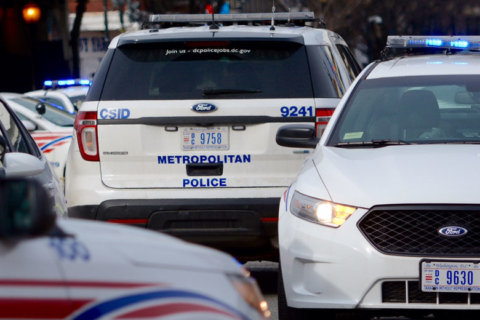
Washington Transit Police work the site in Washington, Wednesday, June 24, 2009, where two metro trains collided on Monday. At right is a section of electrified rail that was removed for the investigation. (AP Photo/Jacquelyn Martin)
WASHINGTON - Investigators say a signaling system has failed to detect a stopped Metro transit train on the same stretch of track where this week's deadly crash occurred.

The National Transportation Safety Board said Thursday that the train control system lost detection of a test train that was stopped in the same place as the train that was struck on Monday.

Investigators say they are still examining the crash site to understand how the train control system functioned on Monday.

There has been some speculation about whether the operator, Jeanice McMillan, was using her cell phone when the train collided with a stopped train during the afternoon rush hour, killing herself and eight others.

Metro General Manager John Catoe tells WTOP the cell phone was not an issue.

"We know where her cell phone was -- it was not on her. It was in a backpack."

He says all signs are showing that the operator did everything she could to prevent the crash. Investigators have found the emergency braking system had been in use 300 to 400 feet before the crash.

"The train itself was trying to stop for several hundred feet," Catoe says. "There's not one letter of evidence that our operator did anything to cause the accident."

The NTSB also says the operator of the struck train was interviewed Thursday. He told investigators that his train was running in manual mode at the time of the crash. The operator says he was waiting for another train to clear when he felt a hard push to his train from behind.

NTSB Spokesman Debbie Hersman says five of six circuits, or stretches of track, showed no problems during tests Wednesday. But she says there were "anomalies" with the sixth circuit. Hersman would not elaborate on what those might be, saying more tests are needed.

The electronic sensors in question may have sent signals to the striking train to go at speed -- 59 mph.

The Washington Post reports an internal Metro report shows the system was not working properly. The computer system, the paper reports, was telling the striking train that there was no train ahead of it. The computers might have sent the train to crash into the one ahead of it.

"If the sensors didn't work properly, it deprived (the train operator) of very vital information," said Najm Meshkati, professor of engineering at the University of Southern California. "She was the last layer of defense."

The NTSB's investigation may last a year.

Catoe will discuss this week's fatal train crash in his first regular chat since the accident.

The live online chat is planned Friday from 2:30 p.m. to 3:30 p.m. Catoe will directly respond to questions about the accident and how Metro is making sure the system is safe.

Questions must be submitted during the hour-long live chat to be answered. Catoe holds the regular chats, which can be accessed through a link on Metro's home page.

(Copyright 2009 by WTOP and The Associated Press. All rights reserved.)


< Back
 

Picture This

Photo of the Day
Playing Catch
 Pictures of the Week  Sports  People  More


Home | Site Map | Advertise with Us |  Contact Us | Privacy Statement | Terms of Use | Copyright Infringement
 | EEO Public File Report | Bonneville International RSS Feeds RSS Feeds  Podcasts Podcasts
AP material Copyright 2010 Associated Press. All rights reserved. This material may not be published, broadcast, rewritten, or redistributed.