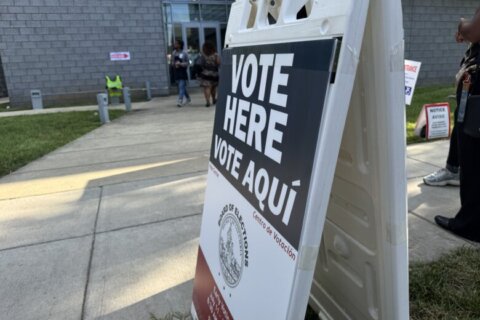
Follow WTOP’s team coverage of the D.C. primary and Election 2026 online, on air at 103.5 FM or on the WTOP News app.
Ahead of D.C.’s primary election in June, WTOP sent a questionnaire to all the candidates in each contested race, asking them to introduce themselves to voters, share their priorities and weigh in on some of the most pressing issues facing the District.
Candidates submitted their responses through an online form, and the answers published are verbatim.
The answers below are from Greg Jackson, who’s running for an at-large seat on the D.C. Council against Dwight Davis, Candace Tiana Nelson, Leniqua’dominique Jenkins, Dyana Forester, Oye Owolewa, Lisa Raymond, Fred Hill and Kevin Chavous.
- WTOP:
Please briefly describe your professional background. What is your current job, and what experience or skills best prepare you to serve in this role?
- Greg Jackson:
Gregory Jackson is the President of the Rocket Foundation, Adviser to Community Justice Action Fund, and Partner of Safer Futures Consulting Firm. Prior to these roles, Jackson served as the Deputy Director of the White House Office of Gun Violence Prevention and Special Assistant to President Joe Biden, where he oversaw efforts to implement federal law, identify new executive actions, expand partnerships, and improve services for those traumatized by gun violence. In this role, Gregory oversaw the execution of 54 executive actions, the implementation of the first law on gun violence in 30 years, and secured $242 billion in federal resources to address gun violence.
A gun violence survivor himself, Jackson has been a leading voice, policymaker, and activist on gun violence prevention for Black and Brown communities for over a decade. Previously, he served as Executive Director of the Community Justice Action Fund, which advances policies to address gun violence in these communities. Prior to this work, he worked locally advancing public safety efforts as the youngest cabinet member under the Mayor of D.C., serving as Director of Community Relations.
- WTOP:
What are your top three priorities if you are elected?
- Greg Jackson:
Making D.C. Safer From Crime and Violence
Investing In Our Youth, Both Education and Recreation
Making D.C. Affordable By Addressing The High Cost of Living
- WTOP:
Crime remains one of the top issues residents talk about, especially violent crime and youth‑involved offenses. At the same time, there are concerns about civil rights and over‑policing. As a Council member, what would you push for legislatively to improve public safety and how would you know those changes are actually working?
- Greg Jackson:
When serving the White House, I created the “Safer States” Agenda with 15 policy proposals that were succesfully passed in 31 states. I would start with adapting those policy recommendations to address the crisis in DC. This means focus on investing in evidence based violence prevention strategies that have shown promise across the country, including expanding cognitive behavioral programs, strengthening youth mental health, strengthening community violence intervention, increasing victim services and expanding mentorship programs for those most vulnerable or at risk to violence.
Secondly, I would focus on better investing in strengthening our upstream accountability efforts to keep illegal firearms off our streets and out of the hands of the most vulnerable, including strengthening crime intelligence, investigative resources to improve case clearance rates and regional efforts to disrupt the iron pipeline of illegal guns coming up from Virginia or down from Maryland.
Lastly, I would focus on addressing the root causes of violence starting with neighborhoods most impacted by violent crime. We must aggressively get to the source and make transformative change.
- WTOP:
Some residents say youth‑involved crime cannot be solved by enforcement alone, while others worry there are not enough consequences when serious crimes occur. What role should the D.C. Council play in reducing youth‑involved crime, and how should prevention, intervention, and accountability work together? Please include where you stand on youth curfews and how, if at all, they should fit into a broader public safety approach.
- Greg Jackson:
We must ensure that youth are safe no matter where they are in the District. The COVID-19 pandemic and recent youth homicides are start reminders that keeping youth at home doesn’t mean they are safe from violence. My strategy would be to invest in targeting accountability for those most at risk to crime, while investing in safe spaces for youth to gather across all 8 wards. This means investing late night hours for DPR programming, investing in out of school programming, providing targeted wrap around services for families and empowering our youth to inform our youth engagement strategies by creating a Youth Network for Safety and investing in a Youth Safety Fund led by youth. We must also ensure we spare no expense in investing in our education resources, to ensure we better prepare our future generations for the real world.
- WTOP:
The D.C. Council does not run schools directly but controls funding and oversight. How would you use that authority to improve outcomes in DCPS and public charter schools?
- Greg Jackson:
I would ensure that we prioritize funding our schools, with an emphasis on family teacher engagement, supporting our teachers, maintenance of our facilities and targeted resources for youth most in need. I would also like to declare chronic absenteeism as a District emergency to better prioritize resources, coordination and policy recommendations to improve the attendance of our youth. Additionally, I hope to create a “WeRead D.C.” Literacy Framework to identify, track and improve literacy rates across all public school in the District, including resources such as high impact tutoring to boost those most in need. Lastly, I would work to advance efforts to better prepare our youth for the real world by investing in programs both in and out of the classrooms. The greatest city in the country should offer the greatest educational opportunity for our future generations.
- WTOP:
Housing costs, including rents and home prices, have increased in many cities. What specific policies would you support regarding housing affordability, and how would you balance new development with protecting existing residents and neighborhoods?
- Greg Jackson:
I believe the largest driver of our District’s affordability crisis is the high cost of living. I would focus on increasing supply, providing more financing options for residents to own homes, targeted resources or reliefs to better preserve homes for our elder residents and lastly provide more opportunities for smaller housing providers to supply short, medium and long term rental opportunities.
- WTOP:
Some residents have raised concerns about response times, service consistency, and follow‑through by District agencies. What role would you, as a Council member, play in using oversight and legislation to strengthen accountability and improve city services?
- Greg Jackson:
After serving as the Director of the Mayors Office of Community Relations & Services, I witnessed first hand how challenges with service delivery can create major disruptions to the quality of life for our neighbors. As Council-member I would lean on my learned experiences in that role to help push agencies to be more proactive in predictable challenges such as potholes, trash removal, vacant property abatement, rat abatement, grass cutting and even weather events. I think a major opportunity is also to not only improve 311 services, but better empower and engage 311 reporters to provide insights into stronger service delivery and improving community engagement to provide more transparency around service breakdowns. Lastly, my approach would be to also better engage with our agency staff and work to ensure that they are well paid, respected, supported and appreciated for the critical service they deliver to keep our complex District moving.
- WTOP:
The Council has a major say in how the city spends its money. When the budget is tight, what should come first, and how would you decide which programs get protected and which don’t?
- Greg Jackson:
I think we should prioritize healthcare, education, housing and social services for our most vulnerable residents. We also need to look closely at which programs are providing the most impactful resources and serving the most D.C. RESIDENTS as important to prioritize. I also think we should look at how do we minimize bureaucracy in our already large DC government and focus on service delivery when making cuts. Lastly, I strongly believe the District can do a much better job GENERATING revenue, as oppose to the typical posture of taxing or cutting to address our budget challenges.
- WTOP:
Because Congress has authority to review and overturn District laws, what do you see as the Council’s role in addressing congressional involvement in local governance? How assertive, if at all, should Council members be in advocating for home rule?
- Greg Jackson:
The D.C. Council should serve as a bridge between residents and Congress. After successfully passing a bipartisan law in Congress, I have built numerous relationships, coalitions and tactics to effectively advance policy that will be critical for D.C. Council. We need a Council that is equipped to protect home rule, protect our budget, but also effective at moving new ideas and policies through Congress. I am the only candidate endorsed by multiple Members of Congress and I aim to build on the relationships I’ve established through advocacy and my time at the White House, when elected to D.C. Council. Congress has been hungry to better partner with D.C. Council, but we simply have not had enough members in Council with the relationships to build a meaningful relationship in recent history.
- WTOP:
From buses and Metro to traffic safety and street conditions, transportation complaints come up across the city. What changes or investments would you focus on to improve how people get around D.C.?
- Greg Jackson:
I would primarily focus on efficient and reliable transportation options across all 8 wards. Recent budget cuts have created major disruptions in public transit from Ward 8 to Ward 3 and I aim to help resolve these challenges first and foremost. With our current economic state, affordable transit and accessibility will be key to ensure every resident has an opportunity to thrive. Lastly, we need to rethink our traffic calming strategy to focus more on safety and harm prevention, not just how many tickets we can write or revenue we can gain from traffic cameras. Traffic calming will require more innovative and thoughtful policies, resources and strategies to shift behavior proactively, not just reactively fine violators.
- WTOP:
Development can involve tradeoffs between growth, neighborhood input, and quality of life. How would you approach development decisions, so neighborhoods have a meaningful voice while the city continues to grow?
- Greg Jackson:
Community engagement is a major priority for my campaign and that will continue in my time at Council. I would focus on weekly neighborhood walks, regular town halls and building a network of liasion across all 8 wards to provide consistent insights into policy, development and resource needs across the District.
- WTOP:
How would you approach the relationship between the Council and the mayor, particularly with respect to collaboration and oversight?
- Greg Jackson:
I think this is a pivotal relationship to nurture especially around aligned priorities and the overall budget process. I aim to build a proactive constructive relationship with whomever is elected to Mayor.
- WTOP:
Residents continue to raise concerns about D.C.’s 911 system, from long wait times to delayed emergency response. What should the Council’s role be in fixing these problems, and what specific changes would you push for to make the system more reliable?
- Greg Jackson:
As a survivor of gun violence, I know first hand how critical response times are, as it was life or death for me personally. We must continue to invest in our first responders, not only in equipment but reliable personnel and efficiency.
- WTOP:
Concerns about ethics and accountability at the D.C. Council have repeatedly surfaced in recent years. As a Council member, how would you help rebuild public trust and what should happen when members violate ethical standards?
- Greg Jackson:
I think transparency is key and as a Councilmember, it’s important that we strengthen relationships between our leaders and the community. Ethics and accountability requires transparency and insights from those who keep us accountable and I see residents as the most important monitors of those.
- WTOP:
At‑large Council members represent the entire city, not a single ward. How would you balance citywide priorities with the distinct needs of different neighborhoods, and what issues do you believe at‑large members should focus on that ward members cannot?
- Greg Jackson:
When I served at the White House, my job was to address the crisis of gun violence across the entire nation and as the Director of the Mayor’s Office of Community Relations & Services, I oversaw constituent concerns in all 8 wards.
I think an effective candidate must have relationships, a pulse and information points for every neighborhood. I aim to do that systemically by having weekly neighborhood walks, regular town hall meetings, establishing strong community partnerships and identifying liaisons by Ward to best inform me on the day to day happenings. I also think it’s important for At-Large members to tackle issues that impact residents ACROSS wards and be equipped to solve District-wide challenges, while supporting Ward specific candidates on more neighborhood or street specific issues.
- WTOP:
What’s one place, tradition, or moment that makes D.C. feel like home to you?
- Greg Jackson:
Celebrating with family or co-workers over chicken wings at Stan’s!
- WTOP:
What’s something about you that voters would never learn from your résumé or campaign website?
- Greg Jackson:
I’m a lifelong Commanders fan and former football running back!
Get breaking news and daily headlines delivered to your email inbox by signing up here.
© 2026 WTOP. All Rights Reserved. This website is not intended for users located within the European Economic Area.