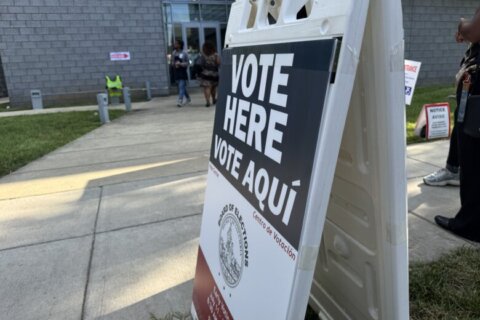
Follow WTOP’s team coverage of the D.C. primary and Election 2026 online, on air at 103.5 FM or on the WTOP News app.
Ahead of D.C.’s primary election in June, WTOP sent a questionnaire to all the candidates in each contested race, asking them to introduce themselves to voters, share their priorities and weigh in on some of the most pressing issues facing the District.
Candidates submitted their responses through an online form, and the answers published are verbatim.
The answers below are from Candace Tiana Nelson, who’s running for an at-large seat on the D.C. Council against Dwight Davis, Oye Owolewa, Leniqua’dominique Jenkins, Dyana Forester, Greg Jackson, Lisa Raymond, Fred Hill and Kevin Chavous.
- WTOP:
Please briefly describe your professional background. What is your current job, and what experience or skills best prepare you to serve in this role?
- Candace Tiana Nelson:
For two decades, I have worked across all three branches of DC government, building a record of public service grounded in leadership, accountability, and results. Today, my full-time job is serving as a candidate for DC Council At-Large, after stepping away from my role as Chief of Staff to Councilmember Janeese Lewis George because I saw a lack of coordination and urgency across District leadership as President Trump’s executive orders began impacting DC residents.
My experience spans the executive, legislative, and judicial branches of government. I have held leadership roles at the DC Department of Health Care Finance, Department of Human Services, Department of Employment Services, and the Mayor’s Office on Women’s Policy and Initiatives. I also led the 2022 Attorney General Transition for Brian Schwalb.
What best prepares me for this role is my understanding of how DC government actually works, from legislation and oversight to agency operations and service delivery, and my ability to bring people together to solve problems. I believe leadership should make people feel seen, heard, and valued.
- WTOP:
What are your top three priorities if you are elected?
- Candace Tiana Nelson:
My top three priorities are housing, education, and healthcare, because they are the foundations people need to build stable lives. I will fight to make housing more affordable, strengthen public education by supporting teachers and advancing universal free meals for students, and improve healthcare access and government coordination so residents can more easily access services. I also believe public safety improves when people are housed, healthy, educated, and connected to opportunity.
- WTOP:
Crime remains one of the top issues residents talk about, especially violent crime and youth‑involved offenses. At the same time, there are concerns about civil rights and over‑policing. As a Council member, what would you push for legislatively to improve public safety and how would you know those changes are actually working?
- Candace Tiana Nelson:
I would push legislatively for a comprehensive public safety strategy that combines targeted enforcement with prevention and intervention. That includes strengthening violence interruption programs, expanding year-round youth employment and mentorship programs, increasing access to mental health and behavioral health services, and improving coordination between schools, agencies, and community organizations so families receive support before crises escalate.
I also support focused policing strategies aimed at violent crime, illegal firearms, and repeat offenders, while maintaining strong oversight and accountability protections to guard against over-policing and civil rights violations.
I would measure success through clear outcomes: reductions in violent crime and recidivism, lower youth reoffending rates, improved school attendance, faster emergency response times, increased participation in prevention programs, and stronger community trust in government and law enforcement.
- WTOP:
Some residents say youth‑involved crime cannot be solved by enforcement alone, while others worry there are not enough consequences when serious crimes occur. What role should the DC Council play in reducing youth‑involved crime, and how should prevention, intervention, and accountability work together? Please include where you stand on youth curfews and how, if at all, they should fit into a broader public safety approach.
- Candace Tiana Nelson:
Youth-involved crime cannot be addressed through enforcement alone, but accountability must still exist when serious harm occurs. The DC Council’s role is to build a comprehensive strategy that combines prevention, intervention, and accountability.
That means investing in year-round youth employment, mentorship, mental health services, violence interruption programs, and stronger coordination between schools, agencies, and community organizations so young people receive support before crises escalate. It also means ensuring there are appropriate consequences and interventions for serious offenses, alongside pathways for rehabilitation and reentry.
I do not support permanent youth curfews as a long-term public safety strategy. However, I understand why some communities have supported temporary and targeted curfews in response to specific public safety concerns. If curfews are used, enforcement should focus on intervention, not simply punishment, by connecting young people to community service, mentorship, workforce programs, and other opportunities that help change the trajectory of their lives.
Long-term public safety requires both accountability and opportunity.
- WTOP:
The DC Council does not run schools directly but controls funding and oversight. How would you use that authority to improve outcomes in DCPS and public charter schools?
- Candace Tiana Nelson:
The DC Council’s role is to ensure schools are properly funded, outcomes are transparent, and public dollars are being used effectively for students. I would use the Council’s budget and oversight authority to strengthen accountability, improve funding equity, and support student success across both DCPS and public charter schools.
That includes supporting teachers, expanding access to mental health and behavioral health services, improving school facilities, and ensuring resources reach classrooms rather than getting lost in bureaucracy. I also support universal free meals for students because children cannot learn while hungry.
I believe oversight should focus on measurable outcomes, including student achievement, attendance, school safety, graduation rates, and access to services for students with disabilities and English language learners.
I also support equitable funding through the Uniform Per Student Funding Formula so resources follow student needs fairly across DCPS and charter schools, while maintaining strong accountability and transparency for how those funds are spent.
Every child in DC deserves access to a high-quality public education, regardless of zip code or school type.
- WTOP:
Housing costs, including rents and home prices, have increased in many cities. What specific policies would you support regarding housing affordability, and how would you balance new development with protecting existing residents and neighborhoods?
- Candace Tiana Nelson:
DC must increase housing production at all income levels while also protecting existing residents from displacement. I support streamlining permitting, improving interagency coordination, and establishing clearer timelines so housing projects move through the process more efficiently and predictably, especially near transit corridors and underutilized properties. Increasing supply is necessary to stabilize housing costs over time.
As a Councilmember, I would use oversight aggressively by requiring agencies to publicly track permitting timelines, housing production goals, and affordable housing commitments through performance measures and public-facing dashboards. Residents deserve transparency and accountability from government.
At the same time, we must strengthen tenant protections, preserve rent-controlled units, expand pathways to homeownership, and support responsible small landlords navigating rising costs themselves.
My goal is a DC where longtime residents, working families, young professionals, and seniors can afford to stay, build wealth, and thrive.
- WTOP:
Some residents have raised concerns about response times, service consistency, and follow‑through by District agencies. What role would you, as a Council member, play in using oversight and legislation to strengthen accountability and improve city services?
- Candace Tiana Nelson:
Oversight is one of the DC Council’s strongest responsibilities, and it is an area where my professional experience sets me apart. During my career in DC government, I helped develop performance plans and key performance indicators for multiple agencies, so I understand how to evaluate whether government is truly delivering results for residents.
As a Councilmember, I would push for stronger agency accountability through measurable performance standards, public-facing dashboards, regular oversight hearings, and clearer timelines for responding to residents and completing services. Residents should be able to see whether agencies are meeting expectations.
I also believe care is coordination. Too often, agencies operate in silos, which creates delays, confusion, and poor follow-through for residents trying to access services. I would use oversight and legislation to strengthen interagency coordination, improve data sharing, and ensure agencies work together more effectively.
Government should be responsive, transparent, and people-centered, and the Council must hold agencies accountable when they fall short.
- WTOP:
The Council has a major say in how the city spends its money. When the budget is tight, what should come first, and how would you decide which programs get protected and which don’t?
- Candace Tiana Nelson:
When budgets are tight, we must protect the services people rely on most: housing, education, healthcare, public safety, and programs that support children, seniors, and working families. But making responsible budget decisions also requires honest performance oversight.
I believe performance oversight comes before budgeting for a reason. The Council should evaluate whether programs are meeting their goals, serving residents effectively, and using taxpayer dollars responsibly before deciding where additional funding should go. I do not believe in continuing to fund programs that consistently fail to deliver results.
During my career in DC government, I have helped develop agency performance plans and have been part of difficult budget discussions where we had to evaluate participation levels, outcomes, duplication of services, and operational effectiveness. Sometimes that means improving a program, consolidating services, or making hard decisions about what should continue.
My approach would be data-informed, transparent, and centered on impact, while remembering that behind every budget decision are real people depending on government to work.
- WTOP:
Because Congress has authority to review and overturn District laws, what do you see as the Council’s role in addressing congressional involvement in local governance? How assertive, if at all, should Council members be in advocating for home rule?
- Candace Tiana Nelson:
The DC Council should be assertive, strategic, and unified in defending home rule and DC’s right to govern itself. Congress overturning locally passed laws undermines the voices of DC residents, who pay federal taxes and serve our country without full voting representation.
I believe the Council must move beyond reactive statements and build a stronger long-term strategy for protecting DC autonomy. That includes strengthening coordination with our Statehood Delegation, improving federal advocacy, and ensuring the Council speaks with a more unified voice to Congress and the White House. I would support establishing a dedicated Office of Federal Affairs for the Council to help lead that work.
I also believe we must protect the independence of the Office of the Attorney General and ensure OAG has the resources necessary to defend the District legally when Congress or the federal government overreach into local affairs.
Home rule requires strategy, coordination, and persistence. The Council’s role is not simply to protest federal interference, but to organize effectively to resist it and strengthen DC’s path toward full self-governance.
- WTOP:
From buses and Metro to traffic safety and street conditions, transportation complaints come up across the city. What changes or investments would you focus on to improve how people get around DC?
- Candace Tiana Nelson:
Transportation should be safe, reliable, affordable, and accessible, whether someone travels by Metro, bus, bike, walking, wheelchair, or car. I support continued investment in Metro and bus service, dedicated bus lanes, safer street design, protected bike infrastructure, and sidewalk improvements that make it easier and safer for people to move throughout the city.
Traffic safety must also be treated as a public safety issue. We need stronger enforcement against dangerous driving, safer intersections, better street lighting, and more data-driven investments in high-crash corridors.
I also believe DC needs stronger coordination between transportation and infrastructure agencies. There once was an Office of the Deputy Mayor for Infrastructure and Operations that helped coordinate agencies like DDOT and DPW. I would support reestablishing it through legislation so it becomes a permanent part of government operations, not something that disappears between administrations.
Transportation is about mobility, safety, economic opportunity, and quality of life.
- WTOP:
Development can involve tradeoffs between growth, neighborhood input, and quality of life. How would you approach development decisions, so neighborhoods have a meaningful voice while the city continues to grow?
- Candace Tiana Nelson:
DC must continue to grow, but growth works best when residents, business owners, and community stakeholders are engaged early, government is transparent, and development is connected to community needs. Too often, people feel brought into conversations after decisions are already made, which creates distrust and conflict.
As Chief of Staff to Ward 4 Councilmember Janeese Lewis George, I led the Georgia Avenue Revitalization Advisory Group, bringing together residents, businesses, and stakeholders to help shape recommendations around housing, economic development, beautification, and public safety. That experience reinforced my belief that meaningful engagement leads to stronger and more sustainable outcomes.
At the same time, DC needs more housing and continued economic growth, especially near transit and commercial corridors. Good development requires both community voice and effective coordination so growth is thoughtful, equitable, and sustainable.
- WTOP:
How would you approach the relationship between the Council and the mayor, particularly with respect to collaboration and oversight?
- Candace Tiana Nelson:
The relationship between the Council and the mayor should be collaborative, professional, and grounded in accountability. Residents expect their elected leaders to work together to solve problems, especially during moments of crisis or uncertainty.
One of the reasons I decided to run for Council was because I saw the need for stronger coordination across District leadership as federal executive orders began affecting our city. Government works best when agencies, the Council, and the Executive Branch communicate clearly and operate with urgency and alignment.
At the same time, oversight is one of the Council’s most important responsibilities. Collaboration should never come at the expense of transparency or accountability. The Council must ask hard questions, evaluate agency performance honestly, and ensure taxpayer dollars are being used effectively.
My approach is shaped by both my experience in government and my conflict resolution studies through George Mason University’s Jimmy and Rosalynn Carter School. I believe progress requires communication, coordination, and principled leadership.
- WTOP:
Residents continue to raise concerns about DC’s 911 system, from long wait times to delayed emergency response. What should the Council’s role be in fixing these problems, and what specific changes would you push for to make the system more reliable?
- Candace Tiana Nelson:
The Council’s role is to ensure the 911 system is properly staffed, modernized, and held accountable through strong oversight and clear performance standards. When residents call 911, they should be able to trust that someone will answer quickly and that help will arrive when needed.
I would push for stronger staffing and retention strategies for call takers and dispatchers, upgraded technology systems, improved coordination between agencies, and regular public reporting on response times and service performance. Transparency matters, and residents deserve to know whether the system is improving.
I also believe the District should continue expanding alternative response models for certain behavioral health and nonviolent crisis calls so emergency responders can focus on urgent public safety needs while residents receive the appropriate care.
Ultimately, fixing 911 requires operational discipline, investment, and accountability. The Council must consistently use oversight to identify breakdowns, track improvements, and ensure the system delivers reliable service citywide.
- WTOP:
Concerns about ethics and accountability at the DC Council have repeatedly surfaced in recent years. As a Council member, how would you help rebuild public trust and what should happen when members violate ethical standards?
- Candace Tiana Nelson:
Public trust is built through transparency, accountability, and consistent ethical leadership. Residents should feel confident that elected officials are serving the public interest, not themselves.
As a Councilmember, I would support stronger ethics enforcement, timely disclosure requirements, greater transparency around outside income and contracting, and consistent ethics training for members and staff. I also believe the Council should continue strengthening independent oversight bodies and ensuring investigations are handled fairly and transparently.
When ethical violations occur, there must be real consequences. Accountability cannot depend on someone’s political influence or relationships. If a member violates ethical standards, the Council should act appropriately based on the facts and recommendations of the relevant oversight authorities, including public censure, removal from committee leadership, or other disciplinary actions when warranted.
I also believe trust is rebuilt through day-to-day conduct. My approach to leadership is grounded in professionalism, transparency, and service. Residents deserve leaders who make them feel seen, heard, valued, and respected by their government.
- WTOP:
At‑large Council members represent the entire city, not a single ward. How would you balance citywide priorities with the distinct needs of different neighborhoods, and what issues do you believe at‑large members should focus on that ward members cannot?
- Candace Tiana Nelson:
At-Large Councilmembers have a responsibility to think citywide while remaining deeply connected to the unique needs of each ward and neighborhood. My experience working across the Executive Branch gave me the opportunity to engage communities throughout all eight wards, and I would bring that same citywide approach to the Council.
I believe At-Large Councilmembers should create consistent opportunities for engagement across the city through advisory groups, town halls, and regular office hours in every ward, not just during election season. As Chief of Staff to the Ward 4 Councilmember, I led the Georgia Avenue Revitalization Advisory Group, which brought residents, businesses, and stakeholders together around shared goals. I would like to build on that model for commercial corridors and community development efforts across DC.
At-Large Councilmembers are uniquely positioned to focus on issues that cross ward boundaries, including housing, transportation, economic development, public safety, healthcare, and government accountability. The role should help connect communities, coordinate citywide solutions, and ensure every resident feels seen, heard, and valued.
- WTOP:
What’s one place, tradition, or moment that makes DC feel like home to you?
- Candace Tiana Nelson:
DC feels like home to me because of its diversity, its culture, and the way so many different communities come together to shape the city’s identity. One moment that captures that for me is hearing Go-Go music playing at a community event while families from different backgrounds gather nearby, sharing food, conversation, and joy. From neighborhood carryouts to international restaurants to cultural festivals across all eight wards, DC’s richness comes from its people and the cultures they bring together.
- WTOP:
What’s something about you that voters would never learn from your résumé or campaign website?
- Candace Tiana Nelson:
Something voters may not know about me is that I competed in gymnastics growing up through the United Gymnastics Federation. The discipline, focus, and resilience the sport required shaped me early in life and still influence how I approach leadership and public service today. Gymnastics taught me that progress takes preparation, persistence, and the ability to get back up when you fall.
Get breaking news and daily headlines delivered to your email inbox by signing up here.
© 2026 WTOP. All Rights Reserved. This website is not intended for users located within the European Economic Area.