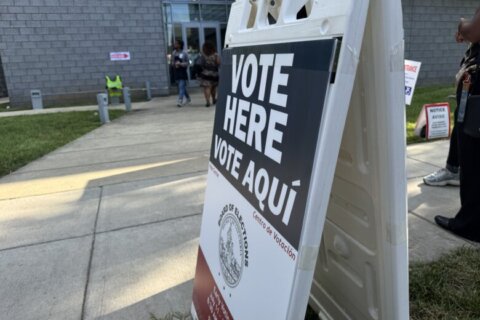
Follow WTOP’s team coverage of the D.C. primary and Election 2026 online, on air at 103.5 FM or on the WTOP News app.
Ahead of D.C.’s primary election in June, WTOP sent a questionnaire to all the candidates in each contested race, asking them to introduce themselves to voters, share their priorities and weigh in on some of the most pressing issues facing the District.
Candidates submitted their responses through an online form, and the answers published are verbatim.
The answers below are from Dyana Forester, who’s running for an at-large seat on the D.C. Council against Dwight Davis, Candace Tiana Nelson, Leniqua’dominique Jenkins, Fred Hill, Oye Owolewa, Lisa Raymond, Kevin B. Chavous and Greg Jackson.
- WTOP:
Please briefly describe your professional background. What is your current job, and what experience or skills best prepare you to serve in this role?
- Dyana Forester:
I began my career as a grassroots organizer with the United Food and Commercial Workers Union, organizing Walmart workers, which launched nearly two decades of work at the intersection of labor, government, and community advocacy. I have served as Director of Political and Community Affairs at UFCW Local 400 and later as President of the Metropolitan Washington Labor Council, where I successfully advocated for groundbreaking policies, including paid sick leave, paid family and medical leave, and a minimum wage increase.
I currently serve as Senior Director of Labor Relations for Governor Wes Moore in Maryland. She has also worked as a Family and Community School Organizer for Teaching for Change, where she helped secure Parent Coordinator positions and supported the passage of Community Schools legislation.
- WTOP:
What are your top three priorities if you are elected?
- Dyana Forester:
If elected, my top three priorities are working families, sustainable economic development and viability, and government accountability. DC’s economy works for developers and contractors, not always for the people who keep this city running. I’ll fight to protect and expand living wages, paid leave, and workforce pathways, especially in healthcare and care work. I’ll push aggressive affordability measures so longtime residents aren’t displaced. And I’ll use every oversight tool available to ensure agencies east of the river deliver the same quality of service as elsewhere.
- WTOP:
Crime remains one of the top issues residents talk about, especially violent crime and youth‑involved offenses. At the same time, there are concerns about civil rights and over‑policing. As a Council member, what would you push for legislatively to improve public safety and how would you know those changes are actually working?
- Dyana Forester:
Public safety and civil rights are not in conflict, they are inseparable. I’ve spent nearly two decades fighting for workers who live in the communities most impacted by both crime and over-policing. I know that when people feel safe, seen, and economically stable, communities thrive.
Legislatively, I’ll push for mandatory use-of-force transparency, continued investment in the Crisis Intervention Team model, and co-responder programs that send mental health professionals, not armed officers, to appropriate calls. I’ll also fight to fully fund the Office of Neighborhood Safety and Engagement and hold it accountable for measurable outcomes.
On measuring progress: I don’t trust dashboards that only count arrests. I want to see victim satisfaction data, recidivism rates, response times, and community-reported feelings of safety, particularly among minority women, youth, and residents who too often experience both crime and police misconduct as twin threats. Real public safety means residents aren’t afraid of violence or of the people sworn to protect them. I’ll push for independent oversight of MPD with real authority, not advisory power, and require regular public reporting on both crime trends and enforcement patterns by ward and demographic. It is also time that DC establishes an office of Police Accountability to provide oversight of law enforcement.
- WTOP:
Some residents say youth‑involved crime cannot be solved by enforcement alone, while others worry there are not enough consequences when serious crimes occur. What role should the DC Council play in reducing youth‑involved crime, and how should prevention, intervention, and accountability work together? Please include where you stand on youth curfews and how, if at all, they should fit into a broader public safety approach.
- Dyana Forester:
Young people involved in crime are not the problem, they are a symptom of systems that have failed them. I believe in a three-part approach: robust prevention, credible intervention, and fair accountability.
Prevention means fully-funded schools, mental health services in every building, and youth employment that pays real wages. Intervention means investing in credible messengers, people who have lived experience and deep community trust, to interrupt cycles of violence before they escalate. Accountability means consequences that are proportionate, rehabilitative, and focused on restoring harm rather than simply incarcerating young people who still have every opportunity to redirect their lives.
On youth curfews: I am skeptical. The evidence that curfews reduce crime is weak, and the enforcement burden falls disproportionately on minority youth, particularly in Wards 7 and 8. Curfews without investment are just punishment. If curfew policies exist, they must be paired with genuine safe spaces, programming, and family supports, not used as a pretext for stops and arrests.
The Council’s role is to resource solutions that actually work. That means listening to young people, not just talking about them, and centering their voices in every policy we write.
- WTOP:
The DC Council does not run schools directly but controls funding and oversight. How would you use that authority to improve outcomes in DCPS and public charter schools?
- Dyana Forester:
As someone who has sat in DCPS classrooms as a student, organized alongside DCPS teachers, fought for safe school reopening as Labor Council president, and shown up to PTA meetings and LSRTs as a parent, I understand what the Council can and cannot do. We don’t run schools. But we control the money, and money is power.
I will use budget authority to protect and expand funding for schools in high-poverty communities first, smaller class sizes, mental health supports, and out-of-school-time programming that kids in Wards 7 and 8 deserve but too often go without. I’ll fight to ensure the Community Schools model is fully resourced, not just legislated and underfunded.
On oversight, I’ll push for honest, transparent reporting on outcomes disaggregated by ward, race, and income, because citywide averages hide what’s actually happening east of the river. I’ll hold both DCPS and the Public Charter School Board accountable through regular Council hearings with real follow-through, not just headlines. And I’ll center educators. Teachers cannot deliver for kids when they’re underpaid, overworked, and stripped of their voice. Supporting strong labor standards for school workers is not separate from student outcomes, it is student outcomes.
- WTOP:
Housing costs, including rents and home prices, have increased in many cities. What specific policies would you support regarding housing affordability, and how would you balance new development with protecting existing residents and neighborhoods?
- Dyana Forester:
Housing is the foundation of economic security, and in DC, that foundation is cracking under the weight of displacement. As someone born and raised in Ward 7, I’ve watched neighbors lose ground they built over generations. That is not development. That is erasure.
I will fight to strengthen and fully enforce the District’s Tenant Opportunity to Purchase Act, expand the Housing Production Trust Fund with dedicated affordability set-asides for extremely low-income residents, and close loopholes developers use to evade affordable unit requirements. I’ll also push for more robust anti-displacement protections for longtime homeowners, including tax relief for long-term residents facing assessment-driven displacement.
On new development: growth is not inherently bad, but growth that excludes minority and working-class residents is. Every major development east of the river must include genuine community benefit agreements, negotiated with residents, not handed down by developers, covering affordable units, local hiring, and reinvestment in neighborhood infrastructure.
The Black Women Best framework is clear: economic stability for Black women requires stable, affordable housing. I will not trade one for the other, and I will not let developers set the terms of what our communities become. Residents decide that.
- WTOP:
Some residents have raised concerns about response times, service consistency, and follow‑through by District agencies. What role would you, as a Council member, play in using oversight and legislation to strengthen accountability and improve city services?
- Dyana Forester:
When agencies chronically underperform in Wards 7 and 8, that is not a management problem, it is a racial equity problem. The Council’s oversight function exists precisely for moments like this, and I intend to use it.
I will push for ward-specific service delivery data, publicly reported, regularly audited, so residents can see exactly how their agencies are performing compared to the rest of the city. When agencies fall short, I will call hearings with mandatory agency head attendance, require corrective action plans with enforceable deadlines, and tie budget allocations to demonstrated performance improvements.
I’ll also fight for structural reforms: civil service hiring that prioritizes residents from the communities agencies serve, and procurement contracts that include local hiring requirements and living wages as baseline conditions.
My labor background taught me that accountability without power is just paperwork. Community members need standing, not just public comment periods, in how agencies are evaluated and reformed. I’ll champion a permanent community oversight infrastructure east of the river, co-designed with residents and centering Black women, that has real authority to surface complaints, track follow-through, and escalate failures directly to the Council floor.
- WTOP:
The Council has a major say in how the city spends its money. When the budget is tight, what should come first, and how would you decide which programs get protected and which don’t?
- Dyana Forester:
A budget is a values document. When money is tight, what you protect tells you everything about who you actually work for.
My framework is simple: protect people before programs, and protect the most vulnerable before anyone else. That means housing assistance, mental health services, youth programming, and the care economy get shielded first, because cutting those doesn’t save money long-term, it just shifts costs onto families and ERs and courts.
I come from the labor movement, and I’ve seen what austerity does to working people. I will not support budget cuts that fall hardest on the lowest-paid workers and the communities they serve. I’ll push for progressive revenue solutions, including closing corporate tax loopholes and ensuring large developers pay their fair share, before accepting cuts to essential services.
I’ll also apply a racial equity lens to every budget decision. If a cut disproportionately impacts Black women and families east of the river, that is not a neutral fiscal choice, it is a policy choice with consequences, and I’ll say so publicly. The Council must stop pretending that budget decisions are technical. They are political, and I’ll be honest about that.
- WTOP:
Because Congress has authority to review and overturn District laws, what do you see as the Council’s role in addressing congressional involvement in local governance? How assertive, if at all, should Council members be in advocating for home rule?
- Dyana Forester:
DC’s lack of full self-governance is a civil rights issue, and I will not treat it as anything less. Congress’s ability to overturn District laws, including legislation supported by the overwhelming majority of DC residents, is a direct violation of the democratic rights of a every resident of this city. That history is not incidental. It is structural.
As a Council member, I defend home rule. That means working with DC’s congressional delegation to advance statehood, actively resisting congressional interference in local law, and refusing to preemptively weaken our own legislation out of fear of federal review.
The labor movement taught me that you don’t bargain against yourself before you reach the table. The Council should pass what DC residents need, full stop, and defend it forcefully.
When Congress attempts to override democratically passed DC law, the Council should respond with coordinated public advocacy, legal challenge where available, and a clear political message to the country about what is at stake.
DC residents pay federal taxes, serve in the military, and contribute to this nation. We deserve full democratic participation. Anything short of that is taxation without representation, and I will say so loudly.
- WTOP:
From buses and Metro to traffic safety and street conditions, transportation complaints come up across the city. What changes or investments would you focus on to improve how people get around DC?
- Dyana Forester:
Transportation is a workforce issue, a safety issue, and an equity issue, and too many residents east of the river experience all three failures at once. Getting to work, healthcare, childcare, and school should not require a car. Right now, for too many Ward 7 and 8 residents, it does.
I’ll push for expanded and more frequent bus service along the most heavily used east-of-river corridors, real-time shelter improvements at high-traffic stops, and enforceable WMATA accountability measures tied to on-time performance and safety data. I’ll also advocate for fare relief programs that center low-income workers, including expanding DC’s existing subsidized transit benefit.
On street safety: Vision Zero cannot be a slogan. I’ll demand Council oversight hearings on DDOT’s implementation record, push for protected infrastructure on dangerous corridors, and require that traffic safety investments be distributed equitably, not concentrated in wealthier neighborhoods.
My lens on transportation comes from labor: if a worker can’t reliably get to their job, all the wage gains in the world don’t fully close the gap. Reliable, affordable, safe transportation is the connective tissue of economic opportunity, and I’ll fight for it like it is.
- WTOP:
Development can involve tradeoffs between growth, neighborhood input, and quality of life. How would you approach development decisions, so neighborhoods have a meaningful voice while the city continues to grow?
- Dyana Forester:
Development without community voice is displacement with paperwork. I’ve seen it happen in Ward 7, and I will not accept it as the price of growth.
My approach starts with the premise that residents, not developers, should set the terms for what happens in their neighborhoods. That means mandatory, early community engagement before zoning decisions are made, not after, and community benefit agreements with teeth: enforceable affordability requirements, local hiring commitments, and green space and infrastructure investments that benefit existing residents, not just future ones.
I’ll also push to reform the way DC processes Planned Unit Developments so that community input is genuinely incorporated, not just recorded and set aside. ANC recommendations should carry real weight, and when they are overridden, the Council should require a formal, transparent explanation.
At the same time, I recognize DC must grow to address its housing crisis. The answer is not to stop building, it’s to build in a way that includes the people already here. Mixed-income development that keeps longtime Black residents in place is not a compromise. It is the goal. I’ll hold every development proposal to that standard and use every Council tool available to enforce it.
- WTOP:
How would you approach the relationship between the Council and the mayor, particularly with respect to collaboration and oversight?
- Dyana Forester:
The Council’s job is not to be the Mayor’s ally, it is to be the public’s check on executive power. I respect the Office of the Mayor and believe collaborative governance is possible, but collaboration cannot come at the cost of accountability.
I’ll work constructively with the Mayor on shared priorities: housing, workforce development, public safety reform, and agency performance. Where we agree, I’ll move legislation and provide political cover to get things done. Where we disagree, I’ll use the Council’s full toolkit, hearings, budget authority, oversight investigations, without apology.
My labor background taught me that the best relationships between institutions are built on honest power dynamics, not deference. Workers and management can work together, but workers who give up their leverage don’t get better outcomes, they get managed. The same dynamic applies here. A Council that rubber-stamps executive decisions isn’t governing. It’s decorating. I’ll be a genuine partner to the Mayor and a genuine check when the public needs one.
- WTOP:
Residents continue to raise concerns about DC’s 911 system, from long wait times to delayed emergency response. What should the Council’s role be in fixing these problems, and what specific changes would you push for to make the system more reliable?
- Dyana Forester:
A broken 911 system is not a technical failure; it’s a public safety crisis that falls hardest on the communities already most vulnerable. Long wait times and delayed responses cost lives, and East of the River residents have documented this problem for years.
I’ll push for immediate Council oversight hearings on OUC operations, call response data disaggregated by ward, and staffing levels benchmarked against peer cities. I’ll demand a public dashboard tracking response times and dispatch outcomes, with accountability mechanisms when targets are missed.
Legislatively, I’ll pursue investments in OUC staff recruitment and retention, because you cannot run a reliable emergency system on chronically understaffed, underpaid workers. That is a workforce issue, and I know how to fight those.
I’ll also push to expand co-responder and non-emergency diversion programs so that 911 can handle genuine emergencies faster by routing mental health, welfare-check, and low-acuity calls to the appropriate responders. Fixing 911 means right-sizing what it’s asked to do.
- WTOP:
Concerns about ethics and accountability at the DC Council have repeatedly surfaced in recent years. As a Council member, how would you help rebuild public trust and what should happen when members violate ethical standards?
- Dyana Forester:
Public trust is rebuilt through transparency, consistency, and accountability. When elected, I would support stronger disclosure rules, clearer committee oversight, timely public reporting, and regular community-facing accountability sessions so residents can see what the Council is doing and why. I recommend strengthening ethics training and making it easier for the public to report concerns and follow the outcome of complaints. My career in labor and community organizing has been grounded in public service, coalition-building, and delivering results for working families, and I would bring that same discipline to the Council.
When members violate ethical standards, there should be real consequences. That means prompt investigation, public findings where appropriate, meaningful penalties, and, in serious cases, censure or removal from leadership roles. Ethics rules only matter if they are enforced without favoritism. Voters deserve a Council that treats public office as a responsibility, not a privilege, and I would work every day to restore the integrity that District residents expect and deserve.
- WTOP:
At‑large Council members represent the entire city, not a single ward. How would you balance citywide priorities with the distinct needs of different neighborhoods, and what issues do you believe at‑large members should focus on that ward members cannot?
- Dyana Forester:
As an at-large Council member, my job is to see the whole city clearly while never losing sight of how policy lands differently in each neighborhood. I would start by listening consistently to residents, ANCs, civic groups, small businesses, and service providers across all eight wards, then use that feedback to shape citywide legislation that is practical, equitable, and accountable. My experience as a community organizer, labor leader, and public servant has taught me how to bring people with different priorities together around shared goals: safe neighborhoods, strong schools, affordable housing, reliable transit, and a city where working families can stay and thrive.
At-large members should focus on the issues that require a citywide lens: housing affordability, labor standards, public safety coordination, education, transportation, government accountability, and how major development benefits residents across ward lines. At-large members should help ensure those local realities inform broader policies and that no neighborhood is left behind. I would use the at-large seat to build coalitions, elevate underrepresented voices, and push for solutions that serve the entire District, especially working people and long-time residents.
- WTOP:
What’s one place, tradition, or moment that makes DC feel like home to you?
- Dyana Forester:
The sound Go-Go Music, culturally diverse experiences, and historical landmarks in communities like the Big Chair.
- WTOP:
What’s something about you that voters would never learn from your résumé or campaign website?
- Dyana Forester:
I love mumbo sauce, Backyard Band, and I am a policy worker.
Get breaking news and daily headlines delivered to your email inbox by signing up here.
© 2026 WTOP. All Rights Reserved. This website is not intended for users located within the European Economic Area.