“Eyes to the Skies” is a recurring feature and publishes on the first of every month. You can find it on WTOP’s The Space Place. Email Greg your space questions and he might answer them in the next edition.
Each month WTOP’s “Eyes to the Skies” feature previews the best the sky has to offer stargazers regarding the moon, planets and stars. Space-related events that might interest you taking place in the D.C. region will be included as well.
Let’s get to the skies for August 2026!
Must-see sky sights for August
Partial eclipses of the sun and moon will take place this month.
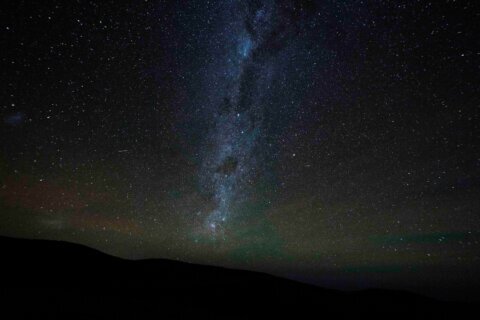
The summer constellations and the Milky Way galaxy are visible after dark, spanning the sky from the northeast to the southeast and getting higher until morning twilight. August is peak Milky Way viewing in the Northern Hemisphere, as our galaxy is visible in the sky right after dark and through the night.
Star of the month
In August we will experience an “eclipse season” with the moon and sun as the “stars” of the month due to their partial eclipses that will be widely visible in the D.C. region.
Also, the “falling stars” of the Perseid meteor shower at its peak take center stage this month. Details are below.
Highlights of the month
Aug. 7: A slim lunar crescent moon accompanies the Pleiades in the east before dawn. Worthy of taking a picture with your smartphone or digital camera using zoom.
Aug. 9: In the eastern sky before dawn, look for reddish Mars and the thin crescent moon side by side. Worthy of taking a picture with your smartphone or digital camera using zoom.
Aug. 10: Remember our star of the month in October, Algol? It is worth looking at it going to minimum brightness for two hours centered at 2:23 a.m., and then getting brighter. See the other dates this month below. Try taking a picture with your camera or smartphone, or maybe even a video.
Aug. 11: See Mercury and a razor-thin lunar crescent above the eastern horizon before dawn. You will need a clear horizon view and binoculars to help see the pair. Try taking a picture with your smartphone or digital camera using zoom.
Aug. 12: A partial solar eclipse will be widely visible in the D.C. region starting at 1:17 p.m. and ending at 2:27 p.m. In the D.C. region, this partial solar eclipse will only obscure about 1% of the sun.
In parts of Greenland, Iceland, northern Russia, the Atlantic Ocean, Spain and a small corner of Portugal, NASA said eclipse viewers will experience a total eclipse of the sun. Visit the NASA website on Aug. 12 for the agency’s eclipse coverage.
Eye safety first
You must adhere to the following solar eclipse viewing safety requirements to prevent injury to your eyes and damage to your smartphone or camera.
If you plan on wearing solar eclipse glasses or using a solar filter for your camera, smartphone or other optical aid, you need to ensure that you purchase them from a reputable supplier.
In 2017 and 2024, there were solar filter and viewer products that did not meet the strict ISO standard and presented a danger to the public.
For those planning on photographing the eclipse, check out this webpage. If you want to use your smartphone, I highly recommend using the Solar Snap app. I beta tested it and it worked like a charm.
Aug. 12 and 13: On this night, the peak of the Perseid meteor shower takes place and will not be hampered by the new moon, which will have eclipsed the sun earlier. This should be an excellent meteor shower experience.
Aug. 12: Algol again at 11:12 p.m.
Aug. 15: Before dawn and very low on the eastern horizon, Jupiter and Mercury form a very close pair. Mercury will be slightly to the left of Jupiter. You will need a clear horizon, and likely binoculars, to see this striking sight. In a low-magnification telescope, you might get both planets.
Aug. 15: Venus is in the west after sunset, accompanied by the crescent moon. Worthy of taking a picture with your smartphone or digital camera using zoom.
Aug. 20: A bright waxing gibbous moon and the star Antares are close together in the south after dark.
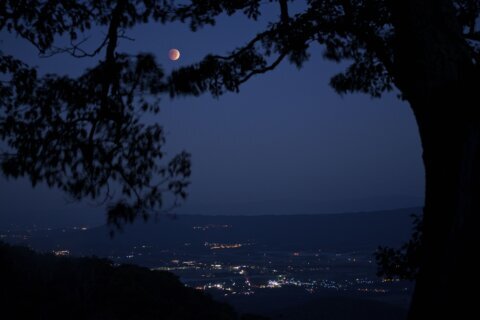
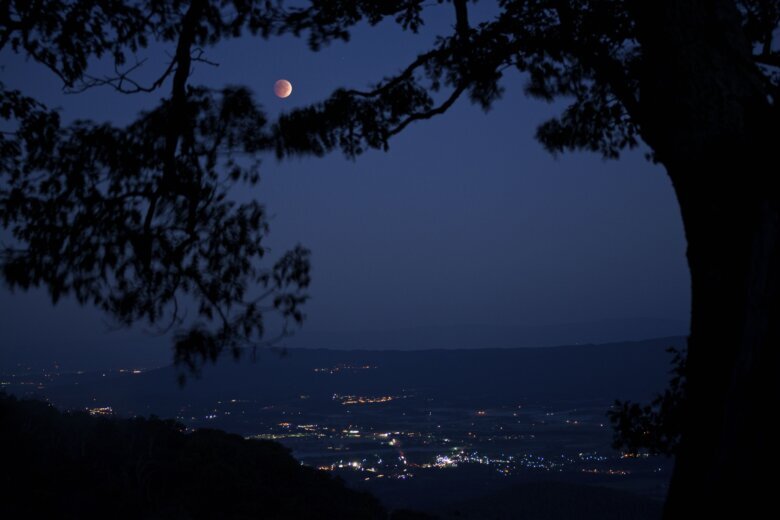
Aug. 27 and 28: In the D.C. region, the full sturgeon moon undergoes a deep partial lunar eclipse that starts Aug. 27 at 9:23 p.m. and ends Aug. 28 at 3:01 a.m. You can get eclipse information for your exact location at this website by entering your city.
Tips for photographing the eclipse using your smartphone are here, while camera tips are here.
You can see the eclipse from essentially anywhere, but it is best to be away from bright lights. When the moon is deep in the Earth’s shadow, the stars become visible and it’s a sight to see the suspended copper-colored moon in a sea of stars.
Aug. 30: Algol again at 4:06 a.m.
The moon
Aug. 6: Last quarter
Aug. 12: New moon (partial solar eclipse)
Aug. 20: First quarter
Aug. 28: Full sturgeon moon (deep partial lunar eclipse)
Planets
Mercury is low in the east before dawn.
Venus is in the west after sunset.
Mars is in the east before dawn.
Jupiter is coming out of the glare of the sun in the east before dawn.
Saturn is in the sky from late evening to dawn.
Uranus is in the western sky after dark. You need a telescope to best observe the planet, although it is visible in binoculars.
Neptune is in the western sky after dark. You need a telescope to observe the planet.
Pluto is way out there in the solar system and requires taking images through a telescope spaced days apart to hunt it down.
D.C.-area events
- Join me at Shenandoah National Park for my “Let’s Talk About Space” presentations. Check out this website for other sky events. Rangers also host night sky programs, so check it out when you visit the park.
- Virginia State Parks
- NOVAC Online Meeting, George Mason University. Check the calendar for astronomy events.
- National Capital Astronomers
- The Analemma Society has resumed observatory operations. Check the link regarding Friday night public viewing sessions at Turner Farm in Great Falls, Virginia. Check their calendar for other astronomy activities in August.
- The Smithsonian Air and Space Museum in D.C and Chantilly has loads of astronomy stuff in August.
- Check out the new attraction at the Smithsonian Air & Space in D.C.: Smithsonian Starstruck: An Immersive Experience. Read more about it in this WTOP story.
- You can check here and here for astronomy clubs that are outside the D.C. region.
- The Nancy Grace Roman Space Telescope mission is scheduled to launch from the agency’s Kennedy Space Center in Florida on Aug. 30. NASA will stream this event live.
Bonus section!
Smartphone photographers: This is a must-have for astrophotography using your smartphone.
Use this useful tool to create a custom star chart for your location to help you find your way around the stars. While you are at it, check out these very useful astronomical tools.
And if you want to plan ahead for 2026 sky events, here’s a nifty guide to help.
You can also send in any space-related questions to my email address. Suggestions about this feature are also welcome.
Follow Greg Redfern on his daily blog to keep up with the latest news in astronomy and space exploration.
Get breaking news and daily headlines delivered to your email inbox by signing up here.
© 2026 WTOP. All Rights Reserved. This website is not intended for users located within the European Economic Area.