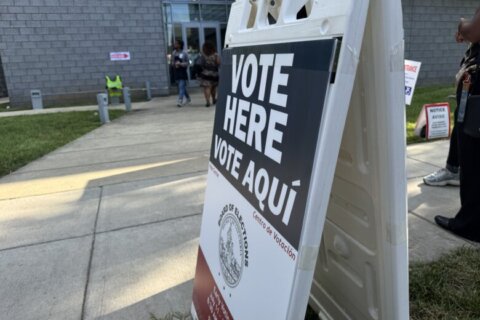
Follow WTOP’s team coverage of the D.C. primary and Election 2026 online, on air at 103.5 FM or on the WTOP News app.
Ahead of D.C.’s primary election in June, WTOP sent a questionnaire to all the candidates in each contested race, asking them to introduce themselves to voters, share their priorities and weigh in on some of the most pressing issues facing the District.
Candidates submitted their responses through an online form, and the answers published are verbatim.
The answers below are from Rini Sampath, who’s running for D.C. Mayor against Ernest Johnson, Kenyan McDuffie, Gary Goodweather, Janeese Lewis George, Vincent Orange and Hope Solomon.
- WTOP:
Please briefly describe your professional background. What is your current job, and what experience or skills best prepare you to serve in this role?
- Rini Sampath:
I am a Cybersecurity Director working on federal contracts. I was born in Theni, India, immigrated to the United States at age seven, and have spent over a decade calling D.C. home. I am running because I believe Washington can be a city with a competent government and vibrant neighborhoods, a strong local economy, and services that residents can count on.
My career has been rooted in public service. As a federal contractor, I have spent years improving government programs and citizen services. I have worked as a field organizer in local communities, managed higher education nonprofit programs, and engaged directly with the policy challenges that shape people’s daily lives.
- WTOP:
What are your top three priorities if you are elected?
- Rini Sampath:
Fix the basics, lower the cost of living, and strengthen communities.
Fix the basics means making D.C. government actually work: 311 requests resolved, schools with reliable heat, permits processed on time, agencies held accountable with published performance data by ward.
Lowering the cost of living means building more housing in every ward, cracking down on predatory junk fees, and pursuing the $250 million D.C. is owed before cutting a single program families depend on.
Strengthening communities means investing in public safety, schools, childcare, and the neighborhoods that have been systematically underserved, particularly east of the river.
- WTOP:
Public safety remains a top concern for District residents, including violent crime and youth‑involved incidents. As mayor, what would be your overall approach to public safety, and how would you balance enforcement, prevention, civil rights, and public trust? How would you work with or push back against the White House if federal intervention in District policing is proposed?
- Rini Sampath:
Public safety requires a stable, accountable police force and investment in the conditions that prevent violence in the first place. D.C. spent over $75 million on MPD overtime in FY2025, twice what was budgeted, while senior commanders were served termination papers for manipulating crime statistics. That is a management crisis, and it is what I will fix first.
I will stabilize MPD staffing to end the overtime spiral, reinvest those savings in communities, and require MPD to publish disaggregated crime data by ward and race on a regular public schedule. Research shows a small group of people drive 60 to 70 percent of D.C. gun violence. The answer is targeted, evidence-based intervention with that small group.
Federal intervention: I will not cooperate with any federal takeover of MPD or deployment of federal law enforcement against D.C. communities. I will support the Attorney General in challenging those actions in court. I will also direct D.C. agencies not to share resident data with federal authorities without legal authorization.
- WTOP:
The mayor has significant authority over public safety policy, enforcement, and youth services. What actions would you prioritize to reduce youth‑involved crime, and where do youth curfews fit into your overall public safety strategy, if at all?
- Rini Sampath:
Reducing youth-involved crime starts with giving young people somewhere to go and something to do. I will expand DPR’s Late Night Hype program, invest in after-school programming and mentorship, and ensure that the agencies responsible for youth services (DYRS, DPR, DCPS, and DBH) are coordinating rather than operating in silos.
Research consistently shows that sustained investment in youth programming, mental health services, and educational opportunity reduces youth crime more durably than enforcement alone. I will govern on that evidence.
I support targeted, temporary youth curfew zones as one limited tool in a broader strategy but only when paired with real investment in youth programming and safe spaces. Curfews without that investment is displacement, not safety. Any curfew zone must have a defined sunset, clear success metrics, and mandatory review.
D.C. already has one of the highest youth incarceration rates in the country. Adding more criminalization as a permanent solution is the wrong direction. The goal is not to clear young people from the streets. It is to invest in the conditions where they thrive.
- WTOP:
Congress retains the power to overturn DC laws and intervene in local decision‑making. As mayor, what specific actions would you take to protect and defend the District’s home rule on a day‑to‑day basis, even without full statehood?
- Rini Sampath:
I will use every tool available. On day one, I will direct D.C. agencies not to cooperate with ICE, not to participate in federal task forces deployed against DC residents, and not to share resident data with federal authorities without legal authorization. I will work with the Attorney General to challenge federal overreach in court, including the congressional budget interference that cost D.C. $180 million from our own tax dollars.
I will build proactive relationships with Congressional allies to stop disapproval actions before they happen, rather than reacting after the damage is done. I will engage directly with the White House on D.C.’s economic interests, and I will use the platform of the Mayor’s office to make D.C.’s case nationally — because protecting home rule requires political pressure sustained over time, not just legal filings.
I will also decline to endorse any candidate for federal office who does not explicitly commit to D.C. statehood. D.C.’s votes should not be taken for granted by politicians unwilling to fight for our rights. Every tool the Mayor has, legal, political, and platform, will be deployed in defense of D.C.’s right to govern itself in my administration.
- WTOP:
DC statehood enjoys strong local support but remains stalled at the federal level. Beyond stating your support or opposition, how would you realistically use the mayor’s office to advance the cause of statehood, and how would you measure progress during your term?
- Rini Sampath:
I will use the Mayor’s office as a national platform for statehood in a way D.C. mayors have not done consistently enough. That means direct engagement with White House leadership, sustained coalition-building with mayors and governors in other states facing federal overreach, and public advocacy that makes D.C. statehood a live national conversation rather than a periodic D.C.-only talking point.
I will decline to endorse any federal candidate who does not commit to statehood. I will work with D.C.’s congressional delegate to develop and advance legislation in every session of Congress. I will build relationships with Senate offices in states where statehood support is persuadable because the votes have to come from somewhere, and they will not come without sustained cultivation.
Measuring progress: I will track the number of Senate cosponsors of D.C. statehood legislation, the number of state legislative bodies passing statehood resolutions in support, and the number of national organizations publicly endorsing D.C. statehood during my term. These are leading indicators of the political infrastructure needed for statehood to eventually pass. Progress on statehood is slow and non-linear, but it is measurable, and I will report on it publicly.
- WTOP:
Recent congressional action has resulted in DC tax dollars being held back, forcing the city to revise its budget. How would you work with, or push back against, the White House and Congress to protect the District’s financial stability and prevent future budget disruptions?
- Rini Sampath:
I will pursue every dollar D.C. is owed through legal and political channels simultaneously. The CFO is holding $180 million from our tax decoupling decision because Congress missed its statutory 30-day window to act and acted anyway. That money belongs to D.C. residents.
I will build a genuine congressional relations operation that engages members proactively — not just when a crisis hits. That means regular engagement with the appropriations committees, relationships with members on both sides of the aisle who have D.C. equities, and a clear public accounting of what congressional interference costs D.C. residents in concrete terms.
I will also build D.C.’s financial resilience by diversifying the economy so that we can weather disruptions like the mass federal layoffs we are experiencing now. Federal employment has long been a pillar of D.C.’s economy, and that is a strength. However, the past year has shown that it cannot be the only pillar. Building out healthcare, clean energy, the creative economy, and the visitor economy alongside our federal base is not a rejection of what D.C. is. It is an investment in making sure D.C. remains economically strong regardless of decisions made in the White House or Congress.
- WTOP:
Now that the Commanders stadium deal is final, what steps would you take as mayor to oversee its implementation and ensure public funds are protected, promises are kept, and surrounding communities benefit as intended?
- Rini Sampath:
The city committed approximately $1 billion in public resources to this deal. That level of investment requires real accountability, not aspirational language in a press release.
As Mayor, I will designate a senior City Hall official with specific responsibility for monitoring every development milestone and publishing quarterly progress reports on affordable unit delivery, local hiring compliance, promised community amenities, and infrastructure timelines. That data will be public so residents can track whether promises are being kept.
I will ensure that noncompliance with the development agreement triggers real consequences, including financial penalties and clawback provisions. The 1,800 affordable units and the $20 million annual transit infrastructure investment are conditions of the public investment, not aspirational goals. I will also work proactively with Kingman Park and Hill East residents to monitor displacement pressure as development proceeds, and ensure that the surrounding communities that were promised benefits are the first to see them delivered.
- WTOP:
Concerns about oversight and agency performance have followed several District departments in recent years. As mayor, what specific steps would you take to improve accountability, transparency and management across city government?
- Rini Sampath:
83 of 97 D.C. agencies overspent their Council-approved budgets at least once in the past 20 years. MPD commanders were served termination papers for manipulating crime statistics. These are not isolated failures. They are symptoms of a government without real accountability for results.
I will take three immediate steps. First, I will launch a public budget and performance dashboard on day one: every major agency’s spending, service delivery timelines, and key outcomes published in real time by ward, so residents can see whether their government is working. Second, I will hold agency directors personally accountable with published performance goals tied to their continued service. If an agency consistently fails its metrics, I will change leadership. Third, I will require every agency to publish a monthly service delivery report covering response times, complaint resolution rates, and budget status.
On the MPD crime data scandal specifically: I will commission an independent audit of crime classifications over the past several years and publish the results. Residents deserve to know the true picture. Accountability starts with honest data.
- WTOP:
As the cost of housing continues to rise in the District, what policies would you prioritize to improve affordability, and how should the city manage growth while considering the impact on existing neighborhoods?
- Rini Sampath:
D.C.’s housing crisis is primarily a supply crisis. We have not built enough homes, and the shortage drives up costs for everyone. My approach has two parts: build more, and protect who is already here.
Building more: I will pursue zoning reform to allow more density near transit, fix permitting timelines that are among the worst of any major city, eliminate parking minimums near Metro, and aggressively convert vacant downtown office buildings to residential. I will require affordable units in every ward and establish ward-level production benchmarks with public reporting.
Protecting existing residents: I will enforce tenant protections aggressively, crack down on predatory junk fees and illegal rent increases, and create a displacement early-warning system that monitors rental prices and eviction filings in neighborhoods facing development pressure.
Managing growth and protecting existing neighborhoods are not in conflict if pursued simultaneously. Building more, especially in high-opportunity wards that have historically excluded density, is how we relieve pressure on the neighborhoods where long-time residents are most at risk.
- WTOP:
As mayor, what would be your top education priorities, and how would you use the powers of the office to improve outcomes and equity across DCPS and public charter schools?
- Rini Sampath:
My top education priority is chronic absenteeism. Thirty-nine percent of DC students are chronically absent, and 57 percent of high schoolers. I will launch a cross-agency attendance task force in my first 90 days, connecting DCPS, DHS, DHCF, and DPR to address root causes school by school, including home visits and regular family touchpoints so schools are not the last to know when a child is struggling.
I will adjust the Uniform Per Student Funding Formula for inflation annually, because underfunding schools is a choice with consequences. I will fix school facilities so no student loses heat in winter. Further, I will work to close the 61-point Black-white ELA proficiency gap by directing the Chancellor to publish ward-level outcome data transparently and be held accountable for closing it.
I will use Mayoral authority over the DC Public Charter School Board to ensure that charter and DCPS students have equitable access to facilities, transportation, and wraparound services. Every child in D.C. deserves a great school regardless of which system they are in.
- WTOP:
Muriel Bowser has served as mayor for more than a decade and shaped major policies on development, public safety, housing, and the District’s relationship with the White House and Congress. If elected, what parts of her agenda or governing approach would you continue and what would you change as the city faces a new political moment?
- Rini Sampath:
I will continue D.C.’s investments in affordable housing production, the Housing Production Trust Fund, and early childhood education. These are real programs that help real people, and I will protect them from the budget cuts currently threatening them.
Under Mayor Bowser, 83 of 97 agencies overspent their budgets without real consequences. MPD commanders manipulated crime statistics and her instinct was to defend rather than act. The permitting system consistently fails residents and small businesses. These are management failures that I will fix through published performance data, personal accountability for agency directors, and a governing discipline that D.C. government has lacked.
I will also change D.C.’s posture on federal overreach. Mayor Bowser has been too quick to appease the White House. I will not. Defending home rule requires more than rhetoric. It requires a mayor willing to say no, go to court, and use every available tool.
- WTOP:
Residents across the District continue to raise concerns about DC’s 911 system, including long wait times, dropped calls, and delayed emergency responses. As mayor, what specific steps would you take to fix the system and how would you hold leadership accountable if problems persist?
- Rini Sampath:
The Office of Unified Communications handles more 911 calls per capita than almost any agency in the country, and it has been failing residents for years. Dropped calls, dispatches to wrong addresses, chronic overtime burning out the people who answer when residents are in crisis are not acceptable.
In my first 90 days, I will commission an independent operational review of OUC focused on staffing levels, technology infrastructure, training protocols, and dispatch accuracy and publish the findings. I will set specific, measurable performance targets for call answer times, dispatch accuracy, and call drop rates, and publish monthly performance data so residents can see whether the system is improving.
OUC leadership cannot deliver measurable improvement against published targets within a defined timeline, I will change leadership. I will also address the chronic overtime problem that is driving dispatcher burnout and errors. A workforce that is running on fumes is a public safety risk, and fixing the staffing model is inseparable from fixing the performance. 911 is the most basic promise the government makes to residents. I will make sure D.C. keeps it.
- WTOP:
What’s one place, tradition or moment that makes DC feel like home to you?
- Rini Sampath:
Pride weekend! D.C. is where I fully embraced my identity. Local spaces like A League of Her Own, Crush, Pitchers, Transmission, etc. all deserve to be supported for their amazing work supporting our queer community!
- WTOP:
What’s something about you that voters would never learn from your résumé or campaign website?
- Rini Sampath:
I learned Mandarin Chinese for the few years I lived in Singapore, but I forgot it! I am fluent in my native language Tamil and hearing proficient in Kannada.
Get breaking news and daily headlines delivered to your email inbox by signing up here.
© 2026 WTOP. All Rights Reserved. This website is not intended for users located within the European Economic Area.