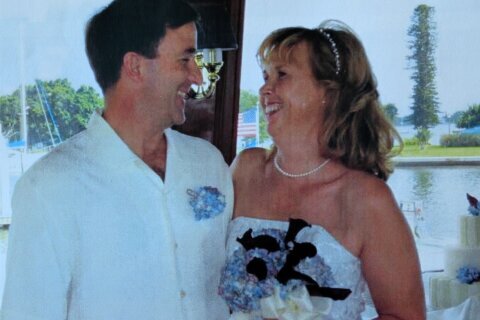
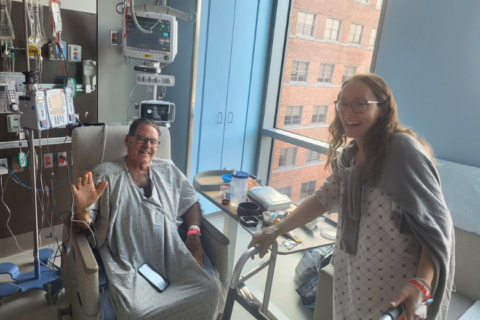
There are few greater gifts someone can give another than themselves, but that is just what one woman did for a Virginia Navy friend that she hadn’t seen in four decades. The two reconnected on Facebook and just months later both went under the knife.
“Kidney disease has been in my family for at least five generations that we know of. And before that, I think they were just undiagnosed,” Debbie Winkfield, who lives in the northern Shenandoah Valley in Virginia, told WTOP. “I found out about 20 years ago that I would need a transplant.”
Now, in April, which is National Donate Life Month, Winkfield decided to share her story to help others because her donor match turned out to be quite a surprise. And not only that, her surgery at MedStar Georgetown University Hospital marked a milestone use of new technology at the hospital.
‘A true hero’
Winkfield said she was doing well until last spring, when doctors told her that they’d need to conduct a serious search to find her a kidney, whether it be through a family member or friend or someone on the transplant list.
Last March, she started a new Facebook group, updating friends and loved ones about her situation and asking for help to find a new kidney. Only 19 people were linked to the page.
“I reached out to some folks that I knew may qualify and may be willing to donate, and I really didn’t know if anyone would be willing or even consider it. It was just a chance I took,” Winkfield said.
Last May, MedStar Georgetown contacted her to say someone had come forward offering their kidney.
“I was very humbled and a little bit in shock because I wasn’t sure that anyone would be willing to do that,” Winkfield said.
The donor, however, was kept anonymous at first as the volunteer underwent a month of tests to see if they were a qualified match. Winkfield was not sure who was making the sacrifice to save her life.
After four weeks of testing, the anonymous donor turned out to be a match.
MedStar Georgetown’s transplant coordinator told Winkfield the donor would contact soon.
An old friend from her Navy days, Lora Booher, called her just two days later.
“The true hero in this story is Lora,” Winkfield said. “Lora did something that she didn’t have to do.”
Groundbreaking female sailors
Booher and Winkfield both served aboard the U.S.S. Sierra — in 1984 they were among some of the first female sailors let aboard ships, and, according to Booher, “apparently both of us were a little crazy, because we’re like, ‘send me.’”
Both said they developed a personal bond on that ship.
“There were several situations, and Debbie and I had each other’s back, and that was a big bond between us, that we took care of each other,” Booher said.
After Booher, a Dayton, Ohio, native, left the ship after a year, the two lost contact until they became Facebook friends years later, keeping an eye on each other from afar, Booher in Ohio and Winkfield in Virginia. Then one day, Booher stumbled upon Winfield’s kidney donation page.
“I think this is meant for me. I got to do this, to help out my shipmate here,” Booher said.
While undergoing tests to make sure her kidney would match, Booher said she was frustrated that she couldn’t talk to her friend just a few states away.
“It was just amazing to me, how it all just worked out perfectly, and I don’t know what made me do it,” Booher said. “I’ve been doing some soul searching, and I haven’t said this out loud, but it was kind of like a reason to live for a while.”
She and Winfield met in D.C. on the night before the surgery and had dinner. Their conversation flowed like they had just seen each other just days ago instead of 40 years ago.
Dr. Talal Al-Qaoud was the surgeon at MedStar Georgetown who completed the kidney transplant surgery last September.
“I believe this is the only field in medicine where it really takes one human being to cure another human being,” Dr. Al-Qaoud told WTOP.
Minimally invasive surgery
Winkfield’s surgery was the first kidney transplant performed at that hospital using a surgical robot.
“The whole point of this was really to kind of benefit Debbie from the recovery standpoint,” Al-Qaoud said.
Usually, a kidney transplant requires a large incision in the back, but with the robot, it’s a much more minimally invasive procedure, according to Al-Qaoud, and Winkfield said she had relatively no pain due to the small incision.
Months later, both women are healthy and are encouraging others to look into becoming organ donors this National Donate Life Month.
“I don’t think there’s any more gratification you can get out of any gift you can give to somebody. It’s priceless,” Al-Qaoud said.
“People are always amazed or thankful or just in awe that I would do something like that, and I’m like, ‘You too, can do this.’ Help somebody out. You never know,” Booher said.
“It’s hard to describe the feeling, because there really are no words for someone to think enough of me, care enough for me, and to sacrifice themselves to go through this surgery,” Winkfield said with emotion in her voice. “To offer an organ is just a feeling you can’t describe. I just don’t have the words. I thank her so much.”
Get breaking news and daily headlines delivered to your email inbox by signing up here.
© 2026 WTOP. All Rights Reserved. This website is not intended for users located within the European Economic Area.