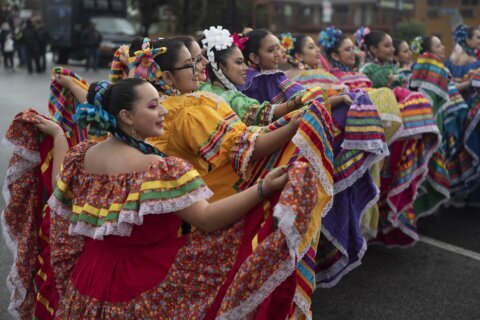
WTOP celebrates National Hispanic Heritage Month this Sept. 15 through Oct. 15, with stories spotlighting the contributions, culture and accomplishments of Hispanic communities across the D.C. region.
This video is no longer available.
While the Hispanic population has grown significantly in recent years — it’s believed more than a million residents in the D.C. region are Hispanic — the number of elected leaders representing the area at the state and local levels is significantly smaller.
And there are no Hispanic leaders representing any part of the D.C. region on Capitol Hill. But the small number of elected officials who are Hispanic say that will be changing in the years ahead.
“It has grown, but not fast enough,” Montgomery County Council member Natali Fani-González said.
Statewide in Maryland, she and Gabe Albernoz are the only county council members who identify as Hispanic.
Other elected leaders who identify as Hispanic agreed they need more representation in local government, and said they believe they’re on the right track.
“We’ve seen just a wealth of folks stepping up and saying, ‘We need to be the leaders that our community deserves,'” Fairfax County Mason District Supervisor Andres Jimenez said.
He’s one of two Hispanic members of that legislative body.
“What is encouraging is that we are starting to see more, we are adding more Hispanic voices, and that’s a good sign,” Jimenez said.
‘It’s this balance’

Both Fani-González and Jimenez were born in other countries. Deni Taveras, a Maryland state delegate from the Hyattsville area, was born in New York but has roots in the Dominican Republic.
All three said they believe federal policies are targeting those they represent, requiring them to be more considerate about how they speak about certain issues.
“We have to walk very sensitively, because it is a very sensitive time that we’re in,” Taveras said.
She said an additional worry was getting name-checked by the president. Back in April, the White House released a statement about sanctuary cities that mentioned Taveras while referencing politicians who are “putting lives at risk.”

“That’s a threat to my life at this at this stage,” she said, addressing the current political divide and heightened instances of political violence.
Taveras said she worries about being targeted over her legislative actions or beliefs.
“It’s this balance between wanting to help the folks and residents in my community, but at the same time, I don’t want to put a target on their back,” he said. “If I come out and I’m extremely vocal, I’ll be fine. But what happens to the community?”
Fani-González said she understands the fear of deportation right now, since she said that nearly happened to her when she was a teenager. Now she’s an American citizen, but she also said she believes things would have transpired differently if she was trying to obtain citizenship today.
“This past year has not been easy. I’m just going to tell you that right up front, with everything happening at the federal level,” Fani-González said.
“I feel this huge responsibility of making sure that people in my community, regardless of where they were born, feel safe, feel proud about their cultural heritage, but also feel that they’re welcome, and then they can function in society and feel free.”
Voting power coming soon
But whatever fear exists today is also paired with optimism that a big field of Hispanic leaders, and voters, is growing up around the D.C. region. While there are plenty of Hispanic residents who aren’t eligible to vote in U.S. elections right now, Tavares said there are plenty of people who are eligible but aren’t registered. She said she believes that community could harness more power now if it wanted to.
“We do have over 100,000 immigrants that are eligible, that have green cards, and we just need them to get them to loosen that fear, to become citizens, and then from there, to get them to vote,” she said.
But if it doesn’t happen now, or in the next few years, there’s belief it will happen in the future.

“There’s a significant number of Latinos who are not United States citizens,” Fani-González said. “But there’s also a lot of them who are. … It’s amazing every time I go to a different middle school, high school here in Montgomery County to speak to kids … to see how many children who are Latinos were born here already, compared to when I was in high school.”
While the three leaders who spoke to WTOP are all Democrats, Virginia Attorney General Jason Miyares, a Republican whose mother came to the U.S. from Cuba, became the first Hispanic-American to win a statewide race in Virginia when he was elected in 2021.
“If your family came to this country seeking hope and opportunity, there’s a good chance your family is a lot like my family,” he said during a Hispanic Heritage Month proclamation last year. “We know Latinos are the backbones of so many of our communities.”
But as the number of Hispanic candidates running for office grows nationwide, Jimenez said that brings no guarantee of increasing political clout. He said the current group of leaders has to do its part too.
“We just need to continue to make sure that we’re inspiring tomorrow’s leaders today,” he said.
Get breaking news and daily headlines delivered to your email inbox by signing up here.
© 2025 WTOP. All Rights Reserved. This website is not intended for users located within the European Economic Area.