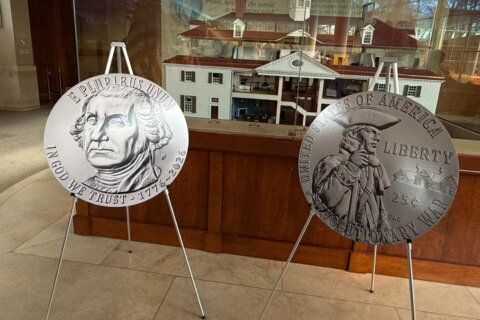
As the United States marks its 250th anniversary, WTOP presents “250 Years of America,” a multipart series examining the innovations, breakthroughs and pivotal moments that have shaped the nation since 1776.
AAR is proud to partner with WTOP to bring you this series.
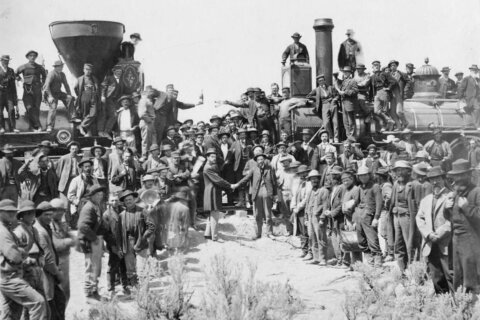
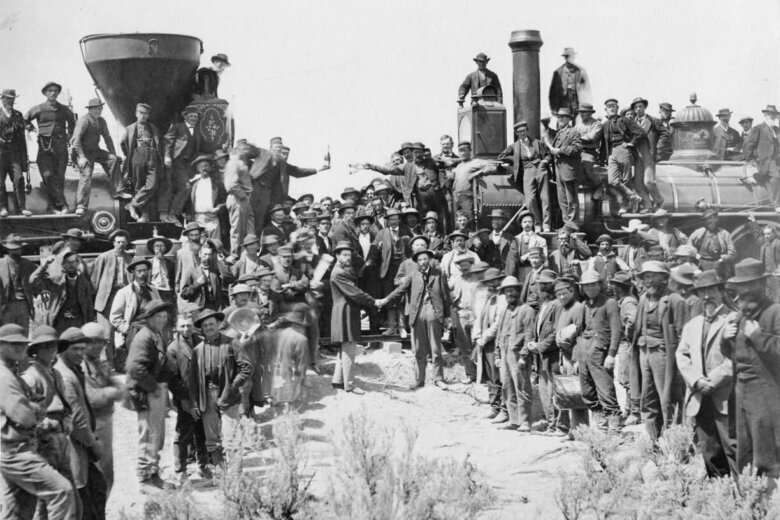
The photo is one of the most iconic in American history. It was taken May 10, 1869, at Promontory Summit, Utah. Two locomotives, one pointing east and the other west, touch, and America is changed forever.
Two railroad workers stand in front of the locomotives, extending their hands. A golden spike is driven into the hard ground at what became known as the Golden Spike Ceremony. A nearby telegraph operator typed the word “DONE” to notify the world.
President Abraham Lincoln supported the railroad by signing the 1862 Pacific Railroad Act, which funded the project using state and U.S. government subsidy bonds, as well as company-issued mortgage bonds.
Just four years after the end of the Civil War, the reunited nation was now linked from the Atlantic to the Pacific.
Engineer Theodore Dehone Judah surveyed the route and identified the Donner Pass route through the difficult Sierra Nevada mountains.
It’s estimated that 90% of the Central Pacific’s workforce was Chinese immigrants, while the Union Pacific relied heavily on Irish laborers and Civil War veterans.
The 1,911-mile rail line, built between 1863 and 1869, connected the existing eastern U.S. network, starting in Council Bluffs, Iowa, with rails that began in San Francisco. The Western Pacific Railroad Co. built 132 miles of track from the road’s western terminus at Alameda/Oakland to Sacramento, California. The Central Pacific Railroad Co. of California constructed 690 miles of track east from Sacramento to Promontory Summit, Utah Territory.
The Union Pacific Railroad built 1,085 miles of track from the road’s eastern terminus at the Missouri River settlements of Council Bluffs and Omaha, Nebraska, westward to Promontory Summit.
“We live in a country that was built on railroads,” SUNY-University at Buffalo professor David Alff, a railroad historian, said. “Promontory Point lives large in the symbolism of American westward expansion.”
Before the railroads expanded, moving goods was a slow process. The Panama Canal had not been built, which meant that, to ship goods west, companies had to sail around Cape Horn, at the southernmost point of South America, or move goods by slow wagon trail.
For the first time, the cross-country railroad system made it more economical to ship food, raw materials and manufactured goods across the continent. Commodities associated with the western states and territories, such as minerals, grain and timber, could be moved from coast to coast in just days.
The railroad made it possible to create industrial supply chains, not just passenger travel, and became the nation’s engine of commerce.
“Today, railroad exchanges with ports in Long Beach, Los Angeles and Oakland are some of the most important logistical nodes in the world,” Alff said.
According to the Smithsonian Institution, by the late 1800s, rail freight volumes easily eclipsed anything wagons or canals could handle over long distances.
With the railroad’s completion, a trip across the nation that once took six dangerous months on horseback or wagon now took eight days from New York City to San Francisco.
The rail line was used extensively for passenger traffic until 1904, and freight continued until 1942.
The line was abandoned because of high operating costs and after new double-track lines were built.
The old steel rails that had brought the East and West together were recycled and used for the war effort in World War II.
Get breaking news and daily headlines delivered to your email inbox by signing up here.
© 2026 WTOP. All Rights Reserved. This website is not intended for users located within the European Economic Area.