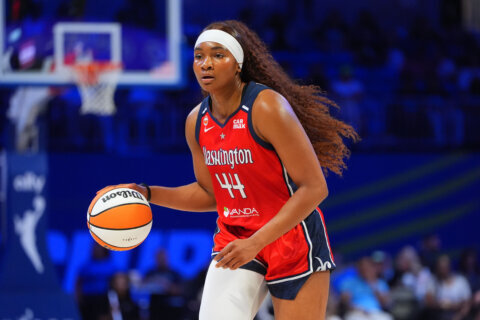
When an offense goes cold, the reflex is to find your best player and feed her until it stops. Christy Winters-Scott has missed exactly one Washington Mystics practice this season, and she thinks that instinct would wreck this team.
“She doesn’t have to be fed to eat,” Winters-Scott said of two-time All-Star Kiki Iriafen, reaching for a metaphor about cutting grapes for a toddler in a high chair. “The ball finds energy and she is energy.”
That is not a broadcaster dodging a question. Winters-Scott is in her 17th season as the Mystics’ color analyst, and for most of that run, she was also the head coach who took South Lakes High in Reston, her alma mater, from 0-21 to 19-4 in four seasons before she stepped away in 2022.
So ask her whether the Mystics offense should run through its best interior scorer and she answers as a coach who had to install one.
Her answer is no, and the reason matters more than the verdict.
“If you do that, you lose the organic beauty of the game,” Winters-Scott said.
Structure an offense around a single entry point and everyone else plays for scraps — bad for spacing, worse for a locker room. Her alternative is the thing this team already does well: read the coverage and punish it.
Winters-Scott pointed to two backdoor cuts to All-Star Sonia Citron in Wednesday’s win over Las Vegas, run twice because the Aces refused to believe they’d see it again.
“Straight from the whiteboard to the court,” she said.
So if the answer isn’t a hierarchy, what explains the droughts? The 57 points at Connecticut, the 49 points against Golden State and the 56 points against Portland a week ago?
The numbers describe a team at war with itself. Washington leads the WNBA in rebounding at 37 per game, which means nobody in the league wins more possessions. It also leads the WNBA in turnovers at 16 per game and its 80.8 points rank second-worst in the league. The Mystics get the ball more often than anyone and do less with it than almost everyone.
Winters-Scott separates the two halves that most people bundle together. The turnovers, she says, aren’t a basketball-IQ problem. They’re a familiarity problem.
“They go too fast for themselves,” she said. Washington has, by her count, 12 developmental players and a five-day training camp to teach them each other. Eight Mystics have made their WNBA debuts this season, the most any team has run out in more than a quarter-century.
The Aces team they beat Wednesday has three titles in four years and the same core taking the same reads. One of those rosters gets to play on instinct. The other is still learning where the cut is coming from.
The Washington Mystics are officially the youngest team in WNBA history
The team’s average age went down to 23.5 years old, after the franchise waived 32-year-old Alex Wilson on Tuesday. pic.twitter.com/uHVtTO4zFY
— Ball Don’t Lie (@Balldontlie) June 2, 2026
The scoring is a different diagnosis with a specific fix. Washington is among the league’s best at generating points in the paint, which is precisely why teams stopped letting them get there. The counter isn’t volume from deep — Winters-Scott was explicit that she doesn’t want 15 attempts a game falling. It’s enough to change how they’re guarded.
“Eight, nine, 10,” she said. Make that many and the defense has to play honest. Pack the paint anyway and you get punished.
There’s evidence she’s right and it’s recent. Winters-Scott told a story about Shakira Austin putting a price on hesitation — telling Georgia Amoore she’d owe $100 every time she pump-faked an open look on a kickout. Amoore, who missed all of last season with a knee injury and is effectively a rookie, went 3 of 4 from 3-point range in Monday’s win at Golden State. Against the Aces on Wednesday, Washington hit 7 of 13 from deep and won 100-99 despite four-time MVP A’ja Wilson pouring in 38 points.
Winters-Scott doesn’t read the Mystics’ two All-Star nods as a workload story at all. She reads them as a coaching outcome — and she’d know the difference. Citron led the league in 3-point percentage last season and now gets top-locked off every pin-down she used to score from. Iriafen answered a similar problem by adding a 3-pointer that wasn’t in her game a year ago.
Both were forced to remake themselves in Year 2, and they are the only returning All-Stars in the league to have raised their points, rebounds and assists per game while doing it. Winters-Scott credits Sydney Johnson’s staff for getting them there.
Which is where the argument gets complicated.
Because if the offense is genuinely democratic, then the story everyone is telling during All-Star weekend in Chicago is the wrong one. Citron and Iriafen are the All-Stars — the first teammates in the league since 1999 to make it in each of their first two seasons. But Wednesday, Citron turned it over six times and Iriafen shot 4 of 12.
Washington won because Austin scored 25, because Lauren Betts gave them 13 off the bench, because six players reached double figures. Austin also ranks second in the WNBA in individual defensive rating, on a team whose case rests on defense.
Winters-Scott said unprompted that Austin had done enough to make the All-Star roster herself. Her own logic points at the same place: the team’s best argument is not its two headliners.
The harder problem is the calendar. Youth is a real diagnosis, but it is also the most comfortable one available, because it requires nothing but patience. The Aug. 2 trade deadline is the point where waiting becomes a decision rather than a condition.
Washington is 14-12 and eighth in the league — in playoff position, but eighth. It is also the only team in the WNBA to have beaten Minnesota, Golden State and Las Vegas this season. Both of those things are true, and the front office has 10 days to decide which one is the tell.
Winters-Scott declined that one and did it honestly.
“I’m so kumbaya,” she said, explaining that as a coach she couldn’t bring herself to cut players and kept them on as managers instead. She’d keep this group whole. She also volunteered that she has no front-office intel and that the answer was feeling, not analysis. It’s worth taking her at her word on both halves of that.
What she would commit to is a standard for the second half, and it isn’t a win total.
Stay elite defensively, she said, through the stretch of the schedule where opponents see you a third and fourth time and arrive with adjustments. Washington is third in the league in defensive rating, behind only Golden State and Minnesota and Iriafen ranks seventh individually — putting two Mystics among the WNBA’s 10 best defenders.
Get the incremental jump from the bench — Betts, Cassandre Prosper, Alicia Florez. Let Citron keep solving the coverages that took the 3-pointer away. Let Iriafen keep extending her range.
Asked for one word, she gave two: “Be consistent and ascend.”
That’s the standard. The Mystics can hold the second one — this roster has spent three months demonstrating improvement. The first is the one that beat them in the games nobody wants to talk about (losses to expansion Portland and the two worst teams in the standings, Connecticut and Seattle) and it’s the only thing between the youngest team in league history and a postseason it has no business reaching yet.
Get breaking news and daily headlines delivered to your email inbox by signing up here.
© 2026 WTOP. All Rights Reserved. This website is not intended for users located within the European Economic Area.