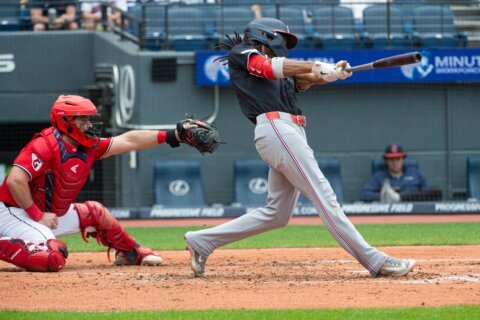
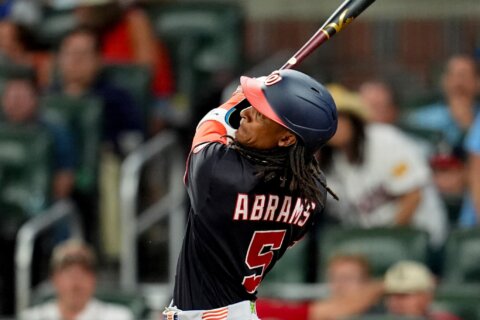
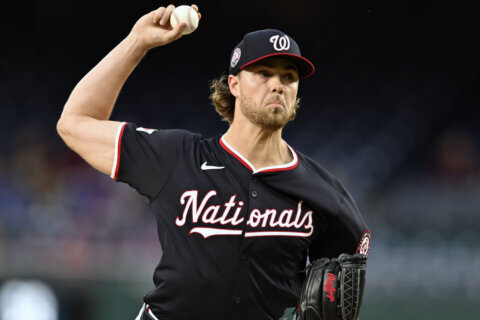
The Washington Nationals are back home after dropping the series finale in Cleveland Wednesday, 3-2, but the bigger picture for a franchise that has posted six straight losing seasons remains remarkably bright.
At 29-28, and winners of back-to-back series against first-place teams, the Nationals have the highest-scoring offense in baseball through roughly the first third of a 2026 season many predicted would feature somewhere between 90 and 100 losses, catching even the most plugged-in observers off guard.
“I don’t think anybody, even the most optimistic person around the team, would have predicted that they would be the number one offense in baseball,” said longtime Nationals beat reporter Mark Zuckerman of Nats Journal, who covers the team daily.
“I mean, they’ve scored the most runs in the major leagues.”
Zuckerman spoke with WTOP as Washington heads into a critical homestand, starting Friday against the San Diego Padres. He said perhaps the most telling sign of how far the Nationals have exceeded expectations is that their own front office may not have seen this coming either.
“The messaging we were getting from the new front office was that they were taking over and really thinking more about the long-term plan than anything in the short term,” Zuckerman said, pointing to the offseason trades of Mackenzie Gore and Jose Ferrer as signals that 2026 was meant to be a bridge year.
“Maybe even the front office didn’t quite realize that they had a chance to be successful right now.”
Coaching, players or both?
The arrival of manager Blake Butera and a revamped coaching staff, including new hitting coach Matt Borgschulte, has drawn considerable attention and credit for the Nationals’ quick turnaround — which plays directly into some organizational baggage from the previous regime.
“I know to go back to last year, the line from Davey Martinez, that it’s never on the coaching, is still going to stick with people, because they’re going to say, ‘Well, see, maybe it was all about the coaching,'” Zuckerman said.
“Well, it’s not entirely that. Sure, the new group has come in with new ideas and a new approach to things, and it’s been very well received, and you can’t deny them the impact that that’s had. But let’s give some credit to the players for being responsible for their own performances, both good and bad.”
He pointed to role players like Curtis Mead, Jose Tena and Foster Griffin — acquisitions that didn’t generate headlines at the time — as evidence that the new front office found value others missed and then put those players in positions to succeed.
“When you’re standing in the box in the bottom of the eighth with two outs and the bases loaded, it’s up to you now to be able to get the job done — and they really have done a good job of that,” Zuckerman said.
On the ‘small ball’ philosophy specifically, Zuckerman said Butera deserves credit for reading his roster rather than forcing a system.
“I think it’s an understanding of what they have and trying to figure out, OK, if this is our roster, how do we get the most out of it?” Zuckerman said.
“If you’ve got runners on first and third, nobody out, the infield back, and Nasim Nunez is at the plate, it probably makes sense to put a play on — because that suits their skill set.”
Wood, Griffin, Cavalli and the players driving it
James Wood entered Wednesday’s games leading all of baseball in runs scored, tallied 15 home runs, and ranks in the top 3 in on-base percentage and OPS. But the Olney, Maryland, native is also among the league leaders in strikeouts — a tension Zuckerman addressed directly.
“When he gets hot, he drives the ball and hits home runs in bunches and draws walks and just tears the cover off the ball and is one of the best hitters in baseball,” Zuckerman said.
“When he goes south, it can get kind of ugly.”
The key, Zuckerman said, is that Wood has learned to be more aggressive with two strikes rather than passively hunting walks — and the consistency he’s shown across most of this season is genuinely new.
Perhaps the biggest wildcard has been starting pitcher Foster Griffin, who has received NL Rookie of the Year buzz despite being 30 years old and having spent the past three seasons pitching in Japan.
“He doesn’t wow you with his stuff, but he throws seven different types of pitches,” Zuckerman said.
“He’s a really smart guy who studies hitters and patterns and keeps you off guard with everything that he throws.”
Then there’s Cade Cavalli — the former first-round pick whose development has been derailed by injury but who is now emerging as the closest thing this staff has to a true ace. Zuckerman has watched this one build for years.
“By default, he kind of is [an ace] and I know a lot of people just want to see it all the time, right now,” Zuckerman said.
“But we have to remember, even though we’ve been hearing about Cade Cavalli and he’s been kind of on our radar for a while now, he’s still got far less than one year of major league experience, and so he’s still got plenty of room to grow and learn — and he’s going to get that on the job as he’s pitching for them in the big leagues right now.”
Zuckerman noted that Cavalli’s recent efficiency — seven innings on just 84 pitches in one recent start — suggests a pitcher learning how to pace himself, not just overpower hitters.
Are these Nationals the new Commanders?
The Nationals’ hot start has inevitably invited comparisons to Washington’s other feel-good sports story of recent vintage.
The 2026 Washington Nationals remind me of the 2024 Washington Commanders:
– New front office & coaching staff breathing much-needed new life into the franchise
– Elite offense led by a phenom (Jayden Daniels & James Wood)
– Great on the road
– Good injury luck@Nats_Chat
— Al Galdi (@AlGaldi) May 27, 2026
A former colleague of mine, Al Galdi — who also happens to co-host the Nats Chat Podcast with Zuckerman — floated the idea that this Nationals team mirrors the 2024 Commanders: new-regime energy, youth and the outperformance of expectations.
Zuckerman largely agreed — with one important caveat.
“James Wood is a great player, no doubt about it. He cannot single-handedly take over a game the way that a quarterback like Jayden Daniels can. That’s just not the way baseball works,” Zuckerman said.
“But I do like the idea of a new regime coming in, a whole lot of new energy, and some young, exciting players that allow you to exceed some expectations and lay the groundwork for the future.”
It’s definitely a fun comparison for D.C. sports fans. But I’d push back with a different one out of market: the 2017 Los Angeles Rams, like these Nationals, had a historically young first-year head coach in Sean McVay, a talented and youthful roster and won the NFC West with an 11-5 record to end a miserable string of 10 straight losing seasons. They weren’t close to winning it all, but they announced themselves.
That feels closer to what’s happening at Nationals Park.
The trade deadline question
Since the 2019 World Series run, Washington has largely been a seller at the MLB trade deadline, and with control questions looming over players like CJ Abrams, the summer will test the new front office’s convictions.
Zuckerman said GM Paul Toboni has been deliberately non-committal — and that the team’s performance could shift the calculus not just for 2026, but for 2027 and beyond.
“If the players keep doing what they’re doing, and they’re in the middle of a pennant race, I don’t think Paul Toboni is going to step in and say, ‘Nope, we’re breaking this up, because that’s part of a larger plan,'” Zuckerman said.
If Washington remains competitive, Zuckerman suggested, the bigger impact may be on how aggressively the front office pursues a contending window — perhaps accelerating a timeline that was never supposed to arrive this soon.
The bottom line
Zuckerman’s message to Nationals fans was optimism, tempered with perspective.
“Be realistic, in addition to optimistic, and understand that this was never about trying to go all in and change it all in one year,” he said.
“There’s a lot to be optimistic about what’s still to come in the next few years.”
That’s sound advice. But here’s the thing — even if this Nationals team doesn’t sniff the wild card and slides below .500 this summer, what Blake Butera’s crew has already given this fan base is something it hasn’t had in years: a reason to turn on the game (you know, if you’re able to find it).
Steal attempts, squeeze plays, James Wood launching one into the seats — this is a team that’s actually entertaining. And after six straight losing seasons, that’s more than enough.
You can find more Nationals news and analysis from Mark Zuckerman on natsjournal.com and the Nats Chat Podcast.
Get breaking news and daily headlines delivered to your email inbox by signing up here.
© 2026 WTOP. All Rights Reserved. This website is not intended for users located within the European Economic Area.