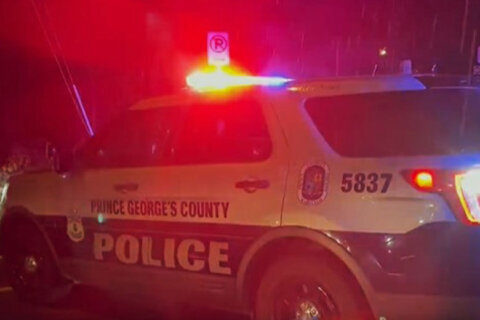
The Prince George’s County Council is getting ready to wrap up its legislative year with a busy final two days of the session.
On Monday, the council passed what’s been dubbed as Zoey’s Law.
The new law, which passed by a 10-0 vote, is named after 3-year-old Zoey Harrison, who was killed in a crash caused by a someone trying to run from police. She was one of three people killed within a 30-day span earlier this year.
The new law, which will take effect in early 2026, aims to bring municipal police departments in line with the county’s policy of not pursuing someone in a vehicle unless they know the driver committed either a felony or violent misdemeanor, or was likely to cause death or serious injury.
“No child should ever — or family — have to ever go through what my family is going through,” said Gina Pryor, Zoey’s grandmother, after the bill’s final passage. “This is a public health, a public safety issue, and so we have to be mindful of the people at hand here. We just can’t be riding around like we want to and then think that nothing’s going to happen.”
The council can’t require municipalities take up the new law, but once the bill takes effect, any municipal department that has any type of memorandum of understanding with the county department will have to abide by that provision to keep the agreement in place.
“If they do not, and they’re not willing to follow the standard, then they’re not, by law, able to have an active MOU with the county police department of any kind,” said Council member Krystal Oriadha, who championed the new law.
The next aspect of Zoey’s law will be taken up by state lawmakers in Annapolis. Oriadha said she’s working with State Del. Nicole Williams so that anyone who causes a fatal crash while running from police faces felony charges for doing so.
“When I found out that it’s just a misdemeanor, it would not be a felony, it was important for me to change that,” Oriadha told WTOP. “People that are evading the law, and that are committing a crime when doing so, have to understand this isn’t going to be a slap on the wrist. We’re not going to let this go.”
The bill also requires departments to issue annual reports about vehicle pursuits, including whether or not they caused a crash, injury or didn’t abide by departmental policies.
What’s on the agenda?
While the final day of votes on Tuesday will include legislation that reverses the county’s ban on pit bulls and moves money around to pay the county executive’s staff millions more than what was budgeted earlier this year, the council also met for a rare Monday session to vote on a pile of bills.
Bills that passed include legislation banning the stopping or parking of vehicles in bike lanes on county roads. The bill was championed by Council member Eric Olson, who represents College Park and is hopeful the state will enact a similar law for state roads.
The council also fixed a loophole in a previous bill that indexed the minimum wage to inflation by agreeing to increase payment to what are known as direct support professionals — people who help take care of the elderly and disabled, for instance.
After the original bill passed, there was concern that nonprofits would struggle to hire caregivers without the extra boost in pay they get from the state and county.
“Failure to address wages for direct support professionals when increasing minimum wage will drive up turnover and cause instability in services to vulnerable people with complex needs,” said April Gower-Getz, executive director of the Prince George’s County Provider Council. “This legislation is a significant step forward in ensuring that these professionals who serve our most vulnerable residents can keep pace with the rising costs of living.”
The council wraps up its work for the year on Tuesday with what is usually a marathon session of votes. On the agenda are bills dealing with incentives aimed at driving up locally-owned businesses. Another bill would allow county employees to use sick leave in order to attend legal proceedings, including immigration hearings.
The council will also take up a resolution to study the feasibility of a county-owned grocery store.
Also on the agenda is a bill that would move around about $10 million to the general fund. About $3.5 million of that would be used to pay people on new County Executive Aisha Braveboy’s staff — an office that was fully funded by the budget the council just passed shortly before Braveboy was elected.
In all, it would boost the amount of money needed to compensate her team from about $10.5 million to almost $14 million. With the county facing about a $170 million deficit next year, Braveboy defended the bump in pay by saying it was about “right sizing” her office.
But the matter is raising questions from some activists around the county.
“Why do we need these extra funds in the executive’s office?” asked Dan Smith, a 40-year resident of Cheverly. “Where are they coming from? What is not being funded? There just seems to be no transparency about what’s going on.”
The legislation says the money for that and other reallocations is coming from a boost in property tax revenue and money from the Maryland National Capital Park and Planning Commission.
“We went through a lot of effort and process to get a budget developed, and now they’re, without really any scrutiny or explanation to the public, moving things around,” Smith said.
Get breaking news and daily headlines delivered to your email inbox by signing up here.
© 2025 WTOP. All Rights Reserved. This website is not intended for users located within the European Economic Area.