Follow WTOP’s team coverage of Election 2026 online, on air at 103.5 FM or on the WTOP News app.
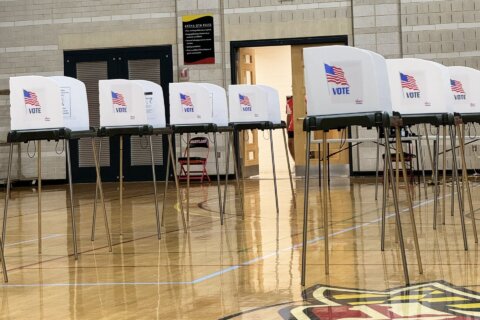
Thursday is the first day of early voting in Maryland’s primary elections.
Voters can cast their ballots from June 11 through June 18. Election Day is June 23.
The early voting process gets underway days after the State Board of Elections outlined an updated set of guidelines on how mail-in ballots will be tabulated.
The state board held a meeting on Tuesday after more than 437,000 mail-in ballots had to be replaced last month due to an error by the vendor that sent out the ballots.
That mistake led to voters getting the wrong ballot: An undetermined number of voters got ballots that didn’t match their party registration, so the replacements were sent out.
David Naimon, president of the Montgomery County Board of Elections, said in last week’s briefing with Montgomery County Executive Marc Elrich that voters have had questions about the replacement ballots and the potential impact on the tabulation process.
“We’re getting a lot of questions about that,” said Naimon. “A lot of good information about this and other subjects is available at the county website” he said, noting it could be accessed by going to 777Vote.org.
There are 14 early voting sites in Montgomery County from June 11 to June 18.
Lawrence Halloran, a substitute member of the Montgomery County Board of Elections, emphasized that no vote will be counted twice, noting that the state-issued replacement ballots have a unique bar code.
Halloran said that if a voter sent in their original ballot, and then filled out the replacement ballot, “we know it’s a second ballot. The first one is put aside. It’s not counted unless and until it’s determined that nothing else has come in from that voter.”
Halloran, a Republican, emphasized that the precautions in making sure that ballots are secured and counted accurately “are not new processes.” He continued, “There’s always replacement ballots. Voters ask for a replacement if they spilled coffee on it, if they destroy it,” or if they filled out a ballot incorrectly.
“So we know how to replace ballots, we know how to track the first one, and the second one, and make sure only one gets counted,” he said.
Halloran added that the processes are tried and true and that “the safeguards and procedures are well-established and they are firmly in place.”
Naimon, a Democrat, pointed out that when the canvassing process begins, they can only be opened by bipartisan teams at the public mail-in ballot canvass. The deadline for counting ballots is July 6 at 10 a.m.
Halloran had advice for voters who may be frustrated by the ballot printing snafu, saying, “the best recourse” is to take that replacement ballot and either mail it, take it to a drop box, an early voting site, or your local voting precinct.
If a voter who signed up for the mail in ballot then decides to vote in-person, they’ll have to fill out a provisional ballot, and Halloran said, an added form to fill out, and it won’t be tabulated until after the July 6 deadline.
“So, it’s best to really get that replacement ballot and vote it,” Halloran said.
Naimon had some advice for making the process as easy as possible: “If you do choose to vote in person for early voting, the busiest time is the last day, especially in the last hours of the last day.” The least busy times, he said are on Saturday and Sunday.
“During early voting,” he said, “you can check the current wait times on our website or by texting EV and your ZIP code to 77788.”
On Election Day, Naimon said the first few hours after the polls open are the busiest times.
Naimon also made the pitch to get more election judges to work the polls. “We definitely still need more election judges,” he said.
Get breaking news and daily headlines delivered to your email inbox by signing up here.
© 2026 WTOP. All Rights Reserved. This website is not intended for users located within the European Economic Area.