For any commuter or vacationer who’s done the calculations of whether it takes longer to drive somewhere or travel to the airport, go through security and wait for their flight, a Manassas, Virginia, company is reimagining regional travel.
The Federal Aviation Administration is encouraging development of next-generation aircraft and how they’re used. In December 2025, it released “The Advanced Air Mobility National Strategy.”
A new market study from Electra shows there’s an existing market for their in-development EL9 Ultra Short, a nine passenger hybrid-electric airplane capable of taking off and landing in just 150 feet.
Standing next to a life-sized model of the plane in the company’s hangar, located at Manassas Regional Airport, Donn Yates, vice president of government programs at Electra Aero, said the EL9 is at the center of what the company calls “direct aviation” — regional air travel designed to meet passengers where they are, not at a major airport miles away.
“You would go to Tysons Corner, go park your car at a parking garage, go right outside to what we call an ultra short access point — which would look almost like a small road or a flat top on top of a parking garage — take off, fly directly to the Manhattan heliport,” without ever setting foot in an airport, Yates said.
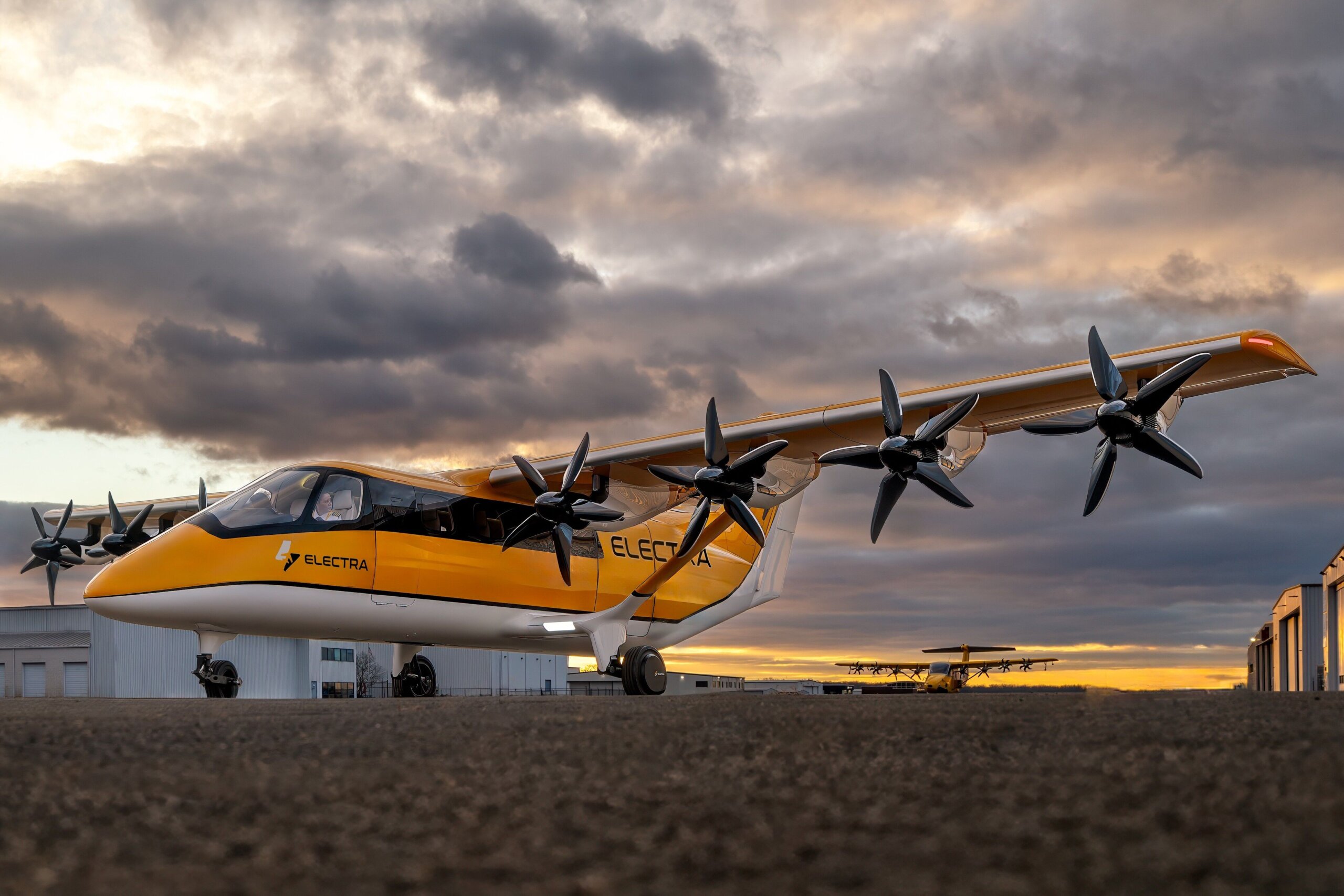
The EL9 uses eight electric motors mounted on its wings (four on each side) that generate extra lift and essentially make the aircraft “think it’s going faster than it really does,” Yates said. That’s what allows it to take off and land in as little as 155 feet, he said.
Instead of navigating airport parking, shuttles and terminals, passengers would use those “ultra short access points,” rooftops, piers, open clearings, even soccer fields. The company said the aircraft could also serve general aviation airports, which tend to be closer to where people actually live.
The target range is 50 to 250 miles — think D.C. to Richmond, or D.C. to Blacksburg, Virginia, where Virginia Tech is located. Those trips currently take up to four hours by car.
According to the market study, there are 6,249 routes across the country where more than 1,000 people travel every day in that distance range. Right now, only 1% of those trips go by air, and 85% of those routes have no air service within 40 miles of where travelers start or end their journey, the report said.
Yates pointed to the I-95 corridor between Richmond and D.C. as a prime example of where the demand exists.
“All you have to do is go spend some time on the I-95 corridor between Richmond and D.C. and you see all kinds of possibilities that could potentially pop up,” he said.
Noise is a factor the company said it has addressed. Yates said the EL9 can switch off its turbo generator on approach and fly in on battery power alone, producing about 55 decibels of sound, roughly equivalent to a hairdryer.
“It’s significantly more quiet than a helicopter or a comparable aircraft in its class,” he said.
The market outlook prepared for Electra describes hybrid-electric propulsion as having “unlocked transformative capabilities that piston and turbine technologies could never achieve.”
The report said many of the targeted routes run through areas where travelers are willing to pay business-class airfare if it means saving time and avoiding the hassle of traditional air travel.
Get breaking news and daily headlines delivered to your email inbox by signing up here.
© 2026 WTOP. All Rights Reserved. This website is not intended for users located within the European Economic Area.