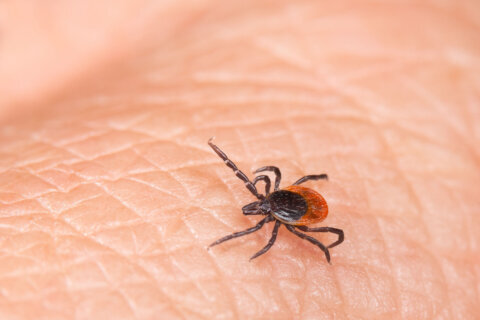
Every year, 31 million people in the United States are bitten by a tick. But the Centers for Disease Control and Prevention said reports of tick bites are higher than normal for this time of year.
The weekly rates of emergency room visits due to tick bites are the highest they’ve been since 2017, according to the CDC.
“We have started seeing an uptick in cases in our emergency rooms, with people coming in either with concerns after being bit by a tick or with symptoms that may be concerning for tick-borne illness, such as Lyme disease,” Dr. Chloe McCoy, an emergency room doctor with MedStar Health, told WTOP.
McCoy said people who believe they were bitten by a tick should tell healthcare providers where they were at the time. The location provides clues about the type of tick and the illness its bite could cause.
She said the most common tick-borne illness in the D.C. region is Lyme disease.
“The most common symptom that I think people attribute to Lyme disease, in particular, is a characteristic rash, which sometimes may look like a bull’s eye,” McCoy said.
But you can still contract Lyme disease from a bite that doesn’t result in that distinctive bull’s eye pattern.
Not every contact with a tick will result in Lyme disease.
“A tick needs to be attached, meaning it needs to have bitten the skin and remain attached for, typically, between 24 to 48 hours for it to even transmit any sort of illness,” McCoy explained.
Lyme disease symptoms typically appear within three to 30 days, McCoy said, and they usually start with a rash that expands over a period of days. Other symptoms of Lyme disease can include severe headaches, neck pain, facial palsy, heart palpitations and dizziness or shortness of breath.
The CDC recommends seeking medical attention if you have any of those symptoms, especially if you have recently spent time outdoors in areas where ticks are prevalent.
McCoy said the best strategy to avoid getting sick from a tick bite is to prevent contact. Before going outdoors, treat your clothes with permethrin, which kills ticks on contact. You can also use bug repellents, especially those with DEET, which she said is the most effective against ticks.
“One big thing that we always recommend is doing frequent tick checks,” McCoy said. “Every time you come in from outdoors, especially if you were in the wilderness or nature environment — check yourself, check your kids, check your pets — because those are all the ways that you can bring ticks into the home.”
The key, she said, is to remove ticks as soon as you notice them, and before they get a chance to attach to you.
“If you can get them off of yourself or your clothing before they attach, then you significantly decrease your risk of bites,” McCoy said.
WTOP’s Scott Gelman contributed to this report.
Get breaking news and daily headlines delivered to your email inbox by signing up here.
© 2026 WTOP. All Rights Reserved. This website is not intended for users located within the European Economic Area.