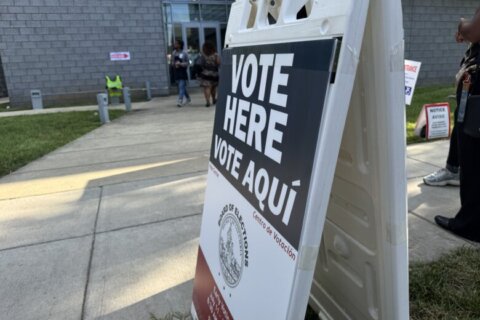
Follow WTOP’s team coverage of the D.C. primary and Election 2026 online, on air at 103.5 FM or on the WTOP News app.
Ahead of D.C.’s primary election in June, WTOP has sent a questionnaire to all the candidates in each contested race, asking them to introduce themselves to voters, share their priorities and weigh in on some of the most pressing issues facing the District.
Candidates submitted their responses through an online form, and the answers published are verbatim.
The answers below are from Rashida Brown, who’s running for the Ward 1 seat on the D.C. Council against Aparna Raj, Terry Lynch, Jackie Reyes Yanes and Miguel Trindade Deramo.
- WTOP:
Please briefly describe your professional background. What is your current job, and what experience or skills best prepare you to serve in this role?
- Rashida Brown:
I’m a Howard University graduate and a social worker, who has spent my career advocating for families. I’m a policy leader, who has dedicated the last 20+ years to increasing access to high quality early childhood education across the country and to helping cities and countries create career pathways for young adults. I am an entrepreneur running my own Woman-owned and Black-owned business. I am a 10-year Advisory Neighborhood Commissioner and the founder of Georgia Avenue Thrive, a neighborhood association that brought neighbors together to turn graffiti into beautiful murals and vacant properties into thriving businesses.
My 20+ year career in public service has instilled in me fundamental values rooted in service, social justice and integrity, and given me the tools to deliver lasting policies that have improved public safety, lowered childcare costs, and increased access to affordable housing across the District.
- WTOP:
What are your top three priorities if you are elected?
- Rashida Brown:
Affordable Housing: I will expand access through bold updates to the Comprehensive Plan and by boosting rental and home purchase assistance. Having secured 400+ units as an ANC, I’m ready to scale these results citywide.
Protecting Immigrants: I’ll defend our neighbors against federal overreach by strengthening local laws and building strategic alliances on Capitol Hill.
Proven Public Safety: I’ll invest in evidence-based violence prevention and community revitalization. Building on my Lower Georgia Avenue Thrive model, I’ll transform blighted spaces into thriving hubs to create lasting safety and social cohesion.
- WTOP:
Crime remains one of the top issues residents talk about, especially violent crime and youth‑involved offenses. At the same time, there are concerns about civil rights and over‑policing. As a Council member, what would you push for legislatively to improve public safety and how would you know those changes are actually working?
- Rashida Brown:
As an ANC Commissioner, I’ve walked the beat with MPD and believe community policing can foster both safety and trust. As Councilmember, I will ensure MPD has the resources and technology necessary to prioritize public safety and community engagement.
However, policing is only one piece of the puzzle. When I helped transform Georgia Avenue from a blighted corridor into a thriving hub, we didn’t just call for more police. We activated vacant spaces with block parties, replaced graffiti with community art, and filled storefronts with local businesses. Safety emerges from social cohesion and shared investment, not from community division.
We often ask police to handle issues that are not their responsibility. I support shifting health and human services responses to specialized programs, such as behavioral health crisis teams and street outreach like District Bridges and HIPS. Additionally, instead of using police for all special event road closures, we should use industry-standard “deployable barriers,” which are safer and more cost-effective than paying overtime.
Most importantly, we must restore funding to evidence-based violence prevention programs. By addressing conflicts before they escalate and stopping cycles of retaliation, we can reduce the need for police intervention and create a safer city for everyone.
- WTOP:
Some residents say youth‑involved crime cannot be solved by enforcement alone, while others worry there are not enough consequences when serious crimes occur. What role should the D.C. Council play in reducing youth‑involved crime, and how should prevention, intervention, and accountability work together? Please include where you stand on youth curfews and how, if at all, they should fit into a broader public safety approach.
- Rashida Brown:
As a social worker who has counseled youth and families in downstream systems, I’ve seen how criminalizing normal teenage behavior pushes young people deeper into the legal system rather than supporting their growth. Curfews specifically harm Black and brown youth, who are already over-policed. We must prioritize upstream resources and proven, positive approaches. Young people deserve investment and opportunity, not incarceration. Instead of expanding curfews, I support:
Year-round employment: Like the program I established at the National Association of Counties. Safe spaces: Funding recreation centers and libraries to stay open late with mentorship.
Mental Health/Trauma support: Expanding school-based services and healing-centered approaches.
Youth Leadership: Creating advisory boards with real power to shape policy.
Violence Interruption: Funding credible messengers to mentor at-risk youth and mediate conflicts before they escalate.
- WTOP:
The DC Council does not run schools directly but controls funding and oversight. How would you use that authority to improve outcomes in DCPS and public charter schools?
- Rashida Brown:
As a former OSSE Director of Policy, 5-term ANC, and social worker, education is my top priority. My career has focused on ensuring families access high-quality services, having developed initiatives like My Child Care DC and Thrive by Five. I am ready on day one to address the chronic underfunding, teacher turnover, and resource disparities that deny Black and brown students the education they deserve.
While the Council does not run schools directly, I will use its oversight and budget authority to: Ensure Equity: Redirect funding to bridge the massive disparities between schools West of the Park and East of the River.
Support Educators: Tackle the root causes of destabilizing turnover to retain experienced teachers.
Holistic Growth: Shift the focus beyond academic success to include robust mental health support and physical safety.
Community Partnership: Work with families and educators to ensure schools celebrate student identities and prepare them for college and careers.
Wraparound Services: Strengthen programs addressing barriers to learning—including pandemic-related loss—and evaluate school-based mental health progress.
Every student deserves a school that nurtures their potential. As Councilmember, I will ensure our budget reflects that promise.
- WTOP:
Housing costs, including rents and home prices, have increased in many cities. What specific policies would you support regarding housing affordability, and how would you balance new development with protecting existing residents and neighborhoods?
- Rashida Brown:
As Councilmember, I won’t just advocate for more housing—I’ll fight for the right mix of housing throughout Ward 1 and in the District of Columbia as a whole to preserve its rich diversity and ensure that residents thrive regardless of their income. I will continue to promote zoning and other adjustments that make it easier to build more units, to bring down prices. I will advocate for a far stronger comprehensive plan than the draft Future Land Use Map recently released by the Office of Planning. To keep our existing residents here in the communities they love I will support, protect, and invest in programs, from rental assistance and the Tenant Opportunity to Purchase Act, to assisting residents with down payments and first purchases. As a Home Purchase Assistance Program (HPAP) recipient, I knows firsthand how these critical programs matter and that they must continue to be funded by the D.C. Council. I’ll also advance housing first policies with wraparound services to promote better pathways for our unhoused neighbors and remove systemic barriers that displace Black and brown residents from our community and make it harder for seniors to age in place.
- WTOP:
Some residents have raised concerns about response times, service consistency, and follow‑through by District agencies. What role would you, as a Council member, play in using oversight and legislation to strengthen accountability and improve city services?
- Rashida Brown:
As an ANC for the past 10 years I have a track record of holding District agencies accountable on our most basic city services like trash collection, rat abatement, infrastructure projects and housing developments. I’ve also worked inside government as a Policy Director delivering on the promise of free Pre-K and better access to childcare.
As Councilmember I’ll use my oversight authority to hold agencies accountable for the smallest issues like filling potholes to the largest ones like a robust Comprehensive Plan to guide our growth for the next decade. With budget authority I’ll ensure our most critical programs are fully funded. A good Councilmember has to be able to pivot from the nitty gritty to the big picture from day-to-day and even hour-to-hour. And when existing laws aren’t getting the job done, that’s when I’ll take pen to paper and introduce and pass new legislation informed by my work with constituents.
- WTOP:
The Council has a major say in how the city spends its money. When the budget is tight, what should come first, and how would you decide which programs get protected and which don’t?
- Rashida Brown:
As a social worker, I know that investing in our social safety net, real community safety, stable housing for all residents, a strong education system and support for our workforce are what it takes to have a strong economy and a thriving city. As Councilmember I’d prioritize fully funding these programs above all else. Right now our city’s budget is being balanced on the backs of our most vulnerable residents. The fiscal year 2027 budget has cuts to childcare, paid family leave, schools, public benefits, housing programs and to our government workforce. It’s time that we take a hard look at our tax code and the inequities in how we distribute the burden. I support comprehensive revenue reform to broaden our tax base and protect the budget. I propose establishing a permanent tax and revenue commission to guide sustainable, equitable policy. By diversifying streams, we ensure everyone contributes fairly based on economic activity, protecting vital programs from being cut.
- WTOP:
Because Congress has authority to review and overturn District laws, what do you see as the Council’s role in addressing congressional involvement in local governance? How assertive, if at all, should Council members be in advocating for home rule?
- Rashida Brown:
D.C. faces the gravest threat to Home Rule in its history. The federal administration has blocked $1 billion of our budget, attempted to federalize MPD, and deployed troops in our streets. This isn’t just about autonomy; it’s about protecting our residents from state violence. As Councilmember, I will:
Present a Unified Front: I’ll work strategically with the Mayor to coordinate legal and legislative resistance. While I will hold any local administration accountable, federal threats demand we stand together to denounce overreach.
Leverage Federal Expertise: With seven years of experience as a federal lobbyist, I know how to navigate Capitol Hill. I will work with congressional allies to introduce protective legislation, use committee hearings to expose abuses, and pressure the federal government to release our budget.
Mobilize Grassroots Power: I will organize with the Free DC movement and Ward 1 residents to build the political pressure necessary for statehood. We cannot remain second-class citizens subject to congressional whims.
Ward 1 needs a fighter who will use every legislative, legal, and organizing tool to protect our democracy and our neighbors. I am ready to lead that fight for our liberation and self-governance.
- WTOP:
From buses and Metro to traffic safety and street conditions, transportation complaints come up across the city. What changes or investments would you focus on to improve how people get around D.C.?
- Rashida Brown:
Ward 1’s density and walkability are tremendous assets, yet many residents remain car-free by necessity or choice. On the Council, I will prioritize pedestrians, cyclists, and transit over cars to ensure our infrastructure reflects these needs.
As an ANC Commissioner, I successfully advocated for protected bike lanes on Kenyon and Warder Streets and Park Place. I also championed bus priority projects on Georgia Avenue and Columbia Heights and worked tenaciously with Vision Zero to implement traffic calming measures like bulbouts and speed bumps across my district.
As Councilmember, I will build on this progress by:
Transforming Transit: Championing a dedicated transit mall in Columbia Heights and a center-running transitway on Georgia Avenue, while funding fare-free buses and 24-hour service.
Expanding Infrastructure: Building more protected bike lanes, repairing sidewalks, and implementing road diets on arterial streets.
Modernizing Policy: Supporting road-pricing, increasing Residential Parking Permit fees, and removing minimum parking requirements for transit-oriented housing.
By pursuing regional reciprocity for traffic enforcement and making key corridors car-free, we can create a safer, more connected Ward 1.
- WTOP:
Development can involve tradeoffs between growth, neighborhood input, and quality of life. How would you approach development decisions, so neighborhoods have a meaningful voice while the city continues to grow?
- Rashida Brown:
As someone who led community engagement efforts on the Bruce Monroe project—testifying before the D.C. Council in March 2024 to maintain community support despite opposition and legal challenges—I know that authentic community engagement isn’t just about holding public meetings. It’s about ensuring that longtime residents have real decision-making power, that their concerns are addressed rather than dismissed, and that development serves existing communities rather than displacing them. Too often, executive agencies treat community engagement as a box to check rather than a meaningful process that shapes outcomes. To address the housing shortage, rising costs and displacement we must be building more housing of all types all across the District. This means large buildings along our commercial corridors and near transit, it means converting single family homes to multi-family homes, it means building taller buildings and wider buildings. This type of change can be scary, and is even sometimes blamed for displacement. That’s why we need genuine engagement and buy-in if we are ever going to build all the housing that we need for our residents.
- WTOP:
How would you approach the relationship between the Council and the mayor, particularly with respect to collaboration and oversight?
- Rashida Brown:
A strong government is based on mutual respect and collaboration. It has been many years since the public has benefitted from that type of relationship between the Mayor and the Council and the people who suffer the most are District residents. Each duly elected official certainly should be able to follow their own priorities. But policy-making should be collaborative. I’ve worked inside the executive branch and I had to work together with the Council as well as the federal government to get things done on behalf of D.C. residents. I know how to set aside differences and find common ground. But I also know when it’s time to fight for something that needs a champion. I don’t back down when I’m faced with a challenge and I will always prioritize the needs of our most vulnerable residents and our Ward 1 residents.
- WTOP:
Residents continue to raise concerns about D.C.’s 911 system, from long wait times to delayed emergency response. What should the Council’s role be in fixing these problems, and what specific changes would you push for to make the system more reliable?
- Rashida Brown:
It’s the most basic of city services: when you have an emergency, you call 911 and should be able to expect that someone will answer your call quickly, and dispatch help to the right place. And yet, year after year we hear stories of callers who cannot get through to 911, or ambulances dispatched to the wrong quadrant. We need a complete overhaul of our 911 call center – which has now been proposed by two different Councilmembers — through legislation when strict oversight has failed. We need stronger and more comprehensive training so that any call taker or dispatcher can step in and so that there is “no wrong door” for a caller. We need a laser focus on quality assurance with after action reports when critical incidents occur. We should separate out DC Fire and EMS calls from police calls to ensure medically-trained staff are involved at every level of first response, including monitoring and staffing calls and directing calls to the nurse triage line effectively.
- WTOP:
Concerns about ethics and accountability at the D.C. Council have repeatedly surfaced in recent years. As a Council member, how would you help rebuild public trust and what should happen when members violate ethical standards?
- Rashida Brown:
The first thing I’d do is restore the Open Meetings Act. Last year the Council exempted itself from the Open Meetings Act broadly, moving immediately to holding closed-door meetings under the premise of discussing strategy in the wake of the federal takeover. That power was soon expanded to discussions about budgets, a costly football stadium, and surely other topics the public will never know about. All the while, a member of the very body is under indictment for accepting bribes to steer a lucrative grant. The Council is going down a slippery slope and we’ve got to stop that trajectory before the public trust is completely eroded. I support the expulsion of a member who has blatantly violated the DC government code of conduct, as well as the use of lesser penalties such as reprimand and censure for less egregious offenses.
- WTOP:
Every candidate in the Ward 1 council race has said housing is the top issue, from rising rents and displacement to vacant and blighted properties. As councilmember, what is the first housing policy you would push, and how would it make a real difference for current Ward 1 residents within one term?
- Rashida Brown:
The number one housing issue that will be before the next Council is updating the Comprehensive Plan. The way we draw the Future Land Use Map and how successful we are at securing the legalization of apartments everywhere will be THE most fundamental thing the Council contributes to addressing the housing shortage. As ANC I worked on Future Land Use Map amendments that allowed for the housing that is now being built along lower Georgia Avenue at Howard University and on public land. Hundreds of units are now in the pipeline because of that work. I’m proud of that, but I also know there is so much more to do. As Councilmember I can have an impact on more than just my single member district or even Ward 1. I can bring this effort to the whole city.
- WTOP:
What’s one place, tradition, or moment that makes D.C. feel like home to you?
- Rashida Brown:
Ward 1’s greatest strength is its people. It is one of the District’s most diverse and progressive communities, where multiple languages and generations live side by side. I love our ward’s spirit; it’s a place where neighbors show up for one another, advocate for our rights, and push the city to live up to its values. This vibrant, activist energy is exactly what makes Ward 1 feel like home.
- WTOP:
What’s something about you that voters would never learn from your résumé or campaign website?
- Rashida Brown:
I practice mindfulness mediation at Elle every Sunday at 9 a.m. It keeps me grounded and engaged in community, wellness, and healing.
Get breaking news and daily headlines delivered to your email inbox by signing up here.
© 2026 WTOP. All Rights Reserved. This website is not intended for users located within the European Economic Area.