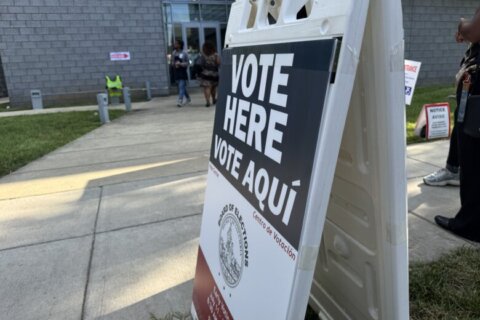
Follow WTOP’s team coverage of the D.C. primary and Election 2026 online, on air at 103.5 FM or on the WTOP News app.
Ahead of D.C.’s primary election in June, WTOP sent a questionnaire to all the candidates in each contested race, asking them to introduce themselves to voters, share their priorities and weigh in on some of the most pressing issues facing the District.
Candidates submitted their responses through an online form, and the answers published are verbatim.
The answers below are from Aparna Raj, who’s running for the Ward 1 seat on the D.C. Council against Rashida Brown, Terry Lynch, Jackie Reyes Yanes and Miguel Trindade Deramo.
- WTOP:
Please briefly describe your professional background. What is your current job, and what experience or skills best prepare you to serve in this role?
- Aparna Raj:
With the cost of living soaring and the Trump administration bearing down, we need someone with a bold vision, deep policy knowledge, and a broad coalition to fight for Ward 1 residents, and my experiences have provided all that. After first working in consulting, I moved to a super PAC to help elect Democrats. I then started working at food justice nonprofit D.C. Greens, where I supported efforts around school food, senior hunger, and food access during COVID. I now work as a Communications Manager at Local Progress, supporting local elected officials across the country around policies like banning rental price fixing, developing community responder models, and advancing workers’ rights. As a volunteer organizer, I’ve helped people stay in their homes, picketed with unionizing workers, packed groceries for immigrants and kept watch out for ICE, and have lobbied for a D.C. budget that prioritizes working people. I’ve been endorsed by over 30 community organizations, including 17 labor unions because I know a better, more affordable Ward 1 is possible if we fight for it.
- WTOP:
What are your top three priorities if you are elected?
- Aparna Raj:
I’m going to fight to make it more affordable and easier to live here by: stopping rent hikes by making it easier to build more housing everywhere and expanding rent stabilization to cover more multifamily buildings; funding free, universal childcare with a tax on large corporations so families can afford to raise their families while staying at their jobs and in the neighborhoods they love; and standing up for DC by ending MPD collaboration with ICE, closing loopholes in our Sanctuary Values Act, supporting laid off federal workers, and fighting for DC Statehood.
- WTOP:
Crime remains one of the top issues residents talk about, especially violent crime and youth‑involved offenses. At the same time, there are concerns about civil rights and over‑policing. As a Council member, what would you push for legislatively to improve public safety and how would you know those changes are actually working?
- Aparna Raj:
Every person in D.C. deserves to feel safe, and that means preventing violence from occurring in the first place. We know crime and violence go down when people have stable housing, good jobs, quality schools, and accessible healthcare, which is why I’m running to make DC more affordable. I will push to expand violence interruption programs, invest in community responders trained to de-escalate mental health and substance use crises, and fix our 911 system so residents can rely on timely help when they need it. I would also work to end MPD collaboration with ICE so immigrant communities can live freely without fear. And to address youth-involved violence specifically, we must invest in every school across the District including wraparound supports and community schools, guarantee every school has a counselor and a nurse, create free universal out-of-school-time programming, and extend DPR programming and hours so young people have safe places to gather.
We should measure success not just by arrest numbers, but by outcomes: reduction in violent crime, truancy, evictions, youth detention, and deportation; removing federal agents from our streets; and stronger trust between communities and a government that actually works to meet the needs of the people.
- WTOP:
Some residents say youth‑involved crime cannot be solved by enforcement alone, while others worry there are not enough consequences when serious crimes occur. What role should the D.C. Council play in reducing youth‑involved crime, and how should prevention, intervention, and accountability work together? Please include where you stand on youth curfews and how, if at all, they should fit into a broader public safety approach.
- Aparna Raj:
Young people have been clear about what they need: youth have testified about the need for more programming, extended recreation center hours, and safe places to spend time with their friends. Too often, the government’s response is to impose harsher punishments instead of addressing root causes and meeting those needs. Youth curfews have been proven to fail, and as Councilmember I will oppose their extension and any future implementation. We should not create more unnecessary interactions between young people and police, especially when it disproportionately harms young people of color.
The main way to reduce youth crime is to make sure students have stable home lives – that parents have good jobs and can afford housing, groceries, and medicine. We need to invest in young people through quality education, guaranteeing reliable public transit to school, career readiness programs, nurses and counselors in every school so youth have trusted adults, and free, universal, year-round out-of-school-time programming (the hours of 2-6pm are when juvenile crime peaks). Over the years, D.C. has cut sports teams, rec centers, and other third spaces for youth. We need to restore these places with programming for teens, by teens.
- WTOP:
The D.C. Council does not run schools directly but controls funding and oversight. How would you use that authority to improve outcomes in DCPS and public charter schools?
- Aparna Raj:
Education should not depend on a child’s zip code. There must be far greater transparency and accountability in both our public and public charter school systems. D.C. can make the school system more democratic by empowering our elected State Board of Education with greater decision-making authority. At the same time, the Council must increase investment in public schools, stabilize year-to-year school funding, and strengthen oversight of both charter schools and the Public Charter School Board to ensure every student receives a high-quality education and the supports they need to thrive.
I will fight to restructure the school funding formula, make public charter schools subject to the Freedom of Information Act, and fund mental health counselors, nurses, and community schools that provide wraparound resources, so that kids and families have access to what they need. And I will fight for faster repairs to school facilities so every student can learn in safe, comfortable, high-quality classrooms.
I will also work closely with educators, students, and parents to ensure oversight is responsive to the people who know our schools best. Their experiences should shape oversight, funding priorities, and policy decisions – that is the best way to strengthen and improve our school system.
- WTOP:
Housing costs, including rents and home prices, have increased in many cities. What specific policies would you support regarding housing affordability, and how would you balance new development with protecting existing residents and neighborhoods?
- Aparna Raj:
Housing is a basic need like food or water, but it is increasingly out of reach. To lower costs, we have to do two things: build more housing in every neighborhood and expand protections for renters and low-income homeowners so that families who have lived here for generations can stay for years to come. I will work to end exclusionary zoning, making multifamily buildings legal in every area of D.C., and pushing for land use reform so it is easier to build housing across our neighborhoods.
But development alone will not lower housing costs. That’s why I will fight to expand rent stabilization to more multifamily buildings and restore the Tenant Opportunity to Purchase Act, invest in our tools to build affordable housing such as creating a social housing pilot, and make sure our homeownership programs meet the needs of residents at all stages – from home purchase to maintenance and repairs for low-income homeowners. And I will work to end chronic homelessness by sufficiently funding proven tactics, from prevention programs like the Emergency Rental Assistance Program to permanent support through long-term vouchers. And I’m proud to say I’ve been endorsed by Greater Greater Washington and multiple tenant unions.
- WTOP:
Some residents have raised concerns about response times, service consistency, and follow‑through by District agencies. What role would you, as a Council member, play in using oversight and legislation to strengthen accountability and improve city services?
- Aparna Raj:
Improving people’s quality of life means both bringing down the cost of living and making city services more reliable. People should be able to trust that District agencies can deliver quality basic services we all rely on, like trash collection, pothole repairs, school modernizations, or emergency response systems.
I will use both oversight and legislation to strengthen accountability across the agencies that cover those very services and that residents struggle to navigate the most, including the Office of Unified Communications, the Department of Public Works, the Department of Transportation, the Department of Parks and Recreation, and the Department of General Services. That means demanding clear performance standards, transparent reporting on response times and service delivery, and conducting regular oversight both during hearings and in regular communication that centers residents’ experiences.
And stronger city services also requires strong constituent services. I plan to be an organizer in office, proactively canvassing the Ward to hear what residents want to see and what their concerns are to shape my legislative priorities, oversight questions, and budget decisions. Government works best when residents are treated as partners and invited to the table to inform and support how our public systems work.
- WTOP:
The Council has a major say in how the city spends its money. When the budget is tight, what should come first, and how would you decide which programs get protected and which don’t?
- Aparna Raj:
A DC that is truly affordable will require corporations and the ultrawealthy to pay their fair share so that every resident has stable housing, healthy food, quality education, healthcare, vibrant local businesses, and safe streets. In difficult budget years, I will always prioritize working people and the programs that keep families afloat over tax breaks for corporations and the ultrawealthy. That means protecting investments in housing vouchers, cash assistance for low-income families, healthcare for undocumented immigrants, and other essential safety net programs that help residents meet their basic needs. It also means defending programs that support workers and families, including Paid Family Leave, pay for childcare workers, and childcare subsidies that make it possible for people to stay in the workforce and raise children in the city that they love.
Budgets are moral documents, and the choices we make reflect our values. For too long, D.C. leaders have balanced budgets on the backs of working class residents instead of asking wealthy corporations and high-income earners to pay their fair share. As Councilmember, I will fight to raise revenue by closing corporate tax loopholes and ending ineffective tax abatements that fail to deliver the benefits they promise.
- WTOP:
Because Congress has authority to review and overturn District laws, what do you see as the Council’s role in addressing congressional involvement in local governance? How assertive, if at all, should Council members be in advocating for home rule?
- Aparna Raj:
This past year has shown us that we need Councilmembers who will fight not just to defend Home Rule, but to win D.C. statehood. Congress should not be able to overturn laws passed by locally elected representatives or interfere in the District’s budget and ability to govern ourselves. Councilmembers should do everything we can to protect our communities, push back against federal overreach, and demand that D.C. residents receive full representation.
I will work closely with D.C.’s congressional delegation and groups like Free D.C. to oppose attacks on our autonomy and ensure residents’ voices are heard by members of Congress from across the country. But we need to make this fight a national issue. As an organizer, I understand that our autonomy is tied to struggles for democracy nationwide, and we need people across the country to see D.C.’s self-governance the same way. That means building national pressure for statehood by working with nationwide organizations like Working Families Party and Run for Something and allies in Congress. D.C. residents pay taxes, serve on juries, and contribute to this country every day. We deserve self-determination, full representation, and the right to govern ourselves free from federal interference.
- WTOP:
From buses and Metro to traffic safety and street conditions, transportation complaints come up across the city. What changes or investments would you focus on to improve how people get around D.C.?
- Aparna Raj:
Nearly half of Ward 1 residents do not own a car, so investing in safe, reliable public transit, pedestrian infrastructure, and protected bike lanes is essential. People should be able to easily and safely get to work, school, grocery stores, and medical appointments safely, and our transit plan has been endorsed by Bike Walk Bus PAC, Greater Greater Washington, ATU Local 689, and Sierra Club.
I will fight for a comprehensive transit and bus network that improves safety, increases reliability, and connects the Ward. That means prioritizing pedestrian safety by making the Traffic Safety Input system more transparent, expanding traffic calming measures, and redesigning dangerous corridors on the High Injury Network – especially along Georgia Ave, 14th Street, and U Street/Florida Avenue. I will also push for full implementation of the Strategic Bikeways Plan, including protected cross-town bike connections. Paint is not protection, and we need infrastructure that actually keeps cyclists safe.
Just as importantly, we must fully invest in WMATA so buses and Metro are fast, frequent, and reliable. That means expanding dedicated bus lanes, bringing paratransit in house, expanding bus shelters, and redesigning corridors. Public transit is a public good, and DC should treat it like one.
- WTOP:
Development can involve tradeoffs between growth, neighborhood input, and quality of life. How would you approach development decisions, so neighborhoods have a meaningful voice while the city continues to grow?
- Aparna Raj:
Development must balance growth, resident voices, affordability, worker protections, and quality of life. As an organizer, I know it is critical that all impacted communities are meaningfully engaged early and often, while also recognizing that we cannot let process block the investments DC needs to be safe, accessible, and affordable.
Across the District, development and infrastructure projects – whether housing, transit, or the revitalization of commercial corridors – can feel disruptive, especially when they change familiar streets or raise fears of displacement. For many long-term Washingtonians, especially Black and Latino residents, development may signal that they may no longer be able to afford to stay in the neighborhoods they love. Those concerns are real and must be met with both listening and action.
I will meet constituents where they are by engaging early with ANCs, schools, churches, tenant unions, and trusted community institutions so feedback meaningfully shapes projects. I will also prioritize rebuilding trust in communities that have been harmed or excluded by past development decisions, while making sure to fight for development that guarantees what we all want to see: safer streets, higher wages, more affordable housing, and a DC that works for all of us.
- WTOP:
How would you approach the relationship between the Council and the mayor, particularly with respect to collaboration and oversight?
- Aparna Raj:
The Council’s relationship with the Mayor should balance collaboration with strong, independent oversight. DC works best when the executive and legislative branches are able to partner to make DC a better and more affordable place, but we also need accountability over government services.
I will collaborate with the Mayor to build a D.C. that works for every resident. That means proactively working together to make our streets safer, build more housing, make sure our public services are reliable, and strengthen our social safety net. And at the same time, I will commit to conducting rigorous oversight by interrogating agency performance, demanding transparency, and ensuring that promises made to residents are actually delivered. If we want to improve D.C. residents’ lives, we need to work together and be willing to hold each other accountable.
I believe in a Council that is not reactive, but proactive: partnering with the Executive on common goals, making government transparent, and working to fix shortcomings. That balance is how we build a government that actually works for working people.
- WTOP:
Residents continue to raise concerns about D.C.’s 911 system, from long wait times to delayed emergency response. What should the Council’s role be in fixing these problems, and what specific changes would you push for to make the system more reliable?
- Aparna Raj:
D.C.’s 911 system is failing us – callers are put on hold during emergencies, first responders are sent to the wrong addresses, and D.C.’s long response times are out of sync with national standards. These delays are not just unacceptable – they cost lives. That is why I will fight to invest in a 911 system that delivers real public safety to our residents by ensuring adequate staffing and training at the Office of Unified Communications, so that overworked staff don’t make mistakes when working long overtime hours. I will also work to raise dispatcher salaries and invest in modern technology to strengthen responsiveness and reliability of both staff and system. I will also work to strengthen our 911 emergency triage capacity by working to invest in a lasting, city-wide paramedic call taker program model on the pilot DC ran in 2019. This pilot significantly improved emergency triage by routing appropriate calls to Fire and EMS professionals while reducing overcrowding, and should be expanded so residents are better served by our 911 system.
- WTOP:
Concerns about ethics and accountability at the D.C. Council have repeatedly surfaced in recent years. As a Council member, how would you help rebuild public trust and what should happen when members violate ethical standards?
- Aparna Raj:
As an organizer, I know trust is earned, not given. That is especially true in D.C., where residents have too often seen elected officials use public office for personal gain instead of public good. Rebuilding trust starts with how we show up every single day for District residents.
As Councilmember, I will be an active and present member of the Ward 1 community – accessible, accountable, and responsive. My constituent services team will be reliable and quick to get back to every constituent that reaches out, because basic responsiveness is a core part of governmental responsibility.
At the Council level, we also need higher standards of accountability. That means strengthening ethics rules, ensuring full transparency in decision-making, and supporting independent enforcement so violations are taken seriously and addressed consistently. When members violate ethical standards, there must be consequences – no exceptions and no double standards.
I will not support colleagues who put self-interest ahead of the public, and I will expect the same from others. Public service should mean exactly that: serving the public, not ourselves.
- WTOP:
Every candidate in the Ward 1 council race has said housing is the top issue, from rising rents and displacement to vacant and blighted properties. As councilmember, what is the first housing policy you would push, and how would it make a real difference for current Ward 1 residents within one term?
- Aparna Raj:
There are many parts of D.C.’s housing system that need urgent attention, including housing vouchers, rent stabilization, and how we deploy the Housing Production Trust Fund (HPTF). But the first housing policy I will push as Councilmember is fully restoring the Tenant Opportunity to Purchase Act (TOPA) so every D.C. tenant can once again meaningfully exercise this critical right.
TOPA was created during the displacement crisis created by urban renewal, and today we are facing another period of rising rents, speculation, and displacement. For decades, TOPA has been one of D.C.’s most effective tools for preserving and creating affordable housing, preventing displacement, and giving tenants real power and ownership over their homes.
Restoring TOPA also means fully funding the programs that make it work, such as HPTF and the First Right Purchase Program, so tenants have the resources they need to secure the best development plan possible. Within one term, this would help keep Ward 1 residents in their homes, create tenant ownership, expand affordability, and strengthen community stability in neighborhoods facing intense displacement pressure.
- WTOP:
What’s one place, tradition, or moment that makes D.C. feel like home to you?
- Aparna Raj:
Malcolm X Park is home to many personal and political memories. Over the years I’ve gone to the drum circle, deepened friendships, played in the snow with my dog, and my husband and I celebrated our engagement and then wedding. And while the Park has a rich history with legends like Angela Davis, it continues to be a site for ongoing activism, including protests I’ve joined for workers’ rights, immigrant justice, and D.C. autonomy.
- WTOP:
What’s something about you that voters would never learn from your résumé or campaign website?
- Aparna Raj:
In addition to organizing, I run a local food Instagram called District Delicious! Ward 1 has so many great restaurants, including legacy spots with such rich history and culture. It’s been a fun hobby to try different places and highlight them on my account (although it’s a little defunct now during the campaign), but it’s also been a great way to get to know different small businesses and my neighbors.
Get breaking news and daily headlines delivered to your email inbox by signing up here.
© 2026 WTOP. All Rights Reserved. This website is not intended for users located within the European Economic Area.