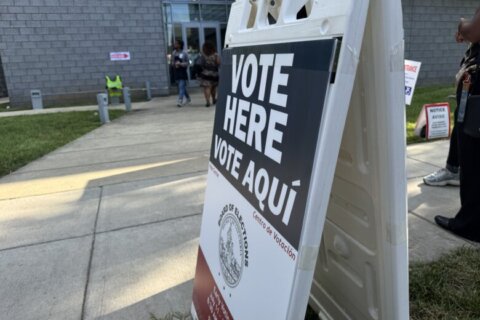
Follow WTOP’s team coverage of the D.C. primary and Election 2026 online, on air at 103.5 FM or on the WTOP News app.
Ahead of D.C.’s primary election in June, WTOP sent a questionnaire to all the candidates in each contested race, asking them to introduce themselves to voters, share their priorities and weigh in on some of the most pressing issues facing the District.
Candidates submitted their responses through an online form, and the answers published are verbatim.
The answers below are from Robert White, who is running for D.C. delegate against Trent Holbrook, Greg Jaczko, Brooke Pinto and Kinney Zalesne.
- WTOP:
Please briefly describe your professional background. What is your current job, and what experience or skills best prepare you to serve in this role?
- Robert White:
I am an At-Large member of the Council of the District of Columbia and a fifth-generation Washingtonian committed to public safety, economic opportunity, government accountability, and protecting the District’s autonomy. Before joining the Council, I served as a legislative aide and counsel to Congresswoman Eleanor Holmes Norton and as community outreach director for D.C.’s first Attorney General, Karl Racine.
Growing up in a family that struggled to make it in Washington gave me a deep understanding of the challenges many residents face. That experience drives my work to expand housing, mental health services, support for returning citizens, and family and senior services.
For nine years as a citywide elected councilmember, I have focused on helping those most in need and making neighborhoods safer by addressing violence and the trauma it causes, so D.C. remains a place where families can live and thrive.
- WTOP:
What are your top three priorities if you are elected?
- Robert White:
My top priorities are defending D.C.’s autonomy, strengthening public safety, and expanding economic opportunity.
First, I will protect Home Rule and advance D.C. statehood, so residents have full representation and local control. Second, I will strengthen public safety by fully staffing our courts, supporting accountable, effective policing, and investing in violence prevention and youth opportunity. Third, I will boost affordability and growth by increasing housing production, expanding workforce development, supporting small businesses, and putting underused federal properties to work to grow the tax base and opportunity citywide.
- WTOP:
D.C. statehood enjoys strong local support but remains stalled on Capitol Hill. Beyond stating your support, what is your realistic plan to move statehood forward and how would you measure progress over a two‑year term?
- Robert White:
My plan is to treat D.C. statehood as a long-term national organizing and coalition-building effort, not simply a bill reintroduced each Congress.
First, I would work to strengthen and expand the coalition supporting statehood by partnering with members of Congress, democracy reform groups, labor organizations, civil rights advocates, mayors, and state legislators across the country. I would also help mobilize D.C. residents and allies to support pro-statehood candidates in key congressional races.
Second, I would keep statehood visible through hearings, media engagement, public education, and coordination with D.C.’s shadow delegation and regional partners. Statehood cannot fade from the national conversation between votes.
Third, I would aggressively defend Home Rule in the meantime by fighting budget riders and congressional interference, while demonstrating that D.C. can govern effectively and responsibly.
I would measure progress over two years by growth in congressional co-sponsors, stronger Senate support, expanded national coalition partnerships, successful defense against Home Rule attacks, and increased public support nationwide for D.C. statehood and voting rights.
- WTOP:
Rising rent, home prices, and displacement are pushing long‑time residents out of the city. What federal policies would you prioritize to make housing more affordable in D.C., and how would you balance development with neighborhood stability?
- Robert White:
For me, housing affordability in D.C. is not a theoretical issue; it is personal. Much of my family has been pushed out of the city because housing became too expensive, and many of my childhood friends could not afford to stay. I lived through some of D.C.’s toughest years, so I know how deeply rising costs and displacement affect families and neighborhoods. That is why I would prioritize stronger federal investment in affordable housing production, preservation of existing affordable units, rehabilitation of neglected public housing, and the use of underutilized federal land for housing in the District. I also support strengthening tools like Housing Choice Vouchers and the Low-Income Housing Tax Credit, increasing support for affordable senior housing, and creating more pathways to homeownership for long-time residents. At the same time, any growth must include anti-displacement protections, including rent protections, tenant assistance, legal support, and policies that help longtime residents and small businesses remain in the communities they helped build.
- WTOP:
The federal workforce is central to D.C.’s economy, and debates over telework and agency cuts directly affect residents. How would you advocate for D.C. workers and businesses while navigating pressure from Congress and federal agencies?
- Robert White:
The federal workforce is critical to D.C.’s economy and to the functioning of the country. I would advocate for a balanced approach that protects workers, supports agency effectiveness, and recognizes the impact federal policies have on local businesses and neighborhoods.
I support flexible, hybrid work arrangements that allow agencies to maintain productivity while also supporting downtown recovery and small businesses that depend on daytime foot traffic. Blanket mandates rarely reflect the realities of different agencies or workers.
I would also strongly oppose indiscriminate federal workforce cuts that destabilize families, weaken public services, and disproportionately harm Black workers in the District. Instead, I would push for workforce investment, retraining opportunities, and stronger coordination between federal agencies and local economic development efforts.
At the same time, D.C. must continue diversifying its economy, so we are not overly dependent on federal employment alone. That means investing in housing, technology, healthcare, education, small businesses, and commercial corridor development.
- WTOP:
The D.C. delegate cannot vote on the House floor. Why are you the best person to be effective within those limits, and how would you ensure D.C. residents still have real influence in Congress?
- Robert White:
Effectiveness as a Delegate depends less on having a final floor vote and more on relationships, coalition building, committee work, and constant engagement throughout the legislative process. I have experience in both local and federal government, including working in Congress, and I understand how decisions are shaped long before final votes occur.
As an At-Large member of the Council of the District of Columbia, I have worked on complex issues involving public safety, housing, ethics, and economic development while building partnerships across agencies, advocacy groups, labor and community organizations. I would bring that same practical, coalition-driven approach to Congress.
I would ensure D.C. residents have influence by aggressively building alliances with members of Congress, regional leaders, national advocacy organizations, labor unions, and civil rights groups. I would also mobilize residents and allies nationwide to support pro-D.C. policies and candidates.
The Delegate’s office must be proactive, strategic, and constantly present in the rooms where decisions are made. My goal would be to ensure D.C.’s voice is heard early, consistently, and effectively on every issue affecting the District.
- WTOP:
Eleanor Holmes Norton has represented D.C. in Congress for 34 years. As someone seeking to take over a role she held for a generation, what parts of her legacy would you continue, and what would you do differently as the District faces a new political moment?
- Robert White:
Eleanor Holmes Norton has been a historic and tireless advocate for D.C., particularly in advancing statehood, defending Home Rule, and fighting for the District’s civil and voting rights. Her persistence helped keep D.C.’s fight for full representation in the national conversation for decades, and that legacy deserves enormous respect.
I would continue that commitment to statehood, voting rights, and defending the District from congressional interference. But this political moment also requires a more aggressive coalition-building and organizing strategy that combines legislative advocacy with national political engagement.
I would focus heavily on building relationships across Congress from day one, mobilizing D.C. residents and allies nationwide, and connecting D.C.’s struggle for autonomy to broader national conversations about democracy, economic fairness, and civil rights.
I also believe the Delegate must play a stronger operational role in protecting D.C.’s budget, advancing economic development, supporting public safety, and navigating increasingly complex federal-local relationships that directly affect residents’ daily lives.
- WTOP:
The deal to bring the Washington Commanders back to the RFK Stadium site includes commitments to housing and surrounding development. Do you support the agreement, and what would you do to make sure team ownership and development partners follow through on their pledges on housing, community investment and transparency?
- Robert White:
I believe this debate comes down to priorities. At a moment when D.C. is under pressure, with federal jobs cut, agencies moved or dismantled, and more than a billion dollars in threats to schools, job training, and health care, we should not be writing blank checks to billionaire sports owners.
I support redeveloping the RFK site, but I opposed this stadium agreement because it asked taxpayers to take too much risk without enough transparency, accountability, or guaranteed return for District residents. RFK is one of the city’s most valuable public assets, and we should treat it that way.
Any redevelopment must deliver affordable housing, accessible recreation, community space, strong public benefits, and real fiscal responsibility. Future public-private deals should require independent financial analysis, full transparency, enforceable affordable housing commitments, local hiring, and clear penalties when developers fail to deliver.
The goal should be redevelopment that creates long-term economic opportunity and community benefit while protecting taxpayers and ensuring residents have a meaningful voice in the process.
- WTOP:
What’s one D.C. place, tradition or moment that makes this city feel like home to you?
- Robert White:
One place that makes D.C. feel like home to me is East Potomac Golf at Hains Point. As a child, I spent time there with my brother, and those memories reflect what makes D.C. special—community, public spaces, and traditions shared across generations. As a fifth-generation Washingtonian, I believe preserving those spaces and the city’s character against federal encroachment matters because they are part of the legacy of D.C. residents.
- WTOP:
What’s something about you that voters would never learn from your résumé or campaign website?
- Robert White:
My path has been shaped by hardship and resilience. After losing my mother to cancer at age 8 and surviving a near-fatal car crash weeks later, I struggled in school and was not expected to succeed. With the help of mentors, I became the first in my family to go to college, studied at Oxford, and earned my law degree at American. I know what it means to overcome adversity, and that experience guides my work today.
Get breaking news and daily headlines delivered to your email inbox by signing up here.
© 2026 WTOP. All Rights Reserved. This website is not intended for users located within the European Economic Area.