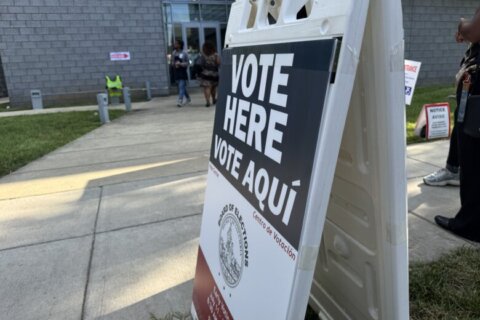
Follow WTOP’s team coverage of the D.C. primary and Election 2026 online, on air at 103.5 FM or on the WTOP News app.
Ahead of D.C.’s primary election in June, WTOP sent a questionnaire to all the candidates in each contested race, asking them to introduce themselves to voters, share their priorities and weigh in on some of the most pressing issues facing the District.
Candidates submitted their responses through an online form, and the answers published are verbatim.
The answers below are from Kinney Zalesne, who’s running for D.C. delegate against Trent Holbrook, Greg Jaczko, Brooke Pinto and Robert White.
- WTOP:
Please briefly describe your professional background. What is your current job, and what experience or skills best prepare you to serve in this role?
- Kinney Zalesne:
I’ve spent 30 years working in senior executive roles in all three sectors, public, private, and nonprofit, fighting on the national stage for D.C. and winning. As Counsel to U.S. Attorney General Janet Reno, I helped beat back Republican efforts to kill after-school programs, which when they were passed, helped drive down crime in D.C. faster and farther than ever. At the White House, I fought to make sure every school and library in D.C., especially in Wards 7 and 8, were wired for the internet. And as president of PeerForward, a nonprofit founded in Adams Morgan, I helped drive the college enrollment rate in D.C. from under 40% to over 60% — work that earned PeerForward a portion of Barack Obama’s Nobel Peace Prize money. I also served as General Manager of Corporate Strategy at Microsoft. I have spent my career building coalitions across partisan and institutional lines to get things done, which is exactly what the Delegate role demands.
- WTOP:
What are your top three priorities if you are elected?
- Kinney Zalesne:
First, protecting D.C.’s Home Rule and autonomy from federal overreach, which is immediate and urgent. Second, advancing D.C. statehood by building the national coalitions and inside congressional strategy needed to make it real. Third, fighting for affordability, housing, healthcare, and economic stability, so longtime D.C. residents aren’t pushed out of the city they built. All three are connected: D.C. can’t fully solve any of these problems as long as Congress can override our laws and control our budget.
- WTOP:
Congress still has the power to overturn D.C. laws, control the District’s budget and limit home rule. As delegate, what specific actions would you take right now to defend D.C.’s autonomy and home rule, even without full statehood?
- Kinney Zalesne:
Protecting Home Rule is my number one priority, and it requires raising the political cost of federal interference. As Delegate, I will use every committee assignment, hearing, and floor speech to expose and challenge attempts to override D.C. laws or control our budget, forcing members of Congress to defend those actions publicly. I will work with pro-democracy allies to ensure that attacks on DC are framed as attacks on democratic self-government
I will also create a Capital Caucus: a new Congressional partnership among D.C., Maryland, Virginia, and other regional leaders to build collective leverage against federal actions that undermine local control. Alone, D.C. is vulnerable; with aligned regional partners, we are significantly stronger. Behind the scenes, I will press leadership, engage appropriators, and mobilize allies early. My relationships at the DNC and across the Democratic caucus give me real access to the people who control what moves and what doesn’t.
D.C. must not be an easy target. I will make federal overreach visible, contested, and politically inconvenient for anyone who tries it.
- WTOP:
D.C. statehood enjoys strong local support but remains stalled on Capitol Hill. Beyond stating your support, what is your realistic plan to move statehood forward and how would you measure progress over a two‑year term?
- Kinney Zalesne:
Statehood requires sustained inside-outside pressure, and I have a concrete three-part plan: (1) targeted public education to turn D.C. residents and visitors into active advocates; (2) alliance-building across the Democratic Party to elevate statehood as a national democracy priority; and (3) careful stewardship of select Republicans with whom a “grand bargain” might be possible.
First-term metrics include: (1) increased activism for statehood inside D.C., across all layers of our city; (2) number of Democratic House and Senate members in the leadership and rank-and-file who are publicly committed to D.C. statehood; and (3) number of prospective Republican allies readier to find a grand bargain. The key is to build the groundwork over the next two years until Democrats can retake the White House. My job in my first term is to make sure we are ready to move the moment that window opens.
- WTOP:
Rising rent, home prices, and displacement are pushing long‑time residents out of the city. What federal policies would you prioritize to make housing more affordable in D.C., and how would you balance development with neighborhood stability?
- Kinney Zalesne:
I will push for increased federal investment in affordable housing production, including expanding Low-Income Housing Tax Credits and supporting community land trusts that permanently protect affordability. I will fight to restore and strengthen HUD funding and tenant protection programs that the current administration has cut or threatened.
On the development side, I will support transit-oriented, walkable, mixed-use development: dense housing centered around transit corridors, with retail, community amenities, and affordable units built in from the start rather than added as afterthoughts. I will also support modifying the Height Act to allow taller buildings outside the original L’Enfant federal city plan, creating new housing capacity while preserving the character of downtown D.C.
Balancing development with neighborhood stability means ensuring communities have a real voice in what gets built near them. Longtime residents shouldn’t have to choose between growth and stability. Smart federal policy makes both possible. I will fight for the tools and the funding to deliver both.
- WTOP:
The federal workforce is central to D.C.’s economy, and debates over telework and agency cuts directly affect residents. How would you advocate for D.C. workers and businesses while navigating pressure from Congress and federal agencies?
- Kinney Zalesne:
The federal workforce is D.C.’s economic backbone, and the reckless downsizing and instability of DOGE has hurt real people — federal workers, local businesses that depend on them, and the communities they anchor.
As Delegate, I will be a consistent and loud voice for federal workers, opposing politically motivated firings, defending collective bargaining rights, and pushing for bigger investments in needed retraining and reskilling. I will also fight to restore positions that have been eliminated through DOGE and other mechanisms, and oppose any effort to reclassify merit-based civil service positions as at-will political jobs.
I will also launch my proposed Capital Caucus to present a united regional voice against agency cuts and workforce decisions that destabilize the region’s economy.
For D.C. businesses hurt by this disruption, I will advocate for federal economic stabilization support and make sure small businesses have access to the programs they need to weather this period.
- WTOP:
The D.C. delegate cannot vote on the House floor. Why are you the best person to be effective within those limits, and how would you ensure D.C. residents still have real influence in Congress?
- Kinney Zalesne:
When you don’t have formal power, like when you’re D.C. on Capitol Hill, the way you get things done is by building relationships, forming coalitions, and making yourself impossible to ignore. That’s exactly what I have spent 30 years learning how to do.
As Delegate, I can vote in committee, introduce legislation, speak on the House floor, and use hearings to challenge policies that harm D.C. But beyond those procedural tools, the Delegate’s most powerful asset is access — to leadership, appropriators, committee chairs, and the members whose votes determine what moves. My career has put me in rooms with those people, and I know how to use those relationships to deliver real results.
Having served as DNC Deputy National Finance Chair and National Co-Chair of Women for Kamala Harris, I have senior relationships across the Democratic caucus. Indeed, three sitting Members of Congress, as well as and local, regional, and national leaders have endorsed me. The depth, breadth, and longstanding nature of those relationships will help me move bills, block riders, and get D.C. a seat at the table instead of being the meal on the table.
- WTOP:
Eleanor Holmes Norton has represented D.C. in Congress for 34 years. As someone seeking to take over a role she held for a generation, what parts of her legacy would you continue, and what would you do differently as the District faces a new political moment?
- Kinney Zalesne:
Delegate Eleanor Holmes Norton built the foundation for everything D.C. has today in Congress. For 34 years, she has made sure this city was seen, heard, and respected, often in spaces that were not designed to include us. Her legacy is one of persistence, credibility, and an unshakable belief in DC’s right to full democracy. I have deep respect for what she built, and as DNC Chair Jaime Harrison — who has known us both for decades — said in endorsing me; I am the candidate best suited to carry forward Norton’s spirit of strength, purpose, and relentless advocacy.
What I would continue: her fierce defense of Home Rule, her insistence on using every available lever of this office, and her commitment to DC statehood as a fundamental civil rights issue.
What this moment demands that is new: urgent, aggressive coalition-building with a national scope, and treating D.C.’s fight as central to the broader democracy movement, rather than as a local concern. The threats D.C. faces today require a Delegate ready to respond to a crisis from day one, with the national relationships to match the scale of what we’re up against.
- WTOP:
The deal to bring the Washington Commanders back to the RFK Stadium site includes commitments to housing and surrounding development. Do you support the agreement, and what would you do to make sure team ownership and development partners follow through on their pledges on housing, community investment and transparency?
- Kinney Zalesne:
I support the return of the Commanders to D.C. and the potential the RFK site represents for the surrounding community. This is a generational (and regional) opportunity to deliver real housing, jobs, and investment in a part of the city that has too often been overlooked.
But support is not a blank check. The commitments on affordable housing, community investment, and local hiring must be enforceable and transparent, not aspirational language that disappears once the deal closes.
As Delegate, I will use the oversight authority of my committee assignments to hold the federal government, the team, and development partners accountable to their commitments. I will also make sure Ward 7 and Ward 8 residents are at the table when decisions are made, not brought in after the fact.
The community surrounding RFK deserves to benefit from this development. I will make sure they do.
- WTOP:
What’s one D.C. place, tradition or moment that makes this city feel like home to you?
- Kinney Zalesne:
My husband and I met at the Van Ness Metro Station in 1996. It will always be our homebase!
- WTOP:
What’s something about you that voters would never learn from your résumé or campaign website?
- Kinney Zalesne:
As of this winter, I can do a side-crow yoga pose!
Get breaking news and daily headlines delivered to your email inbox by signing up here.
© 2026 WTOP. All Rights Reserved. This website is not intended for users located within the European Economic Area.