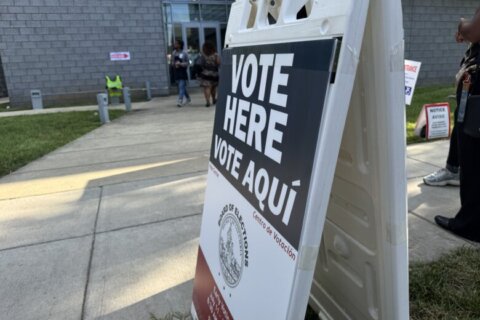
Follow WTOP’s team coverage of the D.C. primary and Election 2026 online, on air at 103.5 FM or on the WTOP News app.
Ahead of D.C.’s primary election in June, WTOP has sent a questionnaire to all the candidates in each contested race, asking them to introduce themselves to voters, share their priorities and weigh in on some of the most pressing issues facing the District.
Candidates submitted their responses through an online form, and the answers published are verbatim.
The answers below are from Jacque Patterson, who’s running in a special election to fill Kenyan McDuffie’s at-large seat on the D.C. Council for the remainder of the year. She’s running against Doni Crawford and Elissa Silverman.
- WTOP:
Please briefly describe your professional background. What is your current job, and what experience or skills best prepare you to serve in this role?
- Jacque Patterson:
Currently I serve as the president and At-Large Representative of the DC State Board of Eduction. Of the candidates in the D.C. Council At-Large (Independent) race, I am the most experience candidate having served in the administration of former Mayor Anthony Williams as a Capital City Fellow and community affairs coordinator. I served the District through my time in D.C. Government, at the Department Human Services , Office of Tax and Revenue, Department Health. and a Reserve MPD officer. I served as a mayoral appointee to the Housing Finance Agency, the Veteran Affairs Board and the Historic Preservation Review Board. Recently I served in executive roles at KIPP D.C. and Rocketship Public Schools.
- WTOP:
What are your top three priorities if you are elected?
- Jacque Patterson:
My top three priorities are:
1. Affordable Housing
2. Public Eduction
3. Public Safety
- WTOP:
Crime remains one of the top issues residents talk about, especially violent crime and youth‑involved offenses. At the same time, there are concerns about civil rights and over‑policing. As a Council member, what would you push for legislatively to improve public safety and how would you know those changes are actually working?
- Jacque Patterson:
As a former MPD Officer and with a clear understanding that MPD is at its lowest manning in 50 years with only 3,100 sworn officers, I would reinstitute the reserve MPD officer program. Currently MPD pays a disproportionate amount of public funds on MPD officer overtime. Budget projections confirm that this is unsustainable. By reconstituting the reserve MPD officer program, we can reduce overtime, realign officer demand to needed areas, and deploy reserve officers to youth events and targeted teen takeover areas. Effectiveness of reconstitution of the Reserve MPD Officer can be measured directly reduction in MPD overtime and morale of MPD officers.
- WTOP:
Some residents say youth‑involved crime cannot be solved by enforcement alone, while others worry there are not enough consequences when serious crimes occur. What role should the D.C. Council play in reducing youth‑involved crime, and how should prevention, intervention, and accountability work together? Please include where you stand on youth curfews and how, if at all, they should fit into a broader public safety approach.
- Jacque Patterson:
As a former leader in local education agency (LEA), I worked directly with our youth daily. Also as a representative on the DC State Board of Education, I interact with our student advisory council on a regular basis. What was expressed to me from youth was an anger in a disinvestment in youth programming (especially the arts) and out of school time funding. This disinvestment is the catalyst to teens expressing themselves in negative ways that disrupt commercial corridors with teen takeovers. While the disappointment by youth is understandable, the reaction can not be condoned. Council has a role to play when the mayor cuts the budget in areas such as behavioral health, out of school time programming at DPR, community schools models, and pay students less than a minimum wage during the summer jobs program. While we must hold teens accountable for violent crimes, we can not criminalize them for their response to disinvestment in youth programming. I agree with the zoned curfews until we can reinvest in youth programming. in the interim time, we have to fund and train violence interrupters to be the mediators in our communities. There still is a lot work that needs to be done in how violence interrupters coordinate with MPD, ANCs and community leaders to truly decrease violent activities in neighborhoods.
- WTOP:
The D.C. Council does not run schools directly but controls funding and oversight. How would you use that authority to improve outcomes in DCPS and public charter schools?
- Jacque Patterson:
Oversight of government performance and budgeting is the domain of the D.C. Council. In regards to public education, I would use oversight to ensure DCPS and charters are held accountable for closing the “proficiency” gap. Currently D.C. has a 79% graduation rate, but an abysmal 16% college and career readiness rate. Those are crisis numbers that can not continue. In the way of budgeting, we cannot allow the executive to create educational inequities between traditional and charter schools through funding schemes that goes around the USPFF. All funding for public schools, both traditional and charter, must be accomplished through the USPFF. They are all our children regardless of the type of public school they attend.
- WTOP:
Housing costs, including rents and home prices, have increased in many cities. What specific policies would you support regarding housing affordability, and how would you balance new development with protecting existing residents and neighborhoods?
- Jacque Patterson:
Currently, we do not fund the Housing Production Trust Fund at a level to meet the affordable housing needs of our city. We have funded it at $100 million annually since 2015, which is notable, but it is insufficient considering the rise in housing cost and limited housing stock. To increase the purchasing power our residents, we should raise this amount to $230 million annually to meet the needs of our lowest-income residents.
- WTOP:
Some residents have raised concerns about response times, service consistency, and follow‑through by District agencies. What role would you, as a Council member, play in using oversight and legislation to strengthen accountability and improve city services?
- Jacque Patterson:
As a Council member, strengthening accountability for D.C. government agencies requires a dual approach of rigorous performance oversight and proactive legislation, focusing on enhancing response times and service consistency. Key Council actions that must be aggressively deployed to hold agencies accountable to residents must include leveraging annual performance hearings, demanding data-driven accountability from agency directors, and fostering resident participation at council roundtables, performance oversight and budget hearings.
- WTOP:
The Council has a major say in how the city spends its money. When the budget is tight, what should come first, and how would you decide which programs get protected and which don’t?
- Jacque Patterson:
As D.C. prepares to face some of the most constrained budgets since the Financial Control Board went domant, council members must prioritize core, non-negotiable services that ensure safety and basic functionality over discretionary, high-cost projects. The decision-making process should be driven by a clear, pre-defined set of principles rather than political pressure, utilizing data and public input to make tough choices.
- WTOP:
Because Congress has authority to review and overturn District laws, what do you see as the Council’s role in addressing congressional involvement in local governance? How assertive, if at all, should Council members be in advocating for home rule?
- Jacque Patterson:
The D.C. Council’s role involves navigating a delicate balance of enacting pragmatic local legislation while engaging in strategic, assertive advocacy to protect the autonomy granted by the District of Columbia Home Rule Act. The Council, which plays the role of a city council and state legislature, operates under the constant threat of congressional intervention, which can overturn local laws or impose federal policies through riders in appropriations bills. This makes it paramount that Council works hand-in-glove with the mayor, attorney general and delegate to ensure it is taking a balanced and strategic approach to lawmaking. Our constitutional status as a federal enclave does not allow for us to be politically divided when it comes to protecting Home Rule. The goal is to move from Home Rule to Statehood.
- WTOP:
From buses and Metro to traffic safety and street conditions, transportation complaints come up across the city. What changes or investments would you focus on to improve how people get around D.C.?
- Jacque Patterson:
To improve transportation in D.C., we must focus on areas that include accelerating dedicated bus lanes and expanding WMATA/MARC services to reduce commute times, particularly East of the River. Investing in safety through redesigned streets, enhanced pedestrian infrastructure, and increased bus shelters to ensures a more equitable, reliable, and accessible network for all residents.
- WTOP:
Development can involve tradeoffs between growth, neighborhood input, and quality of life. How would you approach development decisions, so neighborhoods have a meaningful voice while the city continues to grow?
- Jacque Patterson:
As the only former Advisory Neighborhood Commissioner in the D.C. Council At-Large Independent race, I understand the vital role ANC’s play in our government. They have statutory “great weight” in decisions made about their communities for a reason. As a councilmember, especially an At-Large Councilmember, my approach to balancing growth, neighborhood input, and quality of life would start with ANCs and the commissions they serve on. I practice a simple rule when it comes to community engagement, “those closest to the problem or concern, are closest to the solution.”
- WTOP:
How would you approach the relationship between the Council and the mayor, particularly with respect to collaboration and oversight?
- Jacque Patterson:
As a councilmember, my job is to conduct oversight of government agencies and be a steward of public funds. I believe too many council members base their relationship with the mayor on their political aspirations rather than their responsibilities as council members. My relationships, when it comes to being a councilmember, will never be dictated by personal likes or dislikes, but on the will of D.C. residents. If I keep my focus on my responsibility as a councilmember, I believe I can build a strong working relationship with the mayor and her team as well as my colleagues on the council.
- WTOP:
Residents continue to raise concerns about D.C.’s 911 system, from long wait times to delayed emergency response. What should the Council’s role be in fixing these problems, and what specific changes would you push for to make the system more reliable?
- Jacque Patterson:
Professional development is what is needed to raise the performance of D.C.’s 911 system. The 911 emergency response system is critical to life or death situations, yet we have seen a lapse in the recruitment and professional development of the individual who work at the UCC. As a result, we are experiencing the problems and concerns being raised by residents. My push, through performance oversight, would be to work with DCHR and department leadership to ensure we are selecting the right people for this critical job and providing them with the proper professional development to ensure they can perform their jobs at the required and expected standard.
- WTOP:
Concerns about ethics and accountability at the D.C. Council have repeatedly surfaced in recent years. As a Council member, how would you help rebuild public trust and what should happen when members violate ethical standards?
- Jacque Patterson:
As a D.C. Council member in 2026, rebuilding public trust requires a commitment to radical transparency, proactive constituent engagement, and unwavering accountability, particularly as the Council faces a period of significant leadership turnover. When members violate ethical standards, the response must be swift, public, and firm.
- I would advocate for legislation that empowers BEGA to investigate and, in cases of severe violation of the Code of Conduct, have the authority to recommend expulsion.
- All investigations into misconduct should be conducted by independent bodies, such as an inspector general or an expanded city auditor, to eliminate conflicts of interest.
- I would support rigorous, continuous ethics training for all council members and staff to ensure they understand their obligations and the latest BEGA guidelines.
- All ethics investigations and their outcomes must be made public to ensure accountability, rather than allowing matters to be handled in secret.
- Any member convicted of a crime, such as bribery, should be immediately removed from their seat, as advocated by those calling for accountability in the wake of federal investigations.
- WTOP:
At‑large Council members represent the entire city, not a single ward. How would you balance citywide priorities with the distinct needs of different neighborhoods, and what issues do you believe at‑large members should focus on that ward members cannot?
- Jacque Patterson:
As an At-Large D.C. Council members that represent the entire city, it is incumbent that the member balance citywide priorities with neighborhood needs by focusing on systemic, long-term policy that impacts everyone, such as citywide housing affordability, transportation infrastructure, and the budget, as they assist Ward council members adress rconstituent services. At-Large members must analyze how local issues fit into citywide policy, such as ensuring that by-right zoning changes (discussed in recent debates) are applied equitably to address housing needs across all eight wards. At-Large members are responsible for advocating for historically underserved areas, such as East of the River, while maintaining the infrastructure and services that attract tax revenue in other parts of the city. Balancing priorities requires meeting with Advisory Neighborhood Commissions (ANCs) across all wards to find common ground on issues like public safety or the expansion of childcare subsidies. As the Council handles the entire D.C. budget, At-Large members must prioritize fiscal responsibility, as Ward council members, advocate for Ward specific concerns, ensuring city services are sustainable and equitable.
- WTOP:
What’s one place, tradition, or moment that makes D.C. feel like home to you?
- Jacque Patterson:
The Frederick Douglass home in Ward 8. It sits on a beautiful bluff in Historic Anacostia that allows you to look across the Anacostia River at the rest of the city and reflect on the history of our city and the work that remains to be done. Frederick Douglass was an unapologetic advocate for racial and social justice visiting his home, Cedar Hill, inspires me and reinvigorates me to be public servant in his tradition.
- WTOP:
What’s something about you that voters would never learn from your résumé or campaign website?
- Jacque Patterson:
The one thing voters can’t learn from my campaign website or resume is that in 2004, I entered a Ward 8 Council race thinking I was running against the incumbent, Sandy Allen, only to have Marion Barry make a comeback in the same race. I was trounced, but it was the best experience I ever had in learning while losing as I learned why Marion Barry will forever be know as the people’s champion.
Get breaking news and daily headlines delivered to your email inbox by signing up here.
© 2026 WTOP. All Rights Reserved. This website is not intended for users located within the European Economic Area.