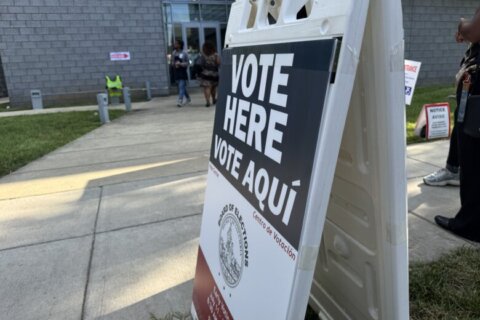
Follow WTOP’s team coverage of the D.C. primary and Election 2026 online, on air at 103.5 FM or on the WTOP News app.
Ahead of D.C.’s primary election in June, WTOP has sent a questionnaire to all the candidates in each contested race, asking them to introduce themselves to voters, share their priorities and weigh in on some of the most pressing issues facing the District.
Candidates submitted their responses through an online form, and the answers published are verbatim.
The answers below are from Doni Crawford, who’s running in a special election to fill Kenyan McDuffie’s at-large seat on the D.C. Council for the remainder of the year. She’s running against Elissa Silverman and Jacque Patterson.
- WTOP:
Please briefly describe your professional background. What is your current job, and what experience or skills best prepare you to serve in this role?
- Doni Crawford:
I currently serve as the At-Large Councilmember for the District of Columbia, appointed unanimously in January 2026. Before that, I spent nearly a decade inside D.C. government and policy, including as Committee Director for the Council’s Committee on Business and Economic Development, where I led budget oversight and advanced legislation supporting small businesses, commercial corridors, and inclusive economic growth. I played a central role in negotiating the Commanders stadium redevelopment deal, securing community benefits, local hiring requirements, and accountability measures. Prior to joining the Council, I was a senior policy analyst at the D.C. Fiscal Policy Institute, where I authored research on racial and economic inequality and helped secure $41 million in pandemic relief for excluded workers. I hold a Master of Public and International Affairs from the University of Pittsburgh. My experience spans budget analysis, legislative drafting, agency oversight, and economic development. I know how DC government works from the inside, and I know where it falls short.
- WTOP:
What are your top three priorities if you are elected?
- Doni Crawford:
My top three priorities are affordable housing, public safety, and protecting D.C.’s home rule. On housing, I will work to expand production, fix the Inclusionary Zoning process, and make the Home Purchase Assistance Program a real pathway to homeownership. On public safety, I support investing in community violence intervention alongside an adequately staffed, well-trained police department. On home rule, Congress has already limited our ability to make decisions over roughly $700 million of our own budget. DC residents deserve full control over their city, and I will work every day to protect and advance it.
- WTOP:
Crime remains one of the top issues residents talk about, especially violent crime and youth‑involved offenses. At the same time, there are concerns about civil rights and over‑policing. As a Council member, what would you push for legislatively to improve public safety and how would you know those changes are actually working?
- Doni Crawford:
Right now, MPD is doing the job of hundreds more officers than it actually has and doing it in the most expensive way possible: overtime. In FY 2025, MPD used over 1.81 million overtime hours, the equivalent of roughly 870 additional officers, at a cost of over $133 million. We could have paid under $88 million by simply hiring them. I will press to right-size the force, consolidate community violence intervention programs for greater efficiency, and require greater transparency between MPD and the communities it serves.
In addition, I believe that enforcement alone is not enough. Crime is connected to housing instability, limited job opportunities, and young people without structured places to be. Investing in those conditions is not soft on crime. It is how you reduce it sustainably. I will also ensure MPD is never used as a tool of federal immigration enforcement, because residents cannot report crimes or cooperate with police when they fear the interaction. Knowing whether changes are working means tracking more than crime numbers. Response times, use-of-force data, community trust measures, and outcomes from intervention programs all have to be reported publicly and consistently.
- WTOP:
Some residents say youth‑involved crime cannot be solved by enforcement alone, while others worry there are not enough consequences when serious crimes occur. What role should the D.C. Council play in reducing youth‑involved crime, and how should prevention, intervention, and accountability work together? Please include where you stand on youth curfews and how, if at all, they should fit into a broader public safety approach.
- Doni Crawford:
Young people who commit serious offenses need to face accountability. I also believe the consequences we enforce as a District should be designed to rehabilitate our youth and lead to real behavioral change. Accomplishing accountability and rehabilitation do not have to be in conflict.
The Council’s job is to make sure both stronger prevention and accountability policies and practices are well-funded. That means supporting out-of-school time programs, which consistently have more demand than available seats, and protecting the School-Based Behavioral Health Program, which places clinicians in D.C. public and charter schools. Cutting supports for youth costs us elsewhere: in emergency rooms, in courtrooms, and in communities.
On youth curfews, many of the residents I’ve talked to support curfews as one tool in a broader approach. In April, I successfully introduced amendments to the permanent youth curfew bill requiring that programming be provided whenever a curfew zone is established, and that officers have defined limits on their discretion. If we are telling young people where they cannot be, we owe them a real answer for where they can be. That is the standard I will apply going forward.
- WTOP:
The D.C. Council does not run schools directly but controls funding and oversight. How would you use that authority to improve outcomes in DCPS and public charter schools?
- Doni Crawford:
What I hear most from parents, students, and educators’ concerns issues such as chronic absenteeism, mental health crises, the literacy gap, and whether young people can see a clear path from school to a real career. I will use the Council’s budget authority to protect the School-Based Behavioral Health Program, which places clinicians in both DCPS and charter schools. With more students navigating anxiety, trauma, and unstable home situations than ever, removing that support would be a serious mistake.
I also believe D.C. has to do more to connect school to what comes next. As a Council staffer, I co-drafted the Budget Support Act subtitle in the FY 2025 budget that created the “From Education to Opportunity” study, which examined gaps between traditional vocational education offerings and newer career and technical education programs. That work put the District on a path toward stronger workforce pathways and better data systems so students and families can actually see what options exist after graduation.
On literacy, I support evidence-based reading instruction and early intervention before gaps become impossible to close. I’m also interested in ensuring that the District has a clear district-wide AI policy that reinforces foundational literacy skills rather than replacing them.
- WTOP:
Housing costs, including rents and home prices, have increased in many cities. What specific policies would you support regarding housing affordability, and how would you balance new development with protecting existing residents and neighborhoods?
- Doni Crawford:
Too many D.C. residents cannot afford to stay in a city they helped build. I have lived this as a renter, and I have studied it and stood alongside affordable housing advocates to push the D.C. Council to do more and to do better. Both experiences point to the same conclusion: we need more housing at more affordable price points, and we need to stop letting process get in the way of us using the many tools we have to house people.
The Housing Production Trust Fund is legally required to direct half its money toward the lowest-income residents, and that requirement has not always been honored. I will press to hold that line. I also support raising the affordable housing requirement on District-owned land from 30 to 35 percent, and fixing the Inclusionary Zoning process so affordable units stop sitting empty while families sit on waitlists.
Building more is not enough on its own. Longtime residents, including working-class homeowners on fixed incomes who have lived in their neighborhoods for decades, are being priced out. I support the Single Family Residential Rehabilitation Program and the Home Purchase Assistance Program as real pathways to stability and homeownership. Additionally, I want to see more missing middle housing, duplexes and small apartment buildings, and greater density across the District to meet our housing demand.
- WTOP:
Some residents have raised concerns about response times, service consistency, and follow‑through by District agencies. What role would you, as a Council member, play in using oversight and legislation to strengthen accountability and improve city services?
- Doni Crawford:
The Council’s oversight function is underused. Committees typically conduct serious oversight only during the January-February performance hearing window, and that is not enough to hold agencies accountable the other ten months of the year. I will push for ongoing, year-round oversight capacity and support an expenditure review commission made up of independent experts who can give the Council a clear read on whether programs are actually working, before we cut or expand them.
Take MPD as an example. In FY2025, the department logged over 1.81 million overtime hours. Spread across a 40-hour work week, that is roughly the equivalent of 870 additional officers, except we are paying existing officers at time-and-a-half instead of hiring. That kind of spending pattern does not surface in a February hearing. It requires consistent, ongoing scrutiny.
When residents contact my office about problems with agencies, that tells me exactly where follow-through is breaking down. My staff is trained to take those concerns seriously and route them to the right place. As a Councilmember, one of my responsibilities is to make sure agencies can account for what they are doing and why. Pressing agencies on outcomes, not just intentions, is a core part of what this seat is for.
- WTOP:
The Council has a major say in how the city spends its money. When the budget is tight, what should come first, and how would you decide which programs get protected and which don’t?
- Doni Crawford:
When the budget is constrained, as it is currently, it’s important that we examine existing spending to see if there are efficiencies we can realize before enacting drastic cuts. Before asking residents to absorb cuts, I want a clear assessment of what is working and what is not, so we can redirect resources toward programs that actually produce results.
My second approach is to look at where we are leaving money on the table. The District has a history of offering tax abatements that drained revenue without delivering proportional community benefit. Restructuring those agreements and closing loopholes are ways to recover revenue before cutting services that families depend on.
When cuts are unavoidable, I said at my very first Mayor-Council breakfast that the health and human services cluster cannot solely bear the weight of our fiscal constraints. That is not just a values statement. It is a practical one. Federal job losses are already straining the same families those programs serve. Before cutting health care or emergency rental assistance, every other part of the budget has to be scrutinized with the same rigor. My background in budget analysis means I know how to read an agency’s numbers, ask the right questions, and identify where spending can be made more effective before we reach for either cuts or new revenue.
- WTOP:
Because Congress has authority to review and overturn District laws, what do you see as the Council’s role in addressing congressional involvement in local governance? How assertive, if at all, should Council members be in advocating for home rule?
- Doni Crawford:
Congress has already limited our ability to make decisions over roughly $700 million of our own budget. This means programs D.C. residents depend on are subject to federal override, regardless of what the people who live and pay taxes here want. D.C. residents pay federal taxes, serve in the military, and contribute to this country fully, without a full vote in Congress or complete control over their local government. This must change.
I hit the ground running on this from my first days on the Council. One of my first meetings was with D.C.’s Shadow Senator to align on statehood strategy. I co-introduced emergency legislation requiring full identification of all officers at the scene of an arrest, including federal agents, because protecting residents from federal overreach requires immediate action.
Moving forward, D.C. officials must be strategic as we navigate threats by the current administration and Congress. I have called for the Council to establish a dedicated federal relations office, so we have consistent, year-round relationships with members of Congress before crises hit, not just in response to them. Statehood requires sustained advocacy, and I will not stop pushing for it.
- WTOP:
From buses and Metro to traffic safety and street conditions, transportation complaints come up across the city. What changes or investments would you focus on to improve how people get around D.C.?
- Doni Crawford:
Getting around D.C. should not be hard. Metro needs stable, adequate funding to deliver consistent service. Bus coverage needs to expand beyond major corridors, so residents are not walking unreasonable distances just to reach a stop. I would work with WMATA to identify those gaps and close them.
I also support expanding the District’s e-bike incentive program to more residents, including public servants who currently do not qualify. Safe streets and protected bike infrastructure make the whole system work better, including for drivers.
Before the District places additional financial burdens on drivers, it needs to make sure people—namely residents east of the river—who rely on their cars by necessity, not by choice, have real transit alternatives.
- WTOP:
Development can involve tradeoffs between growth, neighborhood input, and quality of life. How would you approach development decisions, so neighborhoods have a meaningful voice while the city continues to grow?
- Doni Crawford:
Community engagement should happen early in project planning, not as a final formal step. That means outreach that actually reaches renters, seniors, working families, and small business owners. I have already introduced the Fiscal Accountability and Homeownership Opportunity Act of 2026 to ensure tax incentives deliver real benefits and are withdrawn if projects stall, redirecting unused abatements to more effective uses.
I support building more housing across every ward, including duplexes, triplexes, and small apartment buildings in neighborhoods currently zoned only for single-family homes. I want to reform Inclusionary Zoning to follow the Montgomery County model, where eligible tenants apply directly through the housing provider rather than navigating a cumbersome lottery. For seniors who want to age in place, I will press for stronger investment in home repair programs like the Single Family Residential Rehabilitation Program. And I want to make the Home Purchase Assistance Program a real and reliable pathway to homeownership, not a long shot.
Preserving longtime residents’ ability to stay as development occurs requires specific, enforceable commitments at every stage. Displacement does not happen all at once, and preventing it cannot be treated as an afterthought.
- WTOP:
How would you approach the relationship between the Council and the mayor, particularly with respect to collaboration and oversight?
- Doni Crawford:
The Council and the mayor have to be able to work together, and that starts with honest, early communication. At my first Mayor-Council breakfast, I said directly that in a constrained budget environment, the District cannot make cuts solely to health and human services. That is the kind of engagement I think is productive: specific, early, and on the record.
I believe that Councilmembers and the executive should be in the room together working through tradeoffs as early as possible. I spent years on both sides of that relationship, as a senior budget and policy researcher at DCFPI working to advance investments with the executive and Council, and as a Council staffer conducting oversight of executive agencies. That experience shapes how I approach both sides of this.
When a new mayor takes office in January 2027, the Council will confirm a significant number of new agency heads. I will use those hearings to press nominees on their track records and concrete plans. Those appointments shape how services reach residents and getting them right matters as much as any legislation the Council will pass that year.
- WTOP:
Residents continue to raise concerns about D.C.’s 911 system, from long wait times to delayed emergency response. What should the Council’s role be in fixing these problems, and what specific changes would you push for to make the system more reliable?
- Doni Crawford:
D.C. has one of the busiest 911 call centers in the nation. The volume of calls has grown significantly while the capacity of the system has not kept pace. That is a serious problem.
The Council’s role is to use budget and oversight authority to actually fix it. That means pressing for staffing levels that match demand, investing in technology modernization, and reviewing whether fire and emergency service resources are keeping up with the growth of our city. I support growing the Fire and EMS Department to meet rising call volumes.
Council oversight is also critical. Wait time data, response time data, and dispatch accuracy should be reported consistently and publicly so the Council can identify where the system is failing and act before someone pays for it with their life.
- WTOP:
Concerns about ethics and accountability at the D.C. Council have repeatedly surfaced in recent years. As a Council member, how would you help rebuild public trust and what should happen when members violate ethical standards?
- Doni Crawford:
When I was appointed, one of the first things I did was call every ANC chair across the District, starting with the wards that are often deprioritized in Council business. I heard from a number of chairs that no at-large member had done that before. That told me something about the gap between how the Council operates and what residents actually expect from their representatives.
I have also held office hours in the majority of wards across the District, not to deliver a message but to hear directly from residents about what is and is not working. That kind of consistent, direct engagement is how you start to close the distance between the Council and the people it serves.
On ethics, elected officials are bound by the law, full stop. I will abide by all ethics laws and uphold that standard in how I conduct myself in office.
- WTOP:
At‑large Council members represent the entire city, not a single ward. How would you balance citywide priorities with the distinct needs of different neighborhoods, and what issues do you believe at‑large members should focus on that ward members cannot?
- Doni Crawford:
Before joining the Council, I spent years at the D.C. Fiscal Policy Institute doing budget and policy research that was inherently citywide in scope. Pushing to increase investments in the Housing Production Trust Fund, Baby Bonds, and pandemic relief for excluded workers meant understanding how resources were and were not reaching residents across all eight wards. That is the lens I bring to this seat.
The at-large seat is where you take on the citywide policy failures that show up as local problems. When small businesses along a neighborhood corridor are struggling, that is partly local, but it is also a regulatory and permitting problem that plays out in every ward. When a school is overcrowded because development outpaced planning, that is a local facilities problem, but it is also a failure of how we coordinate land use and school capacity across the whole city. Those are exactly the kinds of cross-cutting problems where an at-large member should be pressing.
I came into this role having spent nearly a decade working inside the Wilson Building on these issues. I know how the budget works, how legislation moves, and how to build the coalitions to get things done.
- WTOP:
What’s one place, tradition, or moment that makes D.C. feel like home to you?
- Doni Crawford:
During COVID, my best friend and I started walking the wards as a way to get out of the house. We never stopped. What keeps drawing me back is the historical markers scattered across the city, the ones most people walk past without a second glance. Each one is a small window into what this place was before it became what it is now. For a history nerd like me, that never gets old. D.C. reveals itself slowly, and that’s exactly why it feels like home.
- WTOP:
What’s something about you that voters would never learn from your résumé or campaign website?
- Doni Crawford:
I am grateful that I have been able to see as much of the world as I have. When traveling internationally, I have a rule: one country, one visit. There is too much world to see and not enough time to see any of it twice, so I keep moving. It is just how I think about time, it is finite and you have to be intentional with it. I bring that same mindset to this job. There is too much work to do to waste time on anything that does not move the needle for residents.
Get breaking news and daily headlines delivered to your email inbox by signing up here.
© 2026 WTOP. All Rights Reserved. This website is not intended for users located within the European Economic Area.