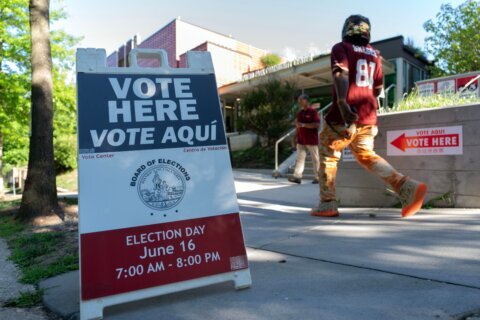
Follow WTOP’s team coverage of the D.C. primary and Election 2026 online, on air at 103.5 FM or on the WTOP News app.
Ahead of D.C.’s primary election in June, WTOP has sent a questionnaire to all the candidates in each contested race, asking them to introduce themselves to voters, share their priorities and weigh in on some of the most pressing issues facing the District.
Candidates submitted their responses through an online form, and the answers published are verbatim.
The answers below are from Elissa Silverman, who’s running in a special election to fill Kenyan McDuffie’s at-large seat on the D.C. Council for the remainder of the year. She’s running against Doni Crawford and Jacque Patterson.
- WTOP:
Please briefly describe your professional background. What is your current job, and what experience or skills best prepare you to serve in this role?
- Elissa Silverman:
All of the jobs over my career have had a similar North Star: improving the lives of working people, elevating their voices in the public debate, and holding those in power accountable. I previously served two terms (2015 – 2023) as an independent at-large member of the D.C. Council, known for being the lead champion of D.C.’s paid family leave program and a budget hawk laser focused on making sure we get a good return on investment for our taxpayer dollars. I also worked for the Maryland Department of Labor during the Francis Scott Key Bridge collapse, helping workers at the Port of Baltimore financially survive that difficult time. Prior to my service in government, I worked for the D.C. Fiscal Policy Institute, analyzing the city’s budget and advocating for programs that help D.C. workers. I began my career in the District of Columbia as a journalist, working for both the Washington City Paper and the Washington Post.
- WTOP:
What are your top three priorities if you are elected?
- Elissa Silverman:
1. Protecting our neighbors, our civic institutions, and our economy from President Trump and the Republican Congress in strategic and smart ways.
2. With Trump dragging down our economy, we need to use our resources efficiently and effectively. The D.C. Council needs to make sure our $22 billion budget delivers programs that work, make residents’ lives better, and make our local businesses stronger.
3. We must be laser-focused on reducing truancy, which shows one-in-three public school students chronically absent. We also need our school day to work for our working families, which means making childcare affordable, as well as making out of school time, afterschool programs free.
- WTOP:
Crime remains one of the top issues residents talk about, especially violent crime and youth‑involved offenses. At the same time, there are concerns about civil rights and over‑policing. As a Council member, what would you push for legislatively to improve public safety and how would you know those changes are actually working?
- Elissa Silverman:
I will push for MPD and our public safety agencies to follow evidence-based practices. From what I understand from experts who’ve looked at our approaches, there are a few big things we need to do better.
1. We need to better identify and focus on the people who are known troublemakers, those likely to pull a trigger on a gun. There needs to be coordination between MPD and our housing, workforce, and social services agencies on offering a better alternative in either earning money or settling disputes. If a violent crime is committed, MPD and the U.S. Attorney’s Office need to work together to make sure there are swift and certain consequences so there is a disincentive for committing a crime, especially if a life is lost.
2. We are facing staffing competition from federal law enforcement and surrounding jurisdictions, and low morale. That’s why our force numbers are dropping. And due to those numbers, we now spend tens of millions of dollars on overtime every year. We’re running our existing officers ragged, with many facing mandatory overtime due to understaffing. We need to staff our force, especially in certain areas such as detectives.
3. Finally, we need to follow best practices and implement the recommendations from the Auditor’s report on staff and the police reform commission so that MPD keeps all of us safe and some residents don’t feel targeted.
- WTOP:
Some residents say youth‑involved crime cannot be solved by enforcement alone, while others worry there are not enough consequences when serious crimes occur. What role should the D.C. Council play in reducing youth‑involved crime, and how should prevention, intervention, and accountability work together? Please include where you stand on youth curfews and how, if at all, they should fit into a broader public safety approach.
- Elissa Silverman:
Again, I think we need to follow best practices: tracking through social media and working with our young people on who are the troublemakers–then focus our efforts on addressing their behavior and keeping the rest of the teens and everyone else safe. We need to limit their troublemaking and address it swiftly but not create an us vs. them dynamic.
I spoke with some seniors at Thurgood Marshall Academy why they go to Navy Yard–they want to eat burritos at Chipotle, window shop, and record their get togethers on TikTok and so forth. I support the curfew if it is paired with real alternative activities for our young people. Hanging out on weekend and summer nights is part of growing up. The curfew is a tool to redirect our young people away from these chaotic teen takeovers… but it has to be towards something they want to do. Maybe its late-night programming at rec centers, free concerts, parking lot pop-ups, or mobile gaming tournaments. We should listen to our teens what they think is an effective alternative.
- WTOP:
The D.C. Council does not run schools directly but controls funding and oversight. How would you use that authority to improve outcomes in DCPS and public charter schools?
- Elissa Silverman:
Right now, the focus is on how much we spend per pupil but not on how much we spend to get the outcomes we want in reading and math and critical thinking in general. I’d go back to a fundamental principle in reporting: follow the money. I tried doing that in my prior terms on the Council, and it was like a corn maze. We need to follow what our experts in primary and secondary education recommend. But as I mentioned in my prior answer, all the money and all the best practices are ineffective if our kids are not in the classroom. We can’t throw up our hands to our truancy problem: We need our kids in school. Again, I would follow the advice of experts of how to get our kids back in the classroom. School needs to be the center of gravity for our young people, the place where they can rely on trusted adults to help them learn, develop, and grow. Some of our kids don’t feel safe and secure at home, and school needs to be that place for them.
- WTOP:
Housing costs, including rents and home prices, have increased in many cities. What specific policies would you support regarding housing affordability, and how would you balance new development with protecting existing residents and neighborhoods?
- Elissa Silverman:
We need to take a multi-pronged approach. We need to build more and make it easier to build, but we need to be intentional in building for our needs as a city. We need to administer our voucher programs much, much better. The District has more than 20,000 vacant housing units across the city. Let’s figure out how to get those units back onto the market, providing stable housing to our residents, income for landlords, and tax revenue for the city. We also need to take advantage of the public lands we have as part of our D.C. Housing Authority, and redevelop those properties to keep current communities intact but modernize and increase their density.
- WTOP:
Some residents have raised concerns about response times, service consistency, and follow‑through by District agencies. What role would you, as a Council member, play in using oversight and legislation to strengthen accountability and improve city services?
- Elissa Silverman:
The Council needs to do oversight, ask the tough questions, and propose legislation if needed to fill gaps. We need to focus on the basics: getting trash picked up on time, answering 911 efficiently and effectively, and helping our residents and businesses efficiently get permits. I read that San Francisco is using AI to streamline regulations and reduce redundancy in local law. That is innovative. We also need to realize that most of our residents and businesses now interact with government through technology. We need a top-flight Office of the Chief Technology Officer to create great apps and websites. I learned this through creating Paid Family Leave: focus on the users and how they interact with the technology.
- WTOP:
The Council has a major say in how the city spends its money. When the budget is tight, what should come first, and how would you decide which programs get protected and which don’t?
- Elissa Silverman:
We need to fund what works, what makes life better in D.C., what moves our city forward, and we need to stop giving money to programs that don’t work, don’t deliver good services, and don’t move our city forward.
- WTOP:
Because Congress has authority to review and overturn District laws, what do you see as the Council’s role in addressing congressional involvement in local governance? How assertive, if at all, should Council members be in advocating for home rule?
- Elissa Silverman:
I will work strategically with my Council colleagues, the mayor and our Delegate to Congress, with the goal always to protect our residents and our local democracy.
And I will also be firm in working with my fellow D.C. elected officials to do much better at standing up for what we believe in. Our police department is still working with federal authorities on immigration enforcement: That needs to stop. We need to defend our city’s values, follow our local law, and work with our allies in Congress to do so while understanding the bigger issues at play.
I will also advocate for the Council beefing up its efforts to work with Congress. We need to work hand in hand with Eleanor Holmes Norton now and our new delegate in the future. In the past, Congress was an afterthought, if the Council ever thought about it at all. Today, the Council needs to be more proactive and better at identifying potential problems with Congressional review before D.C. bills hit the House or Senate floor. We need more D.C. government staff working with Congress, like every other state has, lobbying for our issues and needs.
- WTOP:
From buses and Metro to traffic safety and street conditions, transportation complaints come up across the city. What changes or investments would you focus on to improve how people get around D.C.?
- Elissa Silverman:
The focus needs to be on making sure that people can travel within the city safely and efficiently. I am a big believer in WMATA and our Metrorail and Metrobus system. We need to work with our fellow jurisdictions in the compact to fund it fully and fairly, and, as well, work with General Manager Randy Clarke to make Metro safe and reliable. That’s what will get people out of their own cars or ride-sharing vehicles. But sometimes, for various reasons, you might want to drive your own vehicle and we need roads to be safe for both cars, bikes, and pedestrians. I do think we need to address electric bikes, and better delineate and then enforce where they can travel.
- WTOP:
Development can involve tradeoffs between growth, neighborhood input, and quality of life. How would you approach development decisions, so neighborhoods have a meaningful voice while the city continues to grow?
- Elissa Silverman:
This is where an at-large member can play a key role by seeing how a development is beneficial for the city as a whole.
- WTOP:
How would you approach the relationship between the Council and the mayor, particularly with respect to collaboration and oversight?
- Elissa Silverman:
The North Star for both the mayor and the Council needs to be a government that works efficiently and effectively to better the lives of residents and create an economy that provides opportunity in the present and into the future. When it comes to Home Rule, the mayor and Council need to get on the same page when dealing with Congress. As far as our own government operations, the Council needs to perform its job of oversight to hold the mayor and executive agencies accountable. Again, the focus needs to be on a government that works and makes life better for all in D.C.
- WTOP:
Residents continue to raise concerns about D.C.’s 911 system, from long wait times to delayed emergency response. What should the Council’s role be in fixing these problems, and what specific changes would you push for to make the system more reliable?
- Elissa Silverman:
The Council’s role is vigorous oversight to make sure that this life-saving agency does not lose a life or cause more harm due to dysfunction, including shortcomings in procedure or staffing.
As your next at-large Councilmember, I would work with the Council’s Chair of the Judiciary Committee and the agency leadership to make sure 911 functions properly. That means understanding how our 911 call center works, how the calls get assigned to call takers, coded, prioritized and dispatched. I did this when I previously served on the Council, and many of the issues raised by the D.C. Auditor are concerns that I had visiting the center. We need to work with the front line staff and cooperating agencies such as MPD and FEMS to better coordinate service. Another thing we need to explore is how to smartly use Artificial Intelligence and geotracking to improve services. I believe some of our surrounding jurisdictions are exploring this.
- WTOP:
Concerns about ethics and accountability at the D.C. Council have repeatedly surfaced in recent years. As a Council member, how would you help rebuild public trust and what should happen when members violate ethical standards?
- Elissa Silverman:
Sunlight is the best disinfectant.
I am a former reporter, and I believe the Council should conduct the public’s business in the public eye so it can be documented and decision makers can be held accountable. I would work with the Council Chair and my colleagues on the Council to limit closed door meetings to only those involving proprietary information, such as in a business negotiation, and personnel issues. That is how we restore the public’s trust. If a member is accused of an ethics violation or breaking the law, it should be investigated fairly and dealt with swiftly and referred to the appropriate investigative authorities.
- WTOP:
At‑large Council members represent the entire city, not a single ward. How would you balance citywide priorities with the distinct needs of different neighborhoods, and what issues do you believe at‑large members should focus on that ward members cannot?
- Elissa Silverman:
We have a hybrid Council, so that ward members can focus on specific geographic parts of the city and at-large members can take a citywide view. That is especially important on issues of economic development and affordable housing, because at-large members can assess whether these projects benefit the city overall and not just the ward. You can also be an asset as an assist leader. In my previous two terms on the Council, I advocated with ward members and their constituents, being that second voice to DPW to get trash picked up or working with parent/teacher associations to move up a school modernization and help find the money in the budget. This is a diverse city, and I really enjoy assessing whether a law or program is beneficial overall, advancing equity and making sure this makes D.C. Better For All.
- WTOP:
What’s one place, tradition, or moment that makes D.C. feel like home to you?
- Elissa Silverman:
One of my favorite D.C. moments is taking the yellow line Metro train across the Potomac River. You come out of the darkness of the tunnel and into the light, passing the Jefferson Memorial on the left as the train glides above the river. Especially if I’m taking Metro home from a plane that landed at National Airport, I have a feeling come over me that I am home. It always feels good.
- WTOP:
What’s something about you that voters would never learn from your résumé or campaign website?
- Elissa Silverman:
When I was working to pass paid family leave, I decided to learn how to make balloon animals. Kids love them, and I could talk to their parents about paid leave while they waited for me to make a dog or a light saber. Now I keep doing it, because I really love the joy that it gives kids. It brings a smile to everyone’s face–and if the balloon pops–I can replace and fix the problem pretty easily.
Get breaking news and daily headlines delivered to your email inbox by signing up here.
© 2026 WTOP. All Rights Reserved. This website is not intended for users located within the European Economic Area.