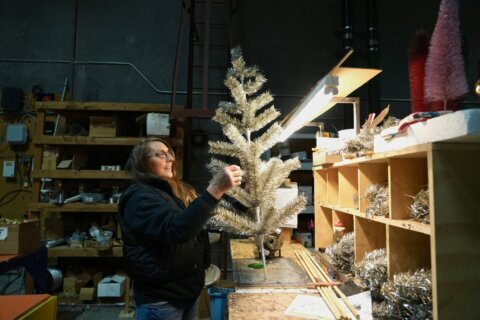
On the third floor of an engineering building at the University of Maryland are a bunch of six-foot tall Christmas trees. Only one of the trees was put in a stand and given lots of water every day. The rest were allowed to just hang and dry out.
Bad things could happen if you did the same thing with your tree at home.
Every year, Isaac Leventon, an adjunct professor at the University of Maryland’s Department of Fire Protection Engineering, brings trees into a special lab with a ventilated hood and then lights them on fire. The difference in outcomes for the trees that were still healthy and given regular water versus the trees that started to dry out is pretty stark.
“They are particularly dangerous because they can ignite easily if they dry out,” said Leventon. “Those fires can grow quickly, and they can grow really large.”
But that’s not what happened with the first tree, which was the healthy, regularly watered one.
“Those branches burn locally. But pretty much the rest of tree is fine. You wouldn’t notice it if you turned it around,” Leventon said. “At the base of most tree holders, there’s room for water. Keep that filled as high as you can and just check that each day to make sure there’s still water in there.”
When he set the dried-out tree on fire, a rush of heat filled the room as the tree went up in flames.
“It took seconds to ignite its base. Probably pit hit its peak fire size, I’m going to estimate on the order of two or two and a half megawatts,” said Leventon. “Within 10 seconds, and the whole thing was gone. I’d say within 30 or 40 seconds.”
When it comes to tree fires, the amount of heat is measured in megawatts.
“Think kilowatts like your old light bulbs, an old 100-watt light bulb. 10 of those would be one kilowatt,” Leventon explained. “Ten thousand of those would be a megawatt. And these tree fires, even the smaller ones, can be between one and three megawatts.”
“Imagine tens of thousands of light bulbs suddenly on, all within seconds from the smallest of flames,” he added.
To prevent these fires, all candles and flames should stay away from your tree. But that’s not the leading cause of Christmas tree fires. A significant number, if not a majority, of tree fires are started from electrical sources, whether it’s a bad string of Christmas lights or an overloaded outlet. There are dozens of these fires every year, causing around $15 million in damage nationwide.
So what should you be watching out for?
“Is it still nice and dark green? Are those branches flexible? Do you see needles that are falling around the base,” he asked. “Is it really crunchy when you go by? All of those are signs that it’s drying out and you may want to consider taking it outside.”
“We’re OK in this lab, right? All of that heat, all the products combustion, they’re pulled out of here,” he said, pointing to the ventilated hood in the middle of the room. “But in your home, if you can imagine your living room or a den where this might be, that heat has got to go somewhere. It’s probably trapped in the room. High likelihood, with such a large fire, that other items nearby can ignite.”
“The real big message is not ‘don’t have these trees,” he added. “Keep it well watered. Keep it healthy.”
Get breaking news and daily headlines delivered to your email inbox by signing up here.
© 2025 WTOP. All Rights Reserved. This website is not intended for users located within the European Economic Area.