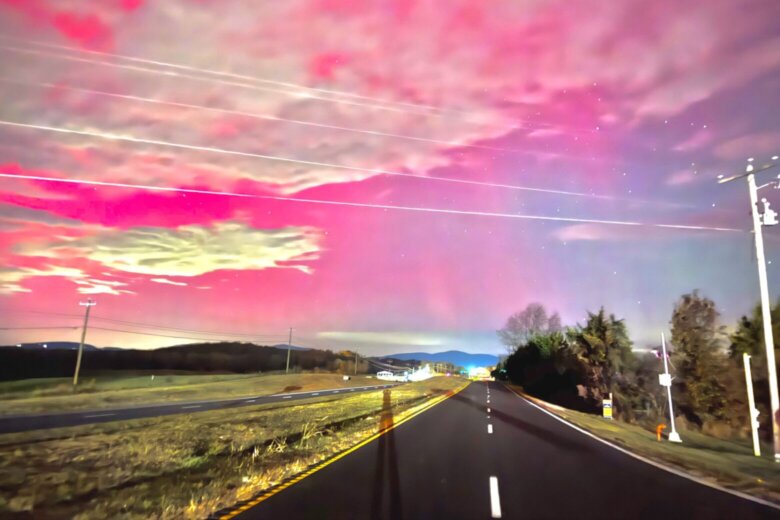
As it gets dark, be sure to look to the west and see the fabulous planetary line up of Jupiter, Venus and Mercury. This planetary spectacle will continue into the weekend so be sure to see it and photograph it with your smartphone.
And while you are outside, look north.
The National Oceanic and Atmospheric Administration Space Weather Prediction Center issued this statement, headlined as an Update on a G3 Watch for Thursday and Friday:
“The current forecast calls for combined CME arrival around mid-afternoon EDT of June 4, with up to G3 levels possible afterwards. CME passage would likely continue into the evening and possibly overnight hours of June 5,” the statement reads, referencing coronal mass ejections, abbreviated CME.
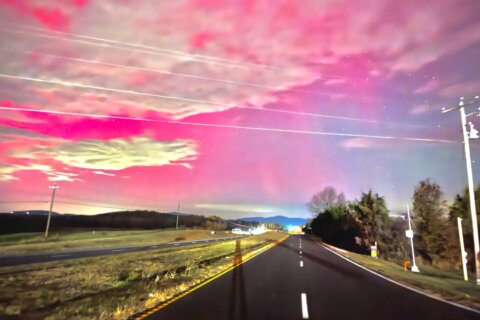
If the forecasts hold — readers need to keep checking the NOAA website for updates — aurora conditions for the D.C. area might, emphasizing “might” here, develop Thursday night. I’m providing this forecast to you because of the unique circumstances involved, which are a story in their own right, as well as the possibility of aurora.
What makes this forecast rather intriguing is explained by spaceweather.com:
“Sky watchers in Europe and North America might see auroras tonight (June 4-5) if, as expected, a Cannibal CME strikes Earth. The impact could spark strong (G3) geomagnetic storms with isolated periods of severe (G4) activity. During similar storms in the past, naked-eye auroras have been visible in more than 25 US states.”
What’s a cannibal CME exactly? Spaceweather.com described it as “a CME that eats other CMEs.”
According to space news website, on Wednesday, “sunspot 4455 exploded several times and hurled multiple CMEs into space. One of the CMEs was so fast, it caught a slower CME and swallowed it.”
The cannibal coronal mass ejection is set to reach Earth late Thursday or Friday.
“This is good news for sky watchers because Cannibal CMEs are very good at producing geomagnetic storms and auroras,” according to spaceweather.com.
The geomagnetic storm that produced stunning displays of northern lights across the Northern Hemisphere in May 2024 was in part caused by a cannibal CME, according to spaceweather.com. Thursday night’s storm isn’t expected to be as strong.
It will be worth taking a look to the north Thursday night, after dark until dawn, from a dark sky site with a clear horizon. You might be able to visually detect some color in the sky if bright aurora are present, but they will likely be low on the northern horizon.
Your camera and/or smartphone significantly improve your chances of detecting and imaging the aurora due to their digital sensors. Even if you do not see aurora, photograph the northern horizon to possibly get an image of them.
Use a camera or smartphone that can take exposures of several seconds — including using “Night Sky” or “Low Light” settings if your camera has them — of the Northern horizon. Steady the camera or use a tripod for best image results. The camera can capture Aurora that your eyes did not.
Our weather is looking promising so our best bet is to monitor Clear Sky Chart for sky conditions, NOAA and space-related websites such as spaceweatherlive.com, EarthSky.org, space.com for aurora viewing updates. There also are aurora apps available as well to help you; I use Aurora Pro and Glendale App.
Good luck, aurora chasers.
Follow Greg Redfern’s daily blog to keep up with the latest news in astronomy and space exploration.
Get breaking news and daily headlines delivered to your email inbox by signing up here.
© 2026 WTOP. All Rights Reserved. This website is not intended for users located within the European Economic Area.