This article was republished with permission from WTOP’s news partners at Maryland Matters. Read the story at Maryland Matters.
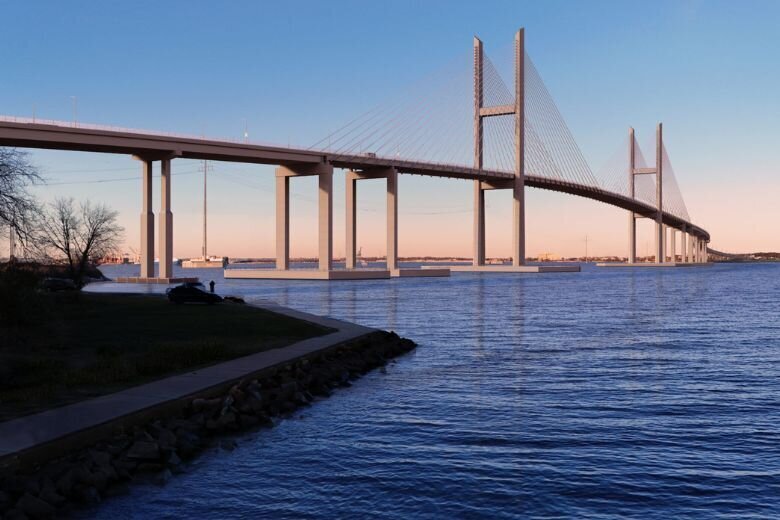
Maryland officials took two key congressional appropriators on a tour Monday of ongoing work to replace the Francis Scott Key Bridge, as ballooning costs have raised fears that the federal government might not honor its pledge to pay 100% of the project.
Gov. Wes Moore (D), current and former members of the state’s congressional delegation and state transportation officials took Sen. Shelley Moore Capito (R-W.Va.) and Rep. Steve Womack (R-Ark.) on a boat tour of the site, where work continues even though the state parted ways this spring with the current contractor over projected costs.
Capito, the chair of the Senate Environment and Public Works Committee, and Womack, the chair of the Transportation, Housing and Urban Development Subcommittee of the House Appropriations Committee, were generally supportive of the project, despite what Capito called “eye-popping” costs on the multibillion-dollar project.
“We have to have a transparent process,” Capito said to reporters after the boat tour. “I want to see why these costs have ballooned and what are the performance measures that are built in … because now, the whole country is paying for this.”
The bridge collapsed into the Patapsco River when it was struck in the early morning hours of March 26, 2024, by a fully loaded container ship leaving the Port of Baltimore, killing six workers who were on the bridge at the time and severing a major East Coast highway route.
In the weeks immediately following the collapse, state officials estimated that replacing the bridge would cost about $1.7 billion. Then-President Joe Biden pledged that the federal government would pay the full cost of replacement, a promise that was made law in late 2024 in legislation passed by Congress.
Since then, however, the state’s official cost estimate has grown to be between $4.3 billion and $5.2 billion — and some unofficial estimates have suggested it might be much higher.
The state this spring ended its contract with Kiewit Infrastructure over price disagreements on the job going forward. Kiewit was involved in expedited planning on a replacement bridge, removal of the old bridge structures and placement of piles for a new bridge, and it will continue that work through the end of this year. But state officials are seeking new contractors for subsequent phases of the project.
State officials have blamed a number of pressures for the higher costs, but say the chief culprit are the modern safety measures that were not a part of the original bridge’s 1970s-era design, but have to be built in today to prevent another tragedy like the 2024 collapse from happening.
“If you look at the fact that this next bridge that we’re building, it is going to have additional safety precautions and mechanisms that were not there when features” that were not there when the bridge was originally built, Moore said Monday.
“It will have to be larger, because it has to accommodate larger ships,” Moore said. “So I know when people say. ‘That’s ambitious, to say you’re going to build a bridge that’s safer and bigger, and build it faster than was done before,’ the answer is, it is ambitious.”
Moore pointed to the work done so far and speed at which crews cleared the shipping channel in and out of the port — in weeks instead of months — and said he is confident the project can still be finished by 2030.
Moore said Capito and Womack have been “with us every step of the way.”
“They were here walking with us after the initial tragedy,” he said. “This is not an introduction to either of these two.”
Both Capito and Womack remained supportive of the project, with Capito noting the 89,000 people who crossed the bridge daily and Womack noting that some of the steel used in the project came from an Arkansas foundry.
“This is not a shirts-and-skins issue. This is not a blue/red issue,” Womack said. “This is a national issue and the sooner we can get this thing built, and they’re track record is pretty good right now, when you consider the speed at which a lot of these things are happening, this is going to be open in record time and everybody’s going to benefit, particularly the nation.”
Capito said that permitting reform that is working through Congress will be key to dealing with projects like the Key Bridge as the nation continues to grapple with aging infrastructure. For member of Congress it has been a case of “lessons learned” with the bridge, she said.
One of the lessons already learned, Capito said, is “Maybe don’t put an estimate out until you’re really sure what the estimate might be.”
Maryland Matters is part of States Newsroom, a nonprofit news network supported by grants and a coalition of donors as a 501c(3) public charity. Maryland Matters maintains editorial independence. Contact Editor Steve Crane for questions: editor@marylandmatters.org.