Water quality near the site of the sewage spill into the Potomac River continues to be a concern, but even a few miles downstream at National Harbor in Maryland, it’s a different story.
The most recent testing by the D.C. Department of Energy and the Environment continues to show levels of E. coli well below the maximum parts per 100 milliliters, which is within safe recreational limits, according to the U.S. Environmental Protection Agency.
Out of an abundance of caution, the state of Maryland has still restricted the harvesting of shellfish from the Harry Nice Bridge (where Route 301 crosses the Potomac) up to an area near Nanjemoy Creek, which is generally the upper limit of where shellfish harvesting takes place. Officials asserted it was done out of caution, and not because water quality testing was raising any alarms there.
That’s an important distinction for watermen, who are pushing back against perceptions about the river influenced by what’s happening 60-80 miles north of where much of their work is done.
Earlier this week, the head of D.C.’s Department of Energy and the Environment raised eyebrows when he said he would eat seafood caught in the Potomac River, and then quickly walked those comments back.
“It’s true. It’s very bad disaster up in that area, but we’re so far away from it,” said Robert T. Brown, who leads the Maryland Watermen’s Association.
Brown makes his living in the winter months harvesting oysters along the Potomac River.
“It has devastated our market,” he said. “The people who shuck the oysters and stuff and ship them to different states, don’t want no oysters coming out of the Potomac because they afraid of what it may be.”
Brown usually works near St. Clement’s Island, which is more than 10 miles past the end of the state government’s restricted zone.
“I went out today and one day last week, and it’s just dead slow,” Brown said, describing the market for oysters right now.
“We’re working way down the river. As a matter of fact, when the health department closed it to the (U.S. Route) 301 bridge, the oyster packers, the big ones down in Virginia, they wouldn’t buy nothing unless it was below 80 miles of where the spill was, instead of 60, like where the bridge was, because they want to make sure that stuff was good for people to eat,” he added.
It comes at a time when he said the market was already tough for watermen, with low demand and depressing prices.
Water quality isn’t to blame — fear is. And Brown said if an oyster from anywhere in the Potomac River got someone sick, the effect on public opinion would be crushing.
“We’ve just got to wait and weather the storm on it,” he said. “It will rectify itself. But once you put something in a person’s head that something may not be safe to eat, it’s hard to overcome that.”
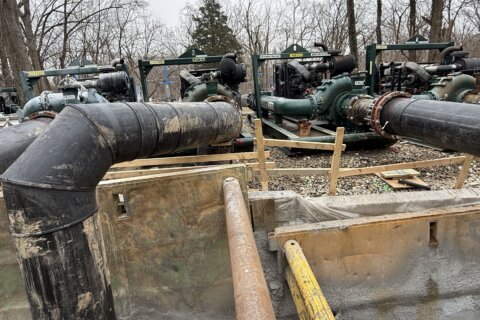
Thursday, D.C. Water crews were able to reach the collapsed pipe section, after bringing in high-capacity pumps to divert sewage from the Interceptor into an isolated stretch of the C&O Canal, around the collapse site, and back into the pipeline.
Using heavy machinery and digging by hand, crews are removing sludge and rocks up to the size of boulders, before being able to get into the pipe to assess the damage. D.C. Water estimates it will take four to six weeks to excavate the area, repair the pipe, and restore wastewater flow to the Interceptor.
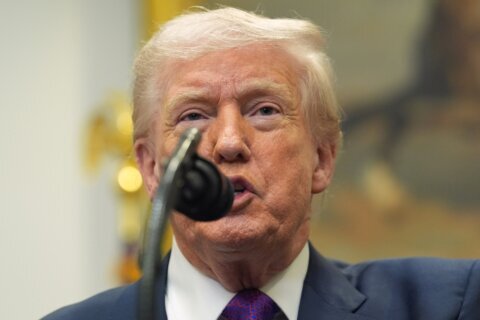
Wednesday evening, Bowser had declared a local public emergency, and asked the federal government to assist in the cleanup and repairs — a move that came after President Donald Trump criticized regional officials for their response to the break, which happened in mid-January.
Maryland’s Department of Natural Resources announced there will be a two-week extension of the commercial oyster season this year, to make up for the time lost during the deep freeze that impacted so many waterways earlier this winter. Now, the season will go until April 14.
WTOP’s Neal Augenstein contributed to this report.
Get breaking news and daily headlines delivered to your email inbox by signing up here.
© 2026 WTOP. All Rights Reserved. This website is not intended for users located within the European Economic Area.