This article was republished with permission from WTOP’s news partners at Maryland Matters. Sign up for Maryland Matters’ free email subscription today.
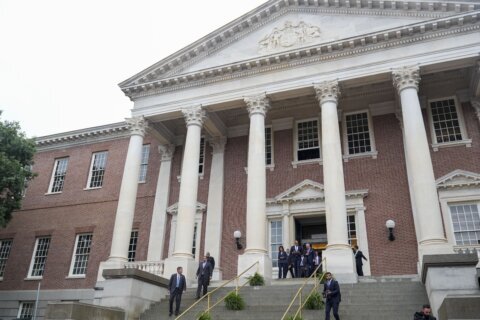
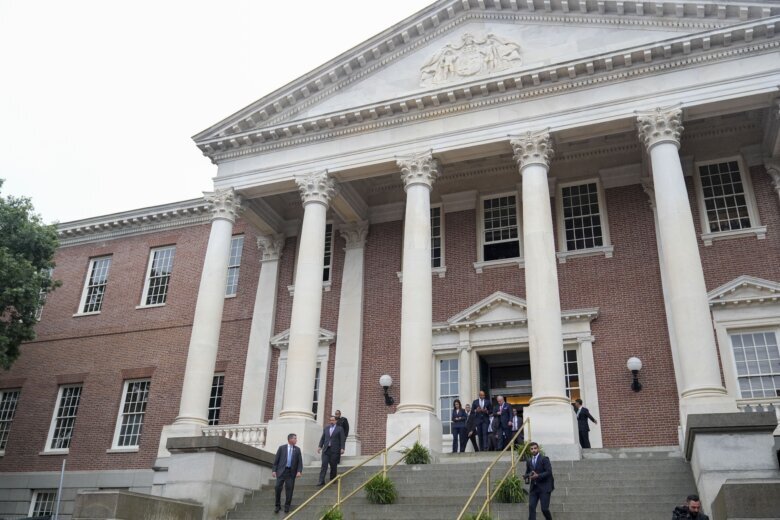
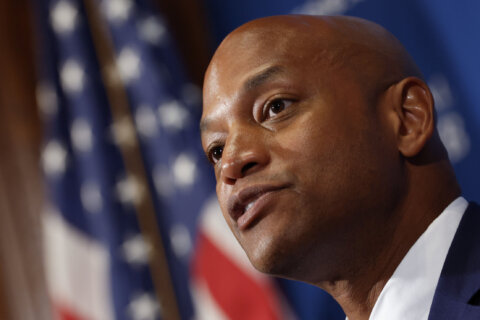
A panel appointed by Gov. Wes Moore (D) to make recommendations on midcycle congressional redistricting voted behind closed doors Thursday to move forward with its work and solicit proposals from the public on how the state’s eight districts could be redrawn.
The 3-2 vote happened in a virtual meeting that was not listed on the Governor’s Redistricting Advisory Commission website and was not open to the public. There was no agenda posted. It was a meeting, and a vote, that Senate President Bill Ferguson (D-Baltimore City) criticized in a blistering statement that called the outcome “preordained” and lacking in public transparency.
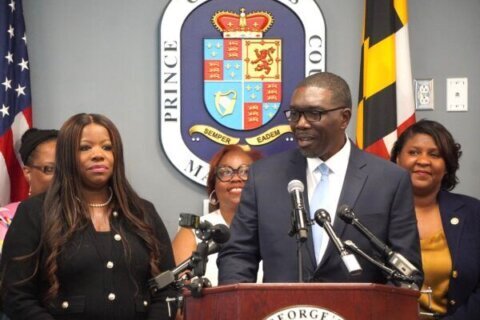
The commission, led by Sen. Angela Alsobrooks (D-Md.), met at 5 p.m. Just after 6, within minutes of the meeting’s close, Moore’s office released a statement in which Alsobrooks announced the commission would solicit maps from the public and hold two more meetings.
“Today, the Governor’s Redistricting Advisory Committee [sic] met to discuss our path forward and decided to continue our work to recommend a congressional map to the Governor and the General Assembly,” Alsobrooks said in the statement.
“After Christmas, we will make the submitted maps available publicly and hold two additional public meetings to gather feedback on the options before us. This process will remain open, transparent, and focused on ensuring Maryland’s districts reflect our communities and comply with the law,” she said.
Joanne Antoine, executive director of Common Cause Maryland, said the commission suffered from a “glaring lack of transparency,” highlighted by Thursday’s decision to move forward with redistricting after failing to release any proposed maps to the public.
Critics: ‘The entire process is a mess’
Thursday’s unannounced and unbroadcast meeting of the Governor’s Redistricting Advisory Commission raised concerns for open-government advocates about transparency and violations of the state’s Open Meetings Act.
“The commission has convened five times already without publishing a proposed map for public comment or review — a pattern that raises serious concerns about the commission’s commitment to public engagement and transparency,” said Common Cause Maryland Executive Director Joanne Antoine. “Tonight’s meeting may have also violated Open Meetings Laws for failing to provide adequate public notice.”
Previous meetings of the panel were all held in public, and virtually. None featured maps that the public or commission members could look at. Meetings were often added along the way without a clear idea whether the panel would hold in-person meetings, produce maps for comment or even if there was an expected end date to proceedings.
Nikki Tyree, executive director of the League of Women Voters of Maryland, said the commission “failed to meet the spirit or intent” of state open meetings laws. The panel “demonstrated that it is more loyal to a single party’s desire to redistrict than to the people of Maryland,” she said.
“There was no notice of today’s meeting; it was not streamed for public viewing,” Tyree said in a statement. “The Commission has not shared future meeting dates or even an outline of a process or tools for people to contribute to the development of meaningful and fair maps. While it seems like small details, it sends a clear message that says the majority party can jam through what it wants while ignoring the citizens.”
The invitation from Sen. Angela Alsobrooks (D-Md.), the redistricting commission chair, to submit redistricting plans included no details on a format or other requirements for such plans. Those interested were simply directed to “submit their map ideas for our consideration over the next two weeks by e-mailing grac@maryland.gov.”
Antoine said she is concerned about the timing for map submissions that leave “only a few days to submit map proposals with no date for the next two meetings. The entire process is a mess.”
A spokesperson for the governor’s office did not respond to a request for comment about the private session.
“It’s unfair to ask voters to comment on what they can’t see,” Antoine said in a statement. “Ultimately, this is about transparency; it’s about whether redistricting happens in the light of day or behind closed doors. The commission should immediately release any maps under consideration so the public can provide meaningful input, instead of putting the burden on members of the public to draw their own maps during the holidays.”
The League of Women Voters of Maryland also said in a statement that it was “disturbed” to learn of the commission’s meeting and subsequent action Thursday.
Making sure maps are ‘fair’
Moore created the five-member panel in early November. He charged it with ensuring the congressional district maps approved by the state in 2022 were “fair” — a term he has repeatedly declined to define.
While Democrats in Maryland hold a 2-1 advantage over Republicans in voter registration, they hold a 7-1 advantage in the state’s congressional districts: Rep. Andy Harris (R-1st) is the sole Republican in the congressional delegation, from the 1st District, which covers the Eastern Shore and stretches into eastern Baltimore County.
Alsobrooks, in her statement, said Maryland has a “responsibility” to redistrict.
“At a moment when other states are moving aggressively to redraw maps — and with some already signaling they want the Supreme Court to weaken or effectively nullify key protections in the Voting Rights Act — Maryland cannot afford to sit on the sidelines,” her statement said. “We have a responsibility to move forward so the next Congress reflects the will of the people and can serve as a real check on this President. That’s what tonight’s announcement is about: doing the work, inviting the public in, and getting this right.”
Democratic Congressional Campaign Committee Executive Director Julie Merz said the Maryland commission “took a critical step in ensuring the voice of Marylanders are heard in the face of national efforts by Donald Trump and Trump supporters to rig the midterm elections in their favor through unprecedented mid-decade redistricting. We applaud the Commission for their continued work to create a firewall against extremists seeking to silence the voice of Marylanders.”
But the commission’s decision drew swift rebukes from Republican leaders in the House and Senate, with House Minority Leader Jason C. Buckel (R-Allegany) calling it “the most corrupt process possible in an inherently corrupt endeavor.”
Ferguson flames commission before meeting
Minutes before the start of the closed-door meeting, Ferguson released a statement charging that “the outcome is already known. Clearly, the Commission’s work was predetermined from the moment the GRAB was announced.”
Ferguson, one of the five commission members, is an outspoken opponent of hyperpartisan midcycle redistricting. He pointed to recent polling that he said showed state residents have bigger issues on their minds than redistricting.
“Our state’s residents have been clear, in front of this commission and through polling,” his statement said. “The overwhelming majority do not want a new congressional map. They want their government focused on fostering growth, affordability, and real protections against this lawless federal Administration. The Senate of Maryland remains focused on this important agenda as we continue to try to tackle a $1.4 billion budget shortfall in Maryland’s state budget.”
Commission members who attended the meeting told Maryland Matters that the bulk of the discussion centered on whether to send a recommendation to the governor to move forward with a redistricting proposal.
Cumberland Mayor Ray Morriss, in an interview early Thursday afternoon, said he expected the meeting to be “administrative” in nature, largely because of the previous lack of maps “or anything like that. So, more than anything, I think that’s what today’s meeting will be … pretty much administrative and sort of figuring out the road map going forward.”
Speaking again after the meeting, Morriss said the commission discussed maps but none were shown to members.
“There were discussions about them, about maps, how they would be drawn, who would be drawing them, and whether or not we would have more hearings open public hearings about it,” said Morriss, who joined Ferguson to vote against moving forward. “I would say that there was a consensus that we would have the public draw maps, and we would have open hearings to just allow to allow the public to voice their opinions about the different maps that they’ve seen.”
But Morriss noted that part of the discussion included an option to send the issue to Moore and the legislature for public hearings.
“That was the discussion, whether we wanted to have the hearings or go directly to the to the General Assembly,” he said. “We decided that it would probably be best, since we were a commission who would ask for the public’s input, to then give them the opportunity to have input on the maps that we were considering.”
Others who attended the meeting called it “a check-in.”
“I didn’t see it as any big deal,” said Del. C.T. Wilson (D-Charles), a member of the commission who voted with the majority Thursday night. “I saw it s a check-in, like, ‘Guys, are we going to keep doing this or what?’ There was no policy discussed.’”
Wilson said he was not privy to how the decision was made to hold the meeting in private. Morriss said after the meeting that he saw no reason why the public could not attend.
“There wasn’t anything being discussed that the public couldn’t have been a part of,” Morriss said by phone. “To be honest, initially, I thought that it was open, and there would be people … listening. But then found out that today that it was just us.”
“I’m not a lawyer but to me, there wasn’t anything we were discussing that couldn’t have been discussed publicly,” he said.
A ‘predetermined’ outcome
Ferguson, in his statement said he agreed to sit on the commission “because we were tasked with hearing from Marylanders as to whether to move forward with mid-cycle redistricting. The cumulative oral and written testimony received to date demonstrates by a large margin that Marylanders oppose mid-cycle redistricting. Moreover, we did not engage in a thoughtful, informed conversation that would have included, at the very least, testimony from the Office of the Attorney General, or our State and local boards of elections.”
“Pushing forward a preordained recommendation outside the public eye is irresponsible and lacks transparency,” his statement said
Morriss agreed that the combination of written and in-person testimony led him to believe that Marylanders were not overwhelmingly in favor of redrawing the congressional maps. He said he’s tried to keep an open mind about how the commission might act but said the makeup of the members leans one way.
“I wouldn’t say that anything is predetermined, but I think when you look at the makeup of the commission, it gives you a general idea of … what their perspective is,” he said. “I think that perspective could be obviously seen going forward from the very beginning. I haven’t seen anything to indicate that there was anybody that really changed their … perspective from what I would have considered it to be.”
Morriss said the makeup of the commission, and the timing of the statement from Moore’s office Thursday so close to the end of the commission meeting, suggests “the commission to a great extent was selected for a specific purpose.”
Senate Minority Leader Stephen S. Hershey Jr. (R-Upper Shore) applauded Ferguson for issuing a statement in advance of the meeting “to speak candidly about what many Marylanders plainly saw from the beginning.”
“Citizens across Maryland recognized this effort for what it was: a thinly veiled attempt to advance a political outcome that had already been decided behind closed doors,” Hershey said. “Public hearings and commissions should be vehicles for transparency and trust, not performative exercises designed to legitimize predetermined decisions.”
Hershey said the commission should seek real input and not just to “rubber-stamp a political strategy already in motion.”
“I share President Ferguson’s belief that Marylanders deserve better,” Hershey said, adding: “When leaders from different parties arrive at the same conclusion, it should serve as a clear signal that this approach missed the mark and that Marylanders were right to be skeptical from the start.”