The D.C. region has seen a big increase in job losses thanks to federal cuts, but even those who have a job haven’t seen their wages keep up with inflation.
And now there are fears that further cuts to the social safety net will only increase what’s already a growing number of people going hungry in the D.C. region.
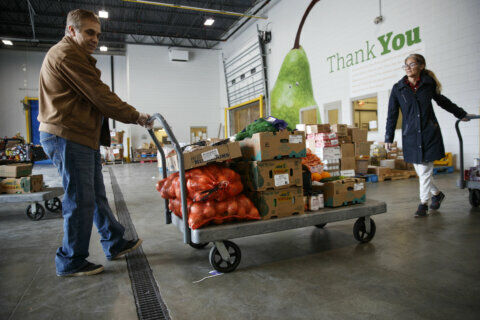
The Capital Area Food Bank put out its annual Hunger Report on Thursday and the stats paint a disconcerting picture, with reasons to think what’s already a bad situation could get worse. And it comes with a warning, if not a plea, for already strapped local governments to be ready to offer help in the future.
“After a large jump in 2024, food insecurity remains at troublingly elevated levels,” said Sabrina Tadele, director of strategic initiatives with Capital Area Food Bank. “Specifically, 36% of households in the DMV are now experiencing food insecurity.”
The numbers span from one in five households in Arlington, Virginia, to as many as about half of all households in Prince George’s County, Maryland.
The numbers are essentially the same as last year when factoring the margin of error, but 4% higher compared to 2023.
In addition, when the survey was done in May, it found 41% of those who lost their jobs during the federal purging of jobs and contracting positions were dealing with some level of food insecurity. Those behind the survey said they believe that number has changed in the past four months.
The findings come at a time when wage growth has lagged inflation to a significant degree around the region.
“Forty percent of adults, that’s up from 35% last year, said they were in a worse financial position than they were the year prior,” said Hilary Salmon, the food bank’s marketing director. “That means that household purchasing power has taken a major hit, especially for low income families. The dollars simply aren’t stretching as far.”
The food bank’s CEO, Radha Muthiah, said hunger continues to be a persistent problem around the D.C. area.
“We’re likely to have to increase the amount of food that we distribute by a good five to 10 million meals a year,” she said.
Meeting that number will be difficult.
“Given that we have a retraction in the level of federally provided benefits through SNAP and Medicaid and through sources of food that we may receive … we’re going to have to increase our purchasing of food to be able to meet the needs of our community,” she said.
Muthiah said the food bank will lean on local governments to keep people on government assistance and help the food bank distribute those meals.
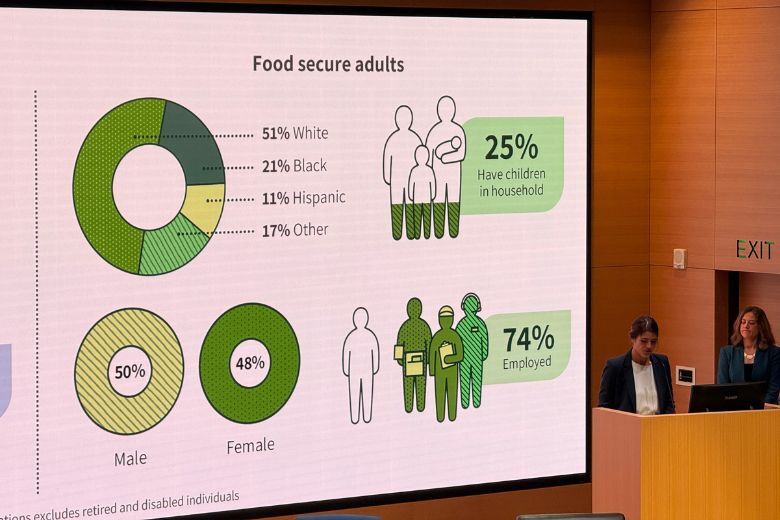
The survey found that minorities, women, people responsible for children, and people who work multiple jobs are more likely to be considered food insecure, which is defined as a lack of consistent access to enough food for an active, healthy life.
Food insecurity has already led many to dip into their savings to make ends meet, make only minimum payments on credit cards, and put off saving for the future, either with retirement or college savings accounts. In fact, credit card delinquencies are up 25 to 50% around the region, varying by county.
Get breaking news and daily headlines delivered to your email inbox by signing up here.
© 2025 WTOP. All Rights Reserved. This website is not intended for users located within the European Economic Area.