From saving on school supplies to the impact of federal cuts, the WTOP team is studying up on hot-button topics in education across the D.C. region. Follow on air and online in our series, “WTOP Goes Back to School” this August and September.
This video is no longer available.
An eventful summer within the Prince George’s County public school system has come to an end, and now it’s time for students to return to classrooms for a new school year.
The summer began with the abrupt departure of former Superintendent Millard House II, who was forced out by the school board, so that new Prince George’s County Executive Aisha Braveboy could bring in someone new.
That’s where interim Superintendent Shawn Joseph enters.
He’s been meeting with parents, community groups and educators throughout the summer to hear what they have to say about what’s working and what isn’t in the county school system.
“We need to let our communities know we’re serious about getting it right for them, getting them in the buildings, letting them see what’s what and just being transparent,” Joseph said. “There are areas where we’ve got work to do. There are areas that we’re working well. Let’s just fix the stuff that needs to be fixed, and let’s continue to build on the stuff that’s working.”
Special education
The first topic Joseph mentioned hearing about was special education. He said making sure there were enough special education teachers and paraeducators where they’re needed has been a problem. But so has communication with the parents who have special needs children in the system.
“I think a lot of our special education families have been a little frustrated. They don’t feel like we’ve been responsive when things needed to be improved, and they could be right,” Joseph said. “We’ve just got to get at it, and we’ve got to have a stronger collaboration with families, and that’s what we’re going to work toward.”
School safety and transportation
School safety is also an issue, with Joseph stressing that clear expectations for behavior in school classrooms and hallways need to be laid out, and when students don’t adhere to those expectations: “We’ve got to address it,” he said matter-of-factly.
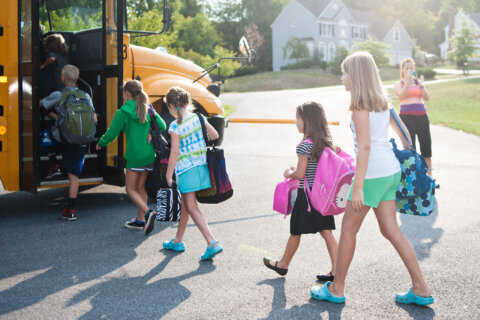
But just getting students to school has also been a major difficulty for Prince George’s County Public Schools. The school system is driving into the new year nearly 130 bus drivers short of what’s needed, which is actually better than recent years.
“We’re going to have vacant routes,” said Keba Baldwin, transportation director for the school system. “Those routes will be covered by existing staff. So that means we may have to double back to pick up trips. … That does mean delays.”
But Baldwin promises better communication than what’s occurred in the past. And in the weeks and months ahead, parents will soon be switching from using the Stop Finder app to a new app called Chipmunk.
“We will have that opportunity for you to track the bus, see where the bus began,” Baldwin said, explaining how a map pops-up on the Chipmunk app and will show the user the route the bus is taking to get to their child’s stop. “You will always be able to see where the bus has been.”
WTOP got a tour and saw the app in action while going through Fort Washington last week.
“Once they’re on, you can see the stop being serviced, a little message pops up and it gives you the time. So parents will have a time-stamp of when their kids were able to get on the bus,” Baldwin said.
The ability to send out push notifications in a near instant will also help parents stay informed about other issues that may crop up while the bus is out. Plus, if English isn’t your first language, the app will translate the information into your native language too.
School leaders tout the app as a “game changer” when it comes to keeping parents informed about their child’s journey to and from school, especially when an unexpected delay might have them wondering if the bus is even coming.
But they also admit that the time to start the rollout was well before this point. So that means the app isn’t quite ready yet — at a time when they know the driver shortage could mean a chaotic first several weeks of school.
School officials warn that, in some cases, delays could be the routine until the school system figures out where changes need to be made. In some cases, it could happen when a new driver is hired, but they will also be working to assess where routes could be adjusted or combined.
The first bus riders to use the Chipmunk app will be special needs students who ride a bus to their school. That should start to happen in September.
“It’s a more targeted, smaller population,” Baldwin said. “It allows us to really tweak our practices. … Having 85,000 students (who ride a bus), it is hard to roll it out en masse.”
“We have this phased approach that makes it work easier for us, and just allows us to analyze and tweak where we need to tweak, before moving on to a next phase,” he added.
He expects the entire county to be using Chipmunk by the end of the first semester. Parents will log in through their ParentVUE accounts tied to the school system.
If parents haven’t set up that account yet, they will need to contact their child’s school. But there’s no other way to get linked into the Chipmunk app without it.
After an account has been established, Baldwin said the hardest aspect of the Chipmunk app will be the initial log in — a far cry from the difficulties parents have endured with the bus system in recent years.
Get breaking news and daily headlines delivered to your email inbox by signing up here.
© 2025 WTOP. All Rights Reserved. This website is not intended for users located within the European Economic Area.