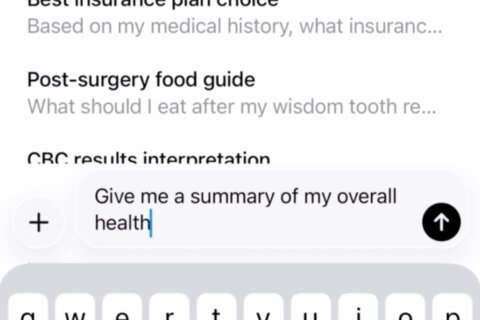
This month, ChatGPT announced it was rolling out GPT Health, a tool inside the chatbot you may have already downloaded that’s aimed at specifically helping to provide answers to certain health questions.
Users are able to connect the various health and wellness apps they may already have on their phones and smartwatches and also upload any health records they choose to.
ChatGPT’s announcement cited the 300 million people who asked health-related questions to its chatbot already and said it hopes to provide one single place that can help people better understand everything from lab results to what their doctor may have told them. But doctors who have studied chatbots and health-related questions aren’t so sure it’s a good idea – yet.
“They have a specific disclaimer on the website saying that it’s not intended for the diagnosis or treatment of any diseases, but the problem is that people are already using ChatGPT for health advice and for diagnosing and treating diseases,” said Dr. Nick Tiller, a research associate at the Lundquist Institute at Harbor-UCLA Medical Center and the author of a new book titled “The Health and Wellness Lie.”
“Having this more personalized system is only going to increase their reliance, not decrease,” he warned.
In April, he led a study that was published, looking at the ability of artificial intelligence to provide accurate health information. The results then were not reassuring.
“We found that a third to half the time, AI chatbots will provide either problematic or highly problematic responses to health and medical questions,” Tiller said.
“For ChatGPT Health, in particular, the most recent data that we have found, that in 52% of genuine emergencies, the chatbot recommended an assessment period of 24 to 48 hours. So that’s a delay that, in a real patient, could mean the difference between life and death.”
However, Tiller also conceded that the AI models he used for the study are by now outdated and inferior to the ones that are being used today. But since he hasn’t seen the current models audited yet, he’s still not sure it can be trusted.
“My concern is that the public are effectively going to be the guinea pigs for this for this new health-specific AI chatbot, and there’s absolutely no indication that it’s going to be able to give reliably good responses,” Tiller said. “It could give you a perfectly coherent and cogent response 50% of the time, and the other third to 50% of the time it could be completely way off base. And with health questions, you kind of need to be reliably good.”
The one thing he’s not concerned about? Privacy. OpenAI said the information you provide won’t be uploaded to train models or provide you with target ads.
“AI has enormous potential to improve access to healthcare,” he said. “But rolling out a system like this before it’s been shown to be safe and effective is frankly irresponsible, and it could end up doing more harm than good.
“If you think the answer is important, and if you think the accuracy of the answer is important, then I wouldn’t ask an AI chatbot,” he added. “In the future, it will absolutely be a very powerful tool, but we’re not there yet, and we need to be patient.”
Get breaking news and daily headlines delivered to your email inbox by signing up here.
© 2026 WTOP. All Rights Reserved. This website is not intended for users located within the European Economic Area.