President Donald Trump criticized Maryland Gov. Wes Moore and state leaders Monday over their handling of the massive sewage spill into the Potomac River.
“There is a massive Ecological Disaster unfolding in the Potomac River as a result of the Gross Mismanagement of Local Democrat Leaders … This is the same Governor who cannot rebuild a Bridge,” Trump said in his Truth Social post.
Trump also said he is directing federal authorities to step in to coordinate the response and protect the region’s water supply.
Ammar Moussa, a spokesperson for Gov. Moore, pushed back, saying the president has been responsible for the Potomac Interceptor sewer line for decades. “The President has his facts wrong — again,” Moussa said in a statement, adding that the Trump administration has failed to act for the last four weeks and has put people’s lives at risk.
Mousa said Maryland officials have been on site since the start of the leak to help coordinate the response and keep the public informed: “If the federal government is just now showing up to take action, we will work collaboratively — as we always do.”
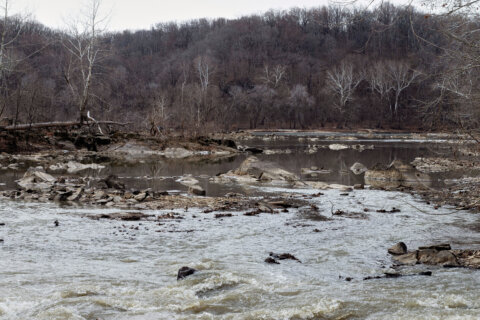
The spill began Jan. 19 when a major section of the Potomac Interceptor collapsed, sending hundreds of millions of gallons of raw sewage into the river.
Since the spill, the Maryland Department of the Environment has been testing bacteria levels. Moussa said concentrations of E.coli have started to fall, although monitoring has increased as temperatures rise and snowmelt affects the river.
Rachel Rosenberg Goldstein, an assistant professor of global, environmental and occupational health at the University of Maryland, told WTOP on Monday that it will take time to fully assess the health impacts of the spill.
“I would say that this is really unprecedented, the amount of raw sewage that’s entering the Potomac River. We’re seeing levels of E.coli that are thousands of times above recreational water quality standards,” she said.
Rosenberg Goldstein said in the past few weeks, the decline in E.coli concentrations is encouraging.
“We’re going to need to continue to monitor what’s happening in the river and the different types of bacteria that are present. As we see temperatures rise, as we see the snow starting to melt; there are lots of different dynamics that can impact bacteria,” she said.
The University of Maryland team is working with the Potomac Riverkeeper Network to collect samples and monitor changes.
“We believe it’s important that the water continues to be monitored so that we can keep those that interact with the river safe,” she said. “It’s extremely important that everyone continues to not interact with the river, as well as the land that’s near the river, because of these high levels of bacteria that we’re seeing.”
Get breaking news and daily headlines delivered to your email inbox by signing up here.
© 2026 WTOP. All Rights Reserved. This website is not intended for users located within the European Economic Area.