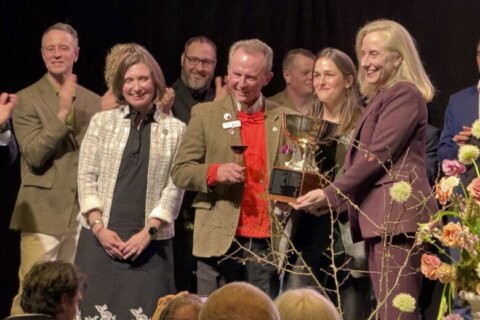
Tom Sietsema’s surprise announcement that he’s stepping down as The Washington Post’s longtime food critic and revealing his identity landed like a thunderclap across D.C.’s dining scene: sudden, seismic and impossible to ignore.
For the past 26 years, Sietsema attempted to “eat under the radar” by remaining anonymous, while writing reviews, guides and Q&As that have been described by restaurant owners and chefs as “fair” and “honest.”
In an interview with WTOP, Sietsema spoke about how he became a food critic, what the reality of being a food critic is like, why he’s stepping down and what he hopes to do next. Read the full Q&A below.
The transcript below has been lightly edited for clarity.
- Michelle Goldchain:
Let’s go back to the beginning. What were you doing before you were a food critic?
- Tom Sietsema:
I went to the School of Foreign Service at Georgetown University, thinking I was going to be a diplomat. That did not work out because I fell in love with journalism.
I had two really great internships with the Chicago Sun Times and ABC News, Good Morning America, and I just fell in love. I found there are these people who are paid to do what they love to do, that was write and report. I’ve always been interested in writing. I’ve always loved food. My mom was a great home cook and everything. But all that came later, right?
I took the first journalism class at Georgetown, which was conducted by Ted Gup, a Washington Post investigative reporter. In my class was Kara Swisher, who went on to become Kara Swisher, and Mary Jordan, the illustrious Washington Post correspondent.
I got a job at the Post as a copy aide back in 1983, and you will do anything to get out of those jobs. … So one week, Bob Woodward was looking for an assistant, as was the legendary Phyllis C. Richman, food critic and food editor. And I applied for both, and soon thereafter, I got a lovely, “Thanks, but no thanks,” from Bob Woodward, and a green light from Phyllis Richman, my predecessor.
… And in four years as her assistant, I learned how to cook. I probably prepared the bulk of the recipes back when we had two food sections a week.
… And so I went from there to be the food editor at the Milwaukee Journal, and I went to San Francisco, and I was a food reporter there. I was a food critic in Seattle at the Post Intelligencer. And then I did a profile on a man who changed my life. He was the number two at Microsoft, and they were developing a new product called Sidewalk.com, and it was basically your weekend section online with 10 sites around the country … and I became the national restaurant producer for them, and that got me back to D.C.
… When that folded, about three years later, I was hired at the Washington Post as a full-time food reporter. And then two years later, I became the food critic.
- Michelle Goldchain:
Being a food critic sounds very glamorous and so fun, but are there any challenges that come with the job?
- Tom Sietsema:
Well, your weight and your health. I learned very early on the day I got this job, I hired a trainer, went to a gym, and it sounds like a yuppie affectation. But for me, it’s health insurance. I want to keep doing this job, and I ended up doing it for almost 26 years.
… People might not think about that so much when they think of the job. You also spend a lot of time going to places, checking places out that aren’t ready for prime time for whatever reason.
… It sort of takes over your life, in a way, I think if you do it right. And I was eating out 10 meals a week, which is a lot, and it’s also a lot of people. So, I had a regular posse, of maybe 70 people that I ate out with, which sounds like a lot, but not when you’re eating 10 meals a week. And then you’ve got to factor in where people live. So I felt like a lot of my job was being a concierge, booking tables under different reservations, remembering those names, killing off a pseudonym when too many restaurants found out about it.
… I really tried as hard as I could to eat under the radar.
- Michelle Goldchain:
What words of advice or words of warning would you have for others who aspire to be food critics?
- Tom Sietsema:
There’s so many people writing about food, and I welcome that.
… I think the more people at the table, the better. I do think if you want to really stand out, you should just start something. Don’t expect to get anywhere. Just do a blog, a newsletter, something that you’re really passionate about, and have someone who’s a really good writer or a friend, someone who knows how to edit, edit you and look it over and make suggestions and learn from that.
Read the greats. Read about Ruth Reichl, Bill Addison, M.F.K. Fisher, I mean, the list goes on and on. Jonathan Gold — all these people who are or were great writers, and I also think it helps to travel as widely as you can, given your budget or whatever.
… It gives you a marker by which to judge other restaurants here and elsewhere in the country. I also think don’t take yourself too seriously, but take what you do seriously.
… I also think it really helps to become an expert in something that no one else is interested in. Tim Carman, my colleague at the Post, has been very good at carving out coffee and barbecue and bargain eating as his sort of areas of expertise, for instance.
- Michelle Goldchain:
What are some of your favorite reviews that you’ve written? Are there any that stand out for you that you’re really proud of?
- Tom Sietsema:
As a food critic, it was very important me to write about other than just what’s on the plate and what’s going on in restaurants. I was really proud of the year that I took to write about the 10 best food cities in the country. The Post sent me around the country for over a year to spend a week in each of the 12 cities that I looked at, and at no small expense.
… I loved going undercover as a dishwasher in Houston. I went down there and worked in a 400-seat upscale Mexican restaurant and spent a very long shift with two young Guatemalan guys who showed me their life, and I realized you cannot exist as a restaurant without dishwashers. And I interviewed a whole slew of big-name chefs who started out as dishwashers. And what I love about that is that it’s a pathway toward getting ahead in this country.
… I loved covering the fast food chains. I went to the top 10 most popular chains in the country, and I treated them seriously.
… It’s easy to think about raves or rants, but one of the reviews that I’m most proud of is when I went and stood in at the nonprofit shelter, Miriam’s Kitchen, which feeds people who are homeless, who might need work, restaurant-quality food. I was extremely proud of that, and I went in just as anyone else would, and I was amazed at the way the volunteers prepared food that was well-balanced, beautiful and treated everyone as a guest, and they would call everyone a guest. And I thought that was beautiful.
- Michelle Goldchain:
Have you ever heard from a restaurant owner after a critical review?
- Tom Sietsema:
Oh, plenty. Yeah, plenty. And it’s always a difficult conversation. I always tell people when I’m fact-checking, a lot of times, chefs would ask me, “How’d we do?” I say, “You know what? I can’t, in fairness, tell you what the review is about. But I did go three or more times, and I feel like I’ve given it a fair shake. But if you’d like to talk about this afterward, or if you have any questions for me, I’m happy to answer them.”
I’m sort of amazed at the responses that I’ve gotten. Not everyone has, but people who I never would have expected to call me back to thank me for critical review. I really admire those people, after the fact, because that’s tough.
I realize a lot of people are employed in restaurants. It can affect people’s futures and everything and their reputations, and they always say, “Everyone should have a story written about him or her to know what it feels like. Are you misquoted? Did the reporter get something wrong?”
So I was always very sensitive to that.
- Michelle Goldchain:
Are there any restaurant reviews or just food stories that you wish you had written?
- Tom Sietsema:
I always wanted to cover a White House State Dinner. And it doesn’t matter whether it’s Republican or Democrat, they really don’t want you in there eating the food and giving it a yay or nay or something else.
… Mario Batali, he cooked an Italian dinner or helped cook an Italian dinner for the Obamas. And smart man that he was in that respect, he passed around these little, tiny plin — these little, tiny, filled pastas — for the press corps to try, and it’s the only time I’ve ever had a taste of something that was actually served at a state dinner at the White House.
I have eaten in the mess. I’ve eaten on the Hill. I got into the CIA to review their dining room, which was the hardest story I’ve ever had to fact check. So, I’ve eaten around in a lot of government places, but the one that got away from me was a White House State Dinner. I would have loved that.
- Michelle Goldchain:
What is the best restaurant you could say you have eaten at?
- Tom Sietsema:
Wow, you know that just depends so much about where I am, who I’m eating with, the moment, my mood.
People often ask about your favorites, and I think those favorites change. The same restaurant that I would pick in the fall wouldn’t be the same place I wanted to eat in the summer and vice versa.
But when I think of magical places, I mean one that comes to mind was in India when I got a chance to eat at Indian Accent many years ago. And this is when a lot more middle-class Indians were actually going to restaurants for the first time, and because of that very famous chef in India wanted to replicate dishes to remind them of maybe childhood memories that they had eaten.
So, the desserts were served, for instance, on a dish that looked like an Indian bed. And I thought was very clever. That was fun.
When Atomix in New York opened, it was really one of the first fine dining Korean restaurants in the country, and that was really fun to experience. It really felt new and novel.
But I’m also really interested in much humbler places, too. … I do go to restaurants that are maybe better known, but the best meals are almost always, street food meals.
- Michelle Goldchain:
Can you tell me about some of the worst restaurants you’ve eaten at?
- Tom Sietsema:
Probably, the one I’m best known for is Founding Farmers, which I reviewed a long time ago, and since went back to to rereview because I think it’s important to give people second chances and do-overs.
And it’s parting advice that I’m giving to diners in my farewell essay, and I thought was important for me to walk the talk. So, I did go back to Founding Farmers, and it’s better than it was when I first encountered it.
… There were a lot of people who hated that review and a lot of people who applauded that review, and I sometimes think as a critic if a large number of people don’t like what you’re doing and a large number of people do like what you’re doing, you’re probably doing your job.
- Michelle Goldchain:
D.C. has become such a food town. It’s become such a destination. What do you think has led to that?
- Tom Sietsema:
I think this is the smartest audience I’ve ever written for. People are from all over the world. We’re a world capital. People have a little bit more money here to go out or have in the past. And I think people are very curious here. Washingtonians are very opinionated, too. I think that helps.
If I get a detail wrong about a West African restaurant, I’m going to hear about it from 20 people who were Peace Corps members or worked at the World Bank or the ambassador. That’s just the nature of living in Washington, D.C.
And I also think we got great food at both ranges compared to other bigger markets like Los Angeles, San Francisco or New York. I think it’s a little easier, or was until recently, a little easier, to do business here in town because we benefited from people from San Francisco and New York and elsewhere coming here to raise a family and start their own business after working for famous chefs elsewhere.
… I love that this city is as curious and hungry as it is.
- Michelle Goldchain:
I think the big question that I really wanted to ask you is, why are you stepping down now?
- Tom Sietsema:
Last year, I celebrated my 25th anniversary, and it just felt like a good time, but I wasn’t quite ready. And when the Post offered buyouts this year, I decided maybe this is an opportunity I really need to jump on and use that money as seed money for my next endeavors.
I do not plan on retiring. I’ve left the Post, but I’m not retired, and I have a book in me. I have other projects that people have talked to me about. I’ve gone on sort of a listening tour in the last three or four months with people in TV, radio and elsewhere to just get a sense of what might be out there.
So, I’m going to surprise myself, in part, but what I’m starting with, I launched my personal website, tomsietsema.com, recently. And what I want to do most immediately is recreate those joyful moments that I had in restaurants around the table. That’s the real perk of the job is getting smart, engaged, good people around a table to share food with you.
… I think we just need more joy in our lives right now, and these are dark times, but we are not powerless. And I think we can change one meal at a time, and I’m going to do that my personal life and hopefully promote it on my website and encourage other people to do something similar.
- Michelle Goldchain:
So, if there’s one thing you hope people take away from your 26-year career, what would you want that one thing to be?
- Tom Sietsema:
I would hope that they saw me as their trusted friend who wanted to point out really good work and steer them away from not good work, and who really had their best interests at heart.
And the great thing about food is it really can be something that brings people together. I love my online chat. That audience has been very special to me, and it’s probably been the most important thing I do every week.
… I hope I’ve been a good friend. I hope I’m a trusted guide. I hope I’ve shined a light on people who might be struggling a little bit and need that extra push, and got it for me.
Get breaking news and daily headlines delivered to your email inbox by signing up here.
© 2025 WTOP. All Rights Reserved. This website is not intended for users located within the European Economic Area.