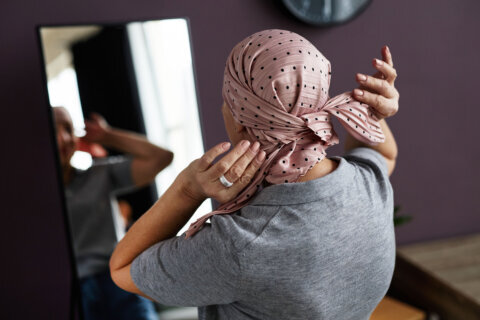
Cancer patients undergoing chemotherapy may soon have a new option to try to keep their hair — a shampoo-like gel that could protect hair from falling out during chemo.
Baldness from chemotherapy-induced alopecia is common, and usually temporary, but there are few good treatments.
Michigan State University researchers have developed a hydrogel, with the consistency of shampoo, as a more comfortable alternative to the only current treatment that’s been approved by the Federal Drug Administration.
Cold capping, which received its first FDA approval in 2015, uses cold temperatures to constrict the blood vessels surrounding hair follicles in the scalp, to keep the cell-killing chemotherapy drugs from reaching the follicles. When chemo drugs kill or damage the follicles, they release the hair from the shaft, which causes it to fall out.
“It’s really cold, and some patients are still willing to undergo it, because their hair is that important to them,” said Bryan Smith, an associate professor in the College of Engineering and with MSU’s Institute for Qualitative Health Science and Engineering.
Studies suggest about two-thirds of patients who used cold caps during chemotherapy reported discomfort, including headaches, scalp pain, neck pain, nausea, vomiting and dizziness.
Smith and his fellow engineering researchers identified the quality of life challenge, then sought a solution.
“We said, ‘We need something that somebody can easily put on top of their scalp, that they could easily wash off their scalp, and delivers a drug that has the ability to mechanistically reduce the amount of chemotherapy that enters the hair follicles,” Smith told WTOP.
How it would work for patients
The hydrogel, which absorbs a lot of water, would be applied to the patient’s scalp before the start of a chemo session.
“The gel would be worn during chemo, as long as the chemotherapy circulates in the bloodstream,” Smith said.
Most chemotherapy drugs are cleared from the bloodstream within a few hours to a few days.
“The patient is usually very exhausted and probably not going to want to go out,” and the gel can be showered off at home, said Smith.
The gel contains lidocaine, a local anesthetic, and adrenaline, a topical vasoconstrictor.
Smith and his team hope to get federal or venture funding to move their research into clinical trials.
“They’re drugs that are used all the time in dentistry and in the hospital, so they’re not toxic,” Smith said. “They’re used all the time, both on the skin and in the body.”
The hydrogel has been tested on animal models, but Smith said he believes the next step would be a small-scale, Phase 0 clinical study to investigate how the gel behaves in humans on a molecular level, before starting a more expensive Phase 1 trial.
“All the individual components of these materials have been either on or in humans before, and we don’t think there’s any great risk in toxicity,” Smith said.
The MSU research is published in the journal Biomaterials Advances.
Get breaking news and daily headlines delivered to your email inbox by signing up here.
© 2025 WTOP. All Rights Reserved. This website is not intended for users located within the European Economic Area.