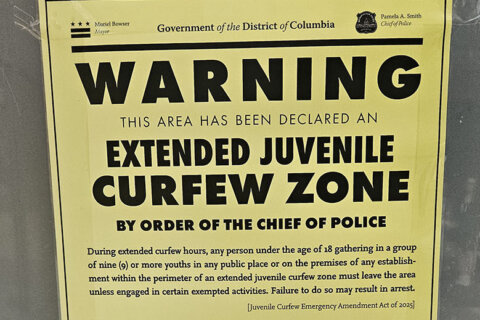
The 13-member D.C. Council voted 8-5 in favor of creating a permanent youth curfew during its legislative session Tuesday.
The move clears the way for a second council vote May 5 when it would face congressional review before taking effect in the fall.
Council member Janeese Lewis George was among the “no” votes, saying that studies from other cities show that “curfews do not result in fewer instances in youth-involved crime, public disturbances or high-risk behaviors.”
Council member Zachary Parker told his colleagues he would be voting “no” on both the permanent curfew bill and an emergency measure. Parker said the government cannot be a substitute for parents.
“Families and guardians have a fundamental responsibility to guide and supervise their children. I’m going to say that one more time, because it takes a village,” he said.
Council member Robert White, a candidate for delegate to Congress, also voted “no” on the permanent curfew bill.
“How is it that we always have the money to incarcerate and handcuff, but we don’t have the money to prevent (youth crime)?” he asked. “We can’t keep going in this circle and expect anything other than what we have.”
Ward 3 Council member Matt Frumin voted in favor of the bill, saying, “We need to be lifting up these kids, but we also need to be protecting our communities and our kids.”
How curfews are working
During a discussion prior to the vote, Ward 2 Council member Brooke Pinto, who lead the push on the legislation, was asked what evidence there is to show curfews actually work when it comes to public safety and young people.
“The most persuasive evidence that I hear is from parents who’ve reached out to say thank you for giving the police this tool,” Pinto said.
Several times, council members commented on a recent social media post that showed a D.C. police officer pulling two girls off an e-bike and then standing at the top of an escalator at the Navy Yard Metro station calling out, “We’re going to get you!”
Council member Wendell Felder called the images “extremely concerning” and said they should be investigated.
Pinto agreed that the incidents were troubling, and said, “These instances are unacceptable and these cases have been referred to the office of police complaints.”
She added that she would continue to work so curfew zones “are implemented properly and safely.”
While the council gave the initial green light to the permanent curfews, the push to extend the current declaration by D.C. Mayor Muriel Bowser with emergency legislation failed to advance.
D.C. Council Chair Phil Mendelson moved to table the vote on emergency legislation, which would have extended curfew zones for another 90 days and needed nine votes to pass.
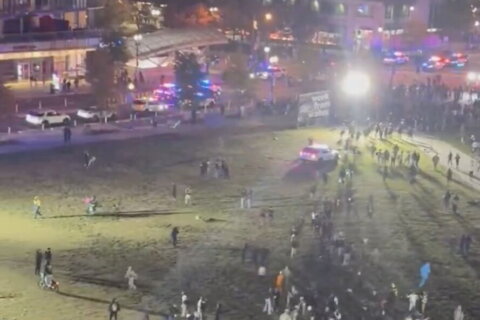
Mendelson explained the postponement by saying the curfews are in reaction to “something new and different,” referring to the teen meetups organized on social media that have resulted in hundreds of young people flooding neighborhoods like the Navy Yard.
“We are not alone in this discussion. And by that I mean, there are folks who are not friends to the District who are looking very intently at what we are doing or not doing,” Mendelson said. “I’m not interested in giving them any talking points or ammunition.”
The failure to vote on the emergency measure before the next scheduled legislative session May 5 means that the curfew in place under Mayor Bowser’s declaration will lapse.
Among those opposing the delay was At-Large Council member Anita Bonds, who said, “You know we kick the can, and the can doesn’t move very far, and we kick it again. We continue to put off what we cannot put off.”
Get breaking news and daily headlines delivered to your email inbox by signing up here.
© 2026 WTOP. All Rights Reserved. This website is not intended for users located within the European Economic Area.