See the full results and follow WTOP’s team coverage of the 2026 Virginia redistricting referendum online, on air at 103.5 FM or on the WTOP News app.
Virginians have approved an amendment to allow for mid-decade redistricting, clearing a major hurdle for Democrats hoping to redraw the state’s congressional maps to gain seats in the U.S. House of Representatives during the midterm elections this fall.
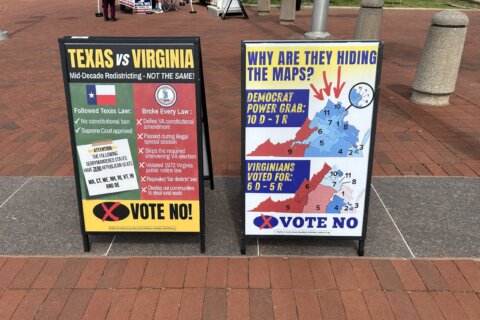
The map proposed by Virginia Democrats could give their party a 10-1 advantage, a stark change from its current 6-5 delegation.
It’s a move that Democrats argue will counteract Republican-led redistricting efforts in other states, including Texas’ successful redistricting, prompted by President Donald Trump.
Millions of Virginians cast votes in Tuesday’s special election which spotlighted a nationwide showdown over gerrymandering.
Voters were asked whether the commonwealth’s constitution should be amended to grant the General Assembly authority to temporarily adopt new congressional maps.
The Democratic “yes” campaign pulled ahead with 51.5% of the vote, while the “no” campaign is just behind with 48.6% of the vote, with 97% of votes counted. The Associated Press called the race about two hours after polls closed.
Republicans have challenged the legality of redistricting, and the Virginia Supreme Court is expected to have the final say on whether the maps can be redrawn. The court had moved to hear arguments after the special election.
If Democrats are cleared to redraw the state’s congressional lines, the party’s gains could impact the overall balance of power in Congress. The new maps would remain in effect through 2030.
Critics of the proposed map have argued it would compromise the representation of Republican voters. Under the current map from 2021, Virginia is represented in the U.S. House by six Democrats and five Republicans.
Republicans, such as former Gov. Glenn Youngkin, have voiced hopes that the state’s highest court will strike down the redistricting plan.
A narrow win for Democrats
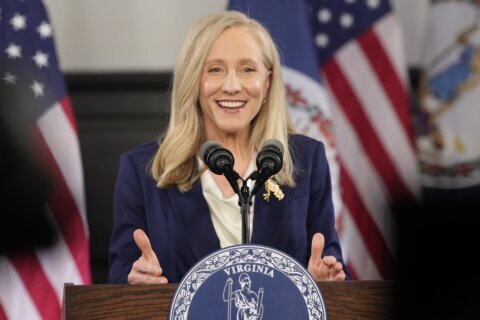
Democrats celebrated the amendment’s approval Tuesday night, including Virginia Gov. Abigail Spanberger. The Democratic governor has been critical of redistricting in the past but campaigned in favor of the amendment, arguing it’s a necessary to push back against Republicans.
“Many people like myself supported and continue to support a bipartisan redistricting commission, but recognize that at this moment in time, the need to take a responsive posture toward what we’re seeing from the Trump administration and the state legislatures, not people, legislatures that are willing to oblige him,” Spanberger told WTOP.
Virginia Senate Majority Leader Scott Surovell also praised the state’s voters Tuesday night.
“Tonight, I think Virginia voters stood up to stand for democracy in America, to say that Virginia deserves a voice at the table, and that democracy is important, and that it’s important that there be a check and balance in Congress against President Trump and unlimited power,” Surovell told WTOP.
Former President Barack Obama, who campaigned in favor of the amendment, posted on social media and warned that the redistricting battle continues. Florida lawmakers are expected to begin a special session next week as Republicans attempt to redraw the state’s map.
Congratulations, Virginia! Republicans are trying to tilt the midterm elections in their favor, but they haven’t done it yet. Thanks for showing us what it looks like to stand up for our democracy and fight back.
— Barack Obama (@BarackObama) April 22, 2026
Turnout statewide
Voters in Southwest Virginia largely sided with the “no” campaign while residents in Northern Virginia overwhelmingly voted to pass the amendment.
Early vote estimates had suggested high turnout in areas led by GOP representatives and less sizable turnout in largely-blue counties located in Northern Virginia, which are densely populated.
Turnout ahead of special election day outpaced the 2025 election in Waynesboro, Rockingham, Augusta, Shenandoah and Prince Edward counties, according to data collected by the Virginia Public Access Project.
But voting picked up in Northern Virginia as the special election closed in and additional early polling places opened up. Some counties reported a surge of voters in the final hours of voting on Tuesday.
In Fairfax County, vote totals showed 262,801 votes for “yes” and 115,280 votes for “no,” as of 11 p.m., according to the state’s office of elections.
The county’s elections office estimated about 41.1% of registered voters cast ballots in Tuesday’s election, as of 5 p.m. Turnout in 2025 reached 55%, according to the state’s department of elections.
In Loudoun County, about 88,057 voters sided with the “yes” campaign, while 57,111 voted against the amendment, as of 11 p.m., according to the state office of elections.
About 48% of the Loudoun County’s 310,406 voters cast ballots in the referendum, when combining Election Day votes with early ballots, according to the state office of elections. In 2025, turnout reached 55% in Loudoun County.
According to the Prince William County Office of Elections, voting surged late in the day. Roughly 143,678 ballots were cast as of 8:15 p.m. In the last statewide election, about 166,400 ballots were cast.
Most of those votes favored Democrats, with 90,240 going toward the “yes” campaign and 53,413 going toward the “no” campaign, according to preliminary vote totals.
In neighboring Fauquier County, a majority of voters were against the amendment with 20,480 voting “no” and 11,399 voting “yes.”
The margin was much closer in Stafford County than nearby counties with 27,604 “yes” votes and 28,113 “no” votes.
Voters on both sides press ‘fairness’
Virginians on both sides of the issue told WTOP’s Luke Lukert they want redistricting to be fair for all voters in the state and around the country.
“I wish that we didn’t have to fight back in a way that feels like fighting fire with fire, like, I wish there was an easier compromise between the parties that it was a fair system always, that it valued all people equally, and that’s just not how it’s happening across the country right now,” Diane Maloney told WTOP outside the Fairfax County Government Center Elections Office.
Rose Winston called the vote a “power play grab” by the Democratic Party.
“I came in and I voted no today,” she said. “The Board of Elections didn’t even allow the citizens to put this in the voting booth area, so they were on purpose deceptive.”
Why analysts said redistricting was a ‘hard sell’ in Virginia
Political analysts have said the debate over gerrymandering may not be divided purely on party lines in Virginia.
Just six years ago, Virginians voted to pass a constitutional amendment that restricted the Virginia General Assembly’s ability to gerrymander maps. Instead, a bipartisan commission handles drawing congressional maps once every 10 years.
That amendment’s passage was seen as Virginians taking a stand against partisan gerrymandering in 2020.
“It’s a hard sell when people have previously opposed something like this and now are in favor of it and you have to sort of make that argument and get people to go back on what they thought they believed,” Marty Cohen, a professor of political science at James Madison University, said ahead of Election Day.
WTOP’s Luke Lukert contributed to this report.
Get breaking news and daily headlines delivered to your email inbox by signing up here.
© 2026 WTOP. All Rights Reserved. This website is not intended for users located within the European Economic Area.