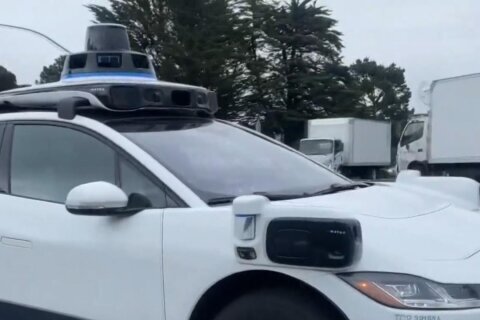
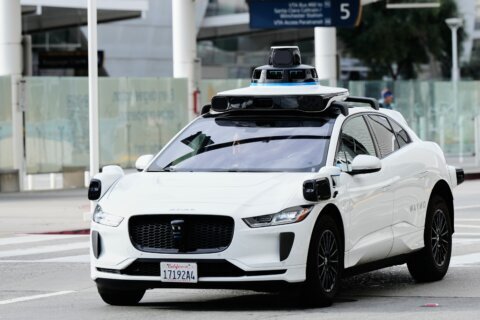
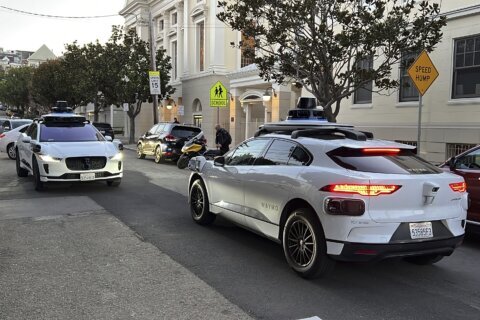
Autonomous vehicles are not a distant concept in the District. Robotaxis, driverless delivery vehicles and even self‑driving transit buses have already been tested on D.C. streets with a human operator on board, ready to take control.
As D.C. officials consider what comes next, the District Department of Transportation on Wednesday released a report examining how autonomous vehicles, or AVs, are affecting other cities that are further along in deployment.
The findings go beyond safety, looking closely at how driverless technology is reshaping local workforces, public services and equity.
The research conducted by Kimley-Horn and Associates found that in cities where AVs are already operating, traditional driving jobs have not disappeared. But as the technology advances, cities might need to invest in workforce retraining.
The report concludes that delivery trucks operating in dense, unpredictable urban environments — with double‑parked cars, cyclists, pedestrians and complex curb regulations — will likely require human drivers or on‑board operators for the foreseeable future.
Beyond drivers, the report outlines a number of indirect workforce impacts that could ripple through cities as AV use expands.
Because autonomous vehicles are programmed to follow traffic and parking laws, widespread adoption could mean fewer violations and less demand for traffic enforcement and parking tickets. Over time, that could affect both revenue streams and enforcement staffing levels.
Fewer crashes also could reduce the need for insurance adjusters, auto body repair technicians, emergency responders, hospital trauma services and personal injury attorneys. While those impacts would likely unfold gradually, DDOT’s report notes they should be part of long‑term workforce planning.
The report also highlights potential benefits, particularly for residents who do not drive.
Autonomous delivery services, it said, could help address food deserts by expanding access to groceries and essentials in neighborhoods underserved by traditional retail. Enhanced autonomous transit could improve job access for people who struggle to reach work due to unreliable or infrequent public transportation.
If paired with policies that prioritize equitable deployment and worker retraining, DDOT said AVs could support more skilled career pathways, strengthen public transit and improve mobility for non‑drivers.
AV testing already underway in D.C.
Under current District law, autonomous vehicle testing is allowed, but all vehicles must have an operator seated behind the wheel who can immediately take over if necessary.
Since 2018, testing activity has included both sustained and short‑term operations. Argo AI and Ford conducted tests from 2018 through 2022. Optimus Ride provided food delivery and limited passenger service in the Navy Yard area in 2020 and 2021.
More recently, Cruise, Nuro, Waymo and Zoox have all collected data or conducted sustained testing. Waymo returned in 2025 for expanded citywide testing and signed an intent to move toward commercial service when regulations allow.
Public transit has also entered the equation. Starting in 2025, companies Beep and Adastec have partnered with the U.S. Department of Transportation to test an autonomous bus in the District.
Get breaking news and daily headlines delivered to your email inbox by signing up here.
© 2026 WTOP. All Rights Reserved. This website is not intended for users located within the European Economic Area.