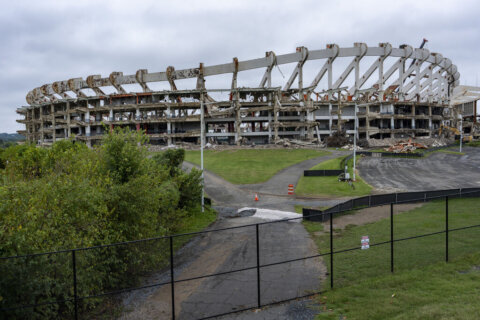
As demolition crews tear down the old RFK Stadium and plans for a new Washington Commanders stadium move full steam ahead, D.C. leaders and Metro and Commanders representatives are facing a critical question: How do you move 65,000 fans, as well as thousands of new residents, without gridlock?
That was the focus of a transportation roundtable led by Ward 6 Council member Charles Allen on Wednesday. Allen warned that decisions made in the next six months will determine whether the stadium opens smoothly in 2030.
“I’m anxious around the opportunity that every day, if we miss a key decision point or milestone, we put ourselves in a further and further and potentially even more expensive type of time crunch,” Allen said.
Metro General Manager Randy Clarke said the Stadium-Armory station, as it stands, will have difficulty handling the surge of fans and residents expected once the stadium and surrounding developments open.
Options under review include adding a new entrance or even building a new train station east of the site, but that comes with a big price tag and additional challenges when it comes to where a new station could go.
“We need, not only a flat piece of track, we need a 600-foot-long piece of track. So it’s going to be — I don’t want to say it’s impossible — but I think most people should assume it’s going to not likely be a new station hanging in the air, kind of à la Rhode Island Avenue (station). Very different layout there,” Clarke said.
Clarke also warned about a potential Red Line bottleneck at Metro Center if fans try to transfer to the Blue, Orange and Silver lines to reach the stadium. One solution being considered is a Bus Rapid Transit line from Union Station to Benning Road.
“We cannot have everyone on (the Red Line) get to Metro Center and then take Blue, Orange and Silver to the site,” Clarke said.
D.C. Department of Transportation Director Sharon Kershbaum said the city is racing to expand transit options before opening day.
“We want to make this the most transit-friendly stadium in the country, and we know that we can use all the other modes as opportunities for folks to get there, so that we can really minimize the impact on the communities,” she said, adding that plans include Bus Rapid Transit and bike access.
Potential solutions
But hurdles remain, including limited Metro capacity, neighborhood traffic fears and the need for new infrastructure.
During the roundtable, Advisory Neighborhood Commissioner Sebrena Rhodes voiced her concerns about air quality and cut-through traffic during construction.
“Diesel trucks, heavy equipment and game day traffic will increase air pollution on our streets,” Rhodes said. “Which will mean more asthma attacks, more missed school days and more health risks for children and seniors.”
Ward 7 Advisory Neighborhood Commissioner Ashley Ruff said she feels although the District is listening, it is not implementing the changes the community is calling for.
“Think about the impact that we’re going to have, having millions and millions of people coming to an area that’s already going through a whole bunch of deficits,” Ruff said.
Commanders Vice President of Communications Kirtan Mehta said the team is committed to transit-first planning, pointing to Nationals Park and Capital One Arena as examples where public transit is heavily used.
“We view Nats Ballpark and Capital One to be great examples where public transit is primarily used,” Mehta said. “That kind of showed us that, obviously, the infrastructure of the city allows for such a thing to happen.”
D.C. Department of Buildings Director Brian Hanlon, who was recently named the District’s RFK project executive, added that other cities offer lessons, among them Atlanta, Detroit and even Baltimore, which he says has a stadium accessible by car or light rail.
Council member Allen pushed back on the Baltimore example, raising concerns about the many open surface parking lots that exist around M&T Bank Stadium.
“That’s a site surrounded by oceans of asphalt and surface parking lots. So, I had to bring up pretty fast — that’s not my ideal. It’s not what I think D.C. should be building at all,” Allen told WTOP.
Officials agree the next six months are critical for locking in plans. The stadium is expected to anchor a massive redevelopment of the RFK campus, which will include retail, restaurants, housing and a hotel, creating what Allen called “a small city.”
Clarke summed up the transportation challenges with optimism.
“I’m confident. There’s robots on Mars that are drilling for water and sending Wi-Fi signals back, so we can get big things done,” Clarke said.
Get breaking news and daily headlines delivered to your email inbox by signing up here.
© 2025 WTOP. All Rights Reserved. This website is not intended for users located within the European Economic Area.