Virginia’s redistricting referendum could have a seismic political impact on congressional districts in the commonwealth, but if it passes, it could also affect the balance of power in the U.S. House.
Several states have undergone redistricting since President Donald Trump announced he wanted Republican-led states to do everything possible to add GOP seats.
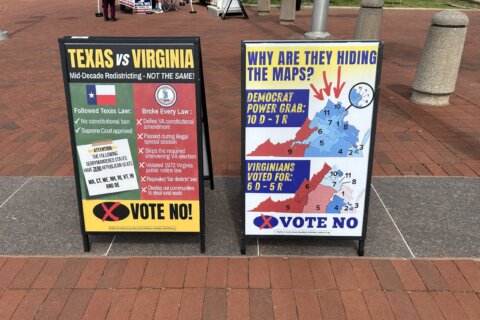
But Virginia would potentially undergo the biggest change of any state, since Democrats currently hold only a 6-5 edge in the state’s congressional delegation. Democrats could gain a 10-1 advantage with redrawn districts.
“In many ways, what happens in Virginia, may very well be the deciding factor in terms of which party controls Congress next year,” said Stephen Farnsworth, professor of political science at the University of Mary Washington. “If the amendment passes, that’s a significant advantage for Democrats going into those November 2026 midterms.”
That’s because the GOP House majority remains razor thin.
The Republican advantage is currently 217-213, with one independent. When all 435 seats are filled, exactly 218 votes are needed to pass legislation.
Currently, there are four vacancies, including those of former Democratic California lawmaker Eric Swalwell and former Republican Texas lawmaker Tony Gonzales, who both recently resigned in the wake of sex scandals.
Republicans are already at a historical disadvantage, since the House usually flips to the opposing party of an incumbent president during the midterm elections.
Referendum is viewed through ‘partisan lens’
Republican opponents of the constitutional amendment have accused Gov. Abigail Spanberger of flip-flopping on gerrymandering, pointing out that she originally supported a state commission that was designed to make redistricting less partisan.
But Democrats said they could not ignore what Republicans have been doing in other states like Texas, where a redistricting plan was ultimately given a green light by the U.S. Supreme Court.
“The reality is that a lot of the people who support this amendment are arguing that Trump started this and not to fight fire with fire is unilateral disarmament,” Farnsworth said.
He pointed out that people who oppose the amendment in Virginia may not necessarily oppose similar efforts in other states.
“There is very much a dynamic here of looking at these issues through partisan lenses, and that’s a key part of the campaign on both sides right now,” Farnsworth said.
Supporters of the amendment have managed to raise more money than those who oppose it, but political analysts say it is still hard to predict a special election like this. The latest polls have indicated a slight edge for backers of the amendment, which was strongly opposed in one of the first polls conducted earlier this year.
Farnsworth said he is a bit surprised Republicans haven’t poured more money into the campaign against the referendum, given what’s at stake.
“There is a narrative out there that is potentially a compelling one — the idea that Virginia just decided to stop gerrymandering a few years ago and now the plan would be to restart it,” he said.
Many Virginians have already voted
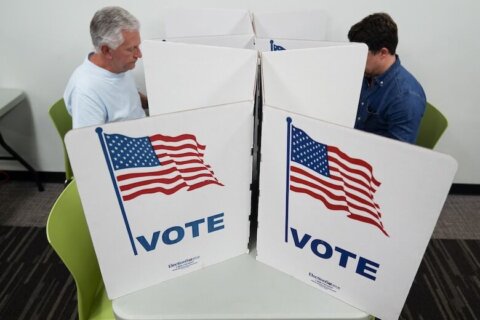
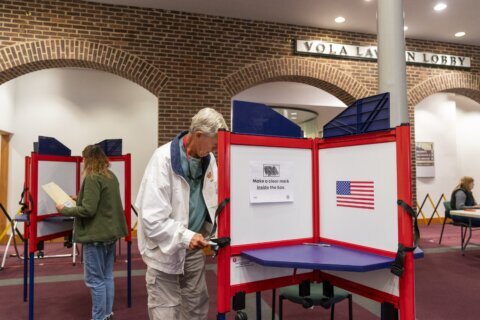
The polls for voting on the referendum will open Tuesday, but over a million people have already cast their ballots through early voting.
“The numbers are high, comparable to the early voting in the gubernatorial election last year,” Farnsworth noted. “That suggests this is something that is resonating with a lot of Virginians.”
If the amendment is approved, it will affect voters across the state.
Many voters could end up in different districts, even if they’ve lived in the same homes for decades.
Farnsworth pointed out that many of the redrawn districts “stretch out from Northern Virginia like spaghetti strings,” to include areas that are more favorable to Democrats.
It could include challenges for voters, as well as congressional candidates.
“You may be in one district today and you may be in a very different district after the election,” Farnsworth said.
Get breaking news and daily headlines delivered to your email inbox by signing up here.
© 2026 WTOP. All Rights Reserved. This website is not intended for users located within the European Economic Area.