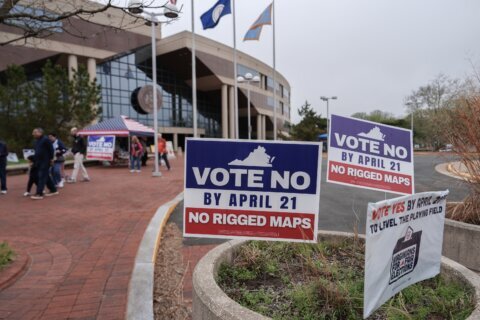
In the days ahead of a special election that could clear a major hurdle in Democrats’ redistricting battle, both parties are pushing to get voters to the polls in Virginia.
Until Saturday, early voting in Northern Virginia was largely muted compared to sizable turnout in parts of the state currently represented in Congress by Republicans.
More polling locations opened for early voting in Northern Virginia last weekend during a “Super Saturday” campaign from Democrats.
Experts say that appears to have boosted early voting numbers. Roughly 40,000 votes were cast Saturday in Northern Virginia counties, according to data collected by the Virginia Public Access Project.
“It is really difficult in places like Fairfax County, for example, to actually physically get to the county registrar’s office in order to cast a ballot,” said Karen Hult, a professor of political science at Virginia Tech.
In Fairfax County alone, 17,000 ballots were cast at early voting locations Saturday.
Just one question is on the ballot in the April 21 special election. The proposed amendment would allow Democrats to temporarily redraw Virginia’s congressional maps to benefit their party — a strategy they argue is a response to Republican-led redistricting efforts in other states.
Even if voters approve the amendment, the Virginia State Supreme Court will have the final say on whether mid-decade redistricting is legal.
“I think things are up in the air,” said Marty Cohen, a professor of political science at James Madison University. “The route of this can be changed. The momentum can be shifted.”
A recent Washington Post-Schar School poll found narrow support for the measure from voters who had already cast their ballots or planned to vote.
If passed, the redrawn map could shift enough seats to cancel out Republican gains from redistricting in other states and secure Democrats a majority in the U.S. House.
Turnout on track to meet Virginia’s 2025 general election
Typically, special elections have lower turnout than primaries and general elections. But even with that precedent, Hult said early voting estimates “are pretty well picking up and tracking what they’ve been since the last statewide election.”
Experts who spoke with WTOP believe more voters have turned their attention to the referendum as the special election day approaches.
“It may be that some people just have not been motivated to go quite yet, and maybe they need a little bit more of a push in an election where nobody, no individual person, is on the ballot,” Cohen said.
Roughly a million votes have already been cast, according to the Virginia Public Access Project.
Campaigns on both sides of the referendum have expressed optimism in their outlook.
A group on the “yes” side of the redistricting debate, Virginians for Fair Elections, is encouraged by turnout during early voting.
“We’re very excited to see the energy that was on the ground this past Saturday,” said Keren Charles Dongo, the campaign manager for Virginians for Fair Elections. “We had canvass kickoff events throughout the commonwealth. Great turnout. People are tuning in.”
Meanwhile, Republicans have also said there’s momentum in their push against gerrymandering.
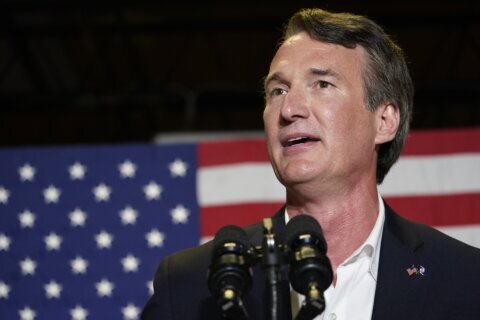
In an interview with WTOP, former Republican Gov. Glenn Youngkin pointed to recent polling that showed a drop in Democratic Gov. Abigail Spanberger’s approval rating as evidence of Virginians’ dissatisfaction.
Youngkin said Spanberger spoke out against redistricting while on the campaign trail. She has since urged Virginians to support the amendment.
A challenge for Democrats
Spanberger’s previous stance on the amendment highlights a challenge Virginia Democrats have faced in their efforts to redraw the map: convincing other members of their party to approve the amendment despite past pushback to gerrymandering.
“There’s a cognitive dissonance among many progressive Democrats that for years have railed against partisan gerrymandering, and now are ready to go and do that in Virginia,” Cohen said.
In 2020, Virginians voted to pass a constitutional amendment that allows for a bipartisan commission to draw congressional maps.
The proposed amendment would allow Democrats to temporarily redraw maps ahead of the 2026 midterms. The maps would then stay in effect through the 2028 and 2030 elections before returning the powers to the bipartisan commission.
Virginia is currently represented in the U.S. House by six Democrats and five Republicans. The new map is designed to give Democrats a 10-1 advantage.
Democrats have tried to make the case that redistricting is a temporary tool to combat President Donald Trump and maintain fairness in the U.S. House as some GOP-led legislatures redraw their maps to favor Republicans in the midterms.
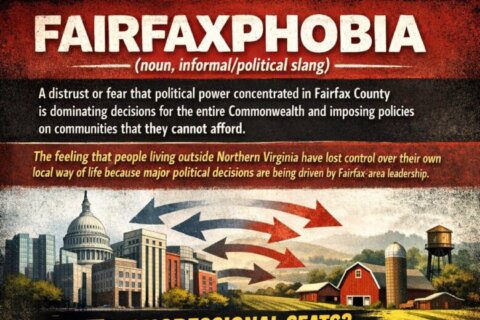
Republicans have said the redistricting would unfairly impact members of their party by combining their districts with areas led by Democratic representatives. For example, the revised map could include parts of Fairfax County in five separate districts.
Hult said the redistricting battle highlights a perceived disconnect between voters and politicians.
“Elected officials seeming to run everything and not paying as much attention to what people care about, which is terms of gas prices and food prices and access to housing and day care and things like that,” she said of frustrations from Republicans and some independents.
“What we’re seeing some of the Democrats do, arguably, is confirming the caricature of Democrats in the national stage.”
At this point, Hult said it’s no longer about trying to convince Virginians to vote “yes” or “no.”
“The most important thing is you get closer to an election is to mobilize the people you think are going to vote on your side,” she said. “That is either vote no or yes, and to try to demobilize those that may not turn out to vote at all.”
Get breaking news and daily headlines delivered to your email inbox by signing up here.
© 2026 WTOP. All Rights Reserved. This website is not intended for users located within the European Economic Area.