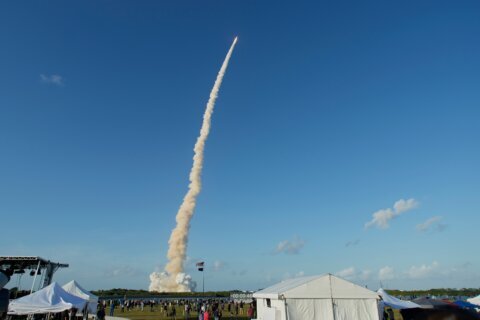
Four astronauts in the Artemis II Space Launch System successfully launched into space Wednesday, marking the start of NASA’s renewed push to get to the moon, and eventually build a base there.
Artemis astronauts Reid Wiseman, Victor Glover, Christina Koch and Jeremy Hansen are on board. They’ll hurtle several thousand miles beyond the moon, hang a U-turn and then come straight back. The mission is set to last less than 10 days.
WTOP covered the first portion of the itinerary here. More excitement is in store in the later days of the mission.
After about a four-day voyage, the crew will review the lunar flyby imaging plan on Day 5. That will be done in two shifts, with two astronauts looking out Orion’s windows with cameras and writing what they see in their personal computers.
In the first hour of Day 6, the crew will make its closest approach to the moon, and minutes later will reach its maximum distance from Earth.
Here is how NASA describes the flyby.
After the TLI burn that sent Orion on its path to the Moon, the lunar science team began building a Lunar Targeting Plan, a guide to what the crew will look at on the Moon’s surface during its approximately six-hour observation on Monday, April 6.
The targeting plan will include documenting features that can help scientists understand how the Moon and solar system formed, such as craters, ancient lava flows, and cracks and ridges created as the Moon’s outer layer slowly shifted over time.
One feature that will be added to the plan is a solar eclipse, which will last for nearly an hour toward the end of the flyby window. During the eclipse, the Sun will be hidden from view as it moves behind the Moon from the perspective of Orion. The crew will see a mostly dark Moon at this time — an opportunity for them to look for flashes of light from meteoroids striking the Moon’s surface, dust lofting above the edge of the Moon, and deep space targets, including planets. While the Sun slides behind the Moon, the crew will observe the solar corona, the Sun’s outermost atmosphere, while it’s visible.
The astronauts, using safe sun viewing glasses, will also witness an eclipse of the sun and see the solar corona.
Artemis mission project scientist Noah Petro is very familiar with the moon, as he was the project leader for Lunar Reconnaissance Orbiter, which has been absolutely crucial to supporting Artemis.
Petro said Lunar Reconnaissance Orbiter images of the moon were used to make a movie simulating what the astronauts would see through the windows of Orion and help in their lunar science training. They also conducted classroom sessions and field geology training in Iceland (parts of that country really do look like the moon).
“A human eyeball connected to a trained brain is a very powerful combination,” Petro told WTOP.
He said the time of the launch determines precisely what the Artemis II crew will see on the far side of the moon. The hope is that they will be able to see an almost fully illuminated far side disk, including areas that have never been seen by human eyes, since Artemis II will fly a different profile than the Apollo astronauts did.
The crew will also get a glimpse of the moon’s South Pole — a prized area for human exploration.
One big difference between the Apollo and Artemis missions, which is a huge advantage for exploring and imaging the moon, is the altitude above the lunar surface.
Petro said Artemis II is 4,000-6,000 miles above the moon, compared with the 60-70 mile altitude of Apollo. That height allows for a wide, global assessment of lunar features.
The moon will appear as big as a basketball held at arm’s length through the windows of the the Orion spacecraft. There will be two separate shifts during the approximately four-hour flyby; one crew member will image the moon with a proven rugged camera and the other will document observations.
Petro described the mission as a “lunar linchpin.” It will bring the legacy of Apollo and the promise of Artemis together. That is a very powerful combination.
Stay tuned to WTOP for ongoing coverage of Artemis II.
GO ARTEMIS II!
Follow my daily blog to keep up with the latest news in astronomy and space exploration.
Get breaking news and daily headlines delivered to your email inbox by signing up here.
© 2026 WTOP. All Rights Reserved. This website is not intended for users located within the European Economic Area.