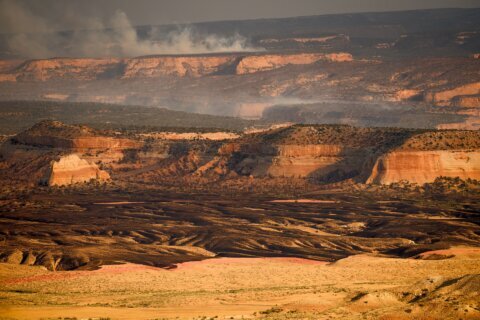
Five firefighters battling a fast-moving wildfire in Colorado were forced to deploy their fire shelters when they couldn’t escape the flames. Three of them were overcome and died, while two were injured and hospitalized.
Fire shelters are mandatory equipment for crews who work across rugged terrain where things can change at a moment’s notice, especially when extremely dry and windy weather drives the flames, as happened last Saturday.
Fire shelters have saved hundreds of lives over the years, but officials caution that the equipment doesn’t guarantee protection in every scenario. Instead, the focus is on having well-defined escape and safety zones.
“Ideally they’re trying to escape and avoid that entrapment,” said Shawn Steber with the U.S. Forest Service’s National Technology and Development Program in Montana. “But if it comes down to it and it’s their last kind of thing they can bring out for their protection, then yes, in that sense it is kind of that last line of defense.”
Fire shelters are made of multiple layers
Crafted from aluminum foil, silica fabric and fiberglass, fire shelters are designed to protect users from the intense heat of flames and to trap breathable air inside as a fire passes. Inhaling hot gases from a fire can damage the airway and lungs.
The ability of a fire shelter to withstand heat depends on how long its materials are exposed to heat and other factors, Steber said.
The one-time-use shelters have been improved occasionally. A recent change made the shelters stand up better when deployed, said John Montrastelle, a sales manager with Anchor Industries, a maker of fire shelters.
“Whenever there’s an incident, a loss of life, there’s more discussion and more talk about a better shelter, a better fire shelter, something that will protect the firefighter in higher temperatures,” he said.
Other modifications include a one-piece floor, improved hold-down handles and reduced bulk, Steber said.
Fire shelters weigh around 6 pounds and are folded up inside several protective layers in a firefighter’s pack. Moisture, sand, debris and rough use can damage them.
Using a shelter takes training
Wildland firefighters have been required to carry fire shelters for decades. Training typically occurs once a year, often during a hike or while practicing digging a fire line. It’s also part of training for cadets hired by local firefighting agencies.
Firefighters are trained to set up their shelters within 30 seconds or less and as early as possible when needed, Steber said.
“We try to teach people ‘within 30 seconds or less,’ but also at the same time, ‘deploy as early as possible,’” Steber said.
The nature of the fire determines how long a shelter user stays inside, whether the fire flashes over them or stays put, Montrastelle said. They can also be used in the event of a freak storm that might drop hail or snow.
When considering escape, guidance shared by national experts reminds firefighters that they can hold their breath for only about 15 seconds while running through flames or superheated air and need to get on the ground before the flames arrive.
A fire shelter is deployed by removing it from the bag or casing protecting it, shaking it to expand it outward, climbing inside and holding it down with your arms, knees and feet to keep out flames and hot air.
“No matter how bad it gets inside, it is usually much worse outside,” the guidance states. “If you panic and leave the shelter, one breath of hot, toxic gases could damage your lungs. Suffocation may follow.”
Shelter use is rare
From 2021 to 2025, four shelter deployments occurred, including two last year and none in 2022 or 2023, according to statistics available from the National Wildfire Coordinating Group. In 2020, 30 deployments occurred, almost all in California.
The recent lower numbers are likely due to a variety of factors, including the nature of fire seasons, including the number of large fires requiring the use of fire shelters, Steber said.
In 2013, 19 firefighters died in the Yarnell Hill Fire in Arizona. Firefighters were deploying their shelters when flames overtook them in a steep canyon. It was nearly a decade earlier that 14 firefighters perished in the South Canyon Fire in Colorado.
Other firefighters have survived in shelters. During the 2015 Twisp Fire in Washington, two crew members used shelters, but three others died in a truck.
A full investigation lasting months will unfold into the circumstances around the three firefighters’ deaths last weekend.
Montrastelle said he hopes studies of the tragedy will result in teachable information for what fire crews should look for when fighting a fire.
“It’s a combination of events that led to somebody deploying, because they’re split-second decisions that are being made,” he said.
___
Dura reported from Bismarck, North Dakota. AP writer Susan Montoya Bryan in Albuquerque, New Mexico, contributed.
Copyright © 2026 The Associated Press. All rights reserved. This material may not be published, broadcast, written or redistributed.