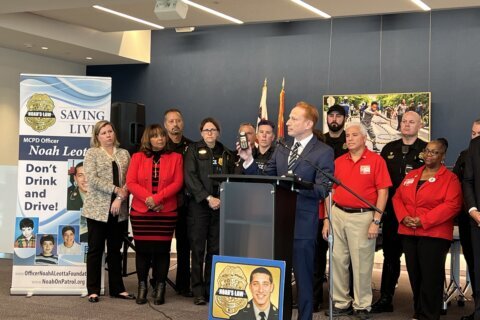
Lawmakers in Annapolis faced questions from the witness table in the House Judiciary Committee room on Wednesday.
The first question came from St. Mary’s County State’s Attorney Jaymi Sterling, who asked lawmakers, “What is a life worth?”
Sterling, who sat with a panel of witnesses made up of families who lost loved ones to crashes involving drunk drivers, let the question hang in the air for a second and continued, “Because I’m left explaining to these grieving families that the penalty for vehicular homicide or manslaughter by vehicle is just 10 years.”
Sterling pointed out, even when sentenced to the current maximum of 10 years for the offense, those serving time are eligible for parole after serving one quarter of their sentence.
John Duckett, whose 18-year-old son Jamari was killed after being hit by a drunk driver in 2022, asked lawmakers a second question. “How do we get any justice?”
“The guy that killed my son, he got 10 years. He only had to do 25% of that time. He’s home already,” Duckett said.
House Bill 873, named Jamari’s Law, would increase the maximum period from 10 to 20 years for a conviction in manslaughter by vehicle case.
In contrast, Duckett said his family is “still grieving.”
Like John Duckett, Ruth Hopson Taylor also grieves the loss of a child.
Taylor’s son, Jazz, 30, was killed in a crash in Burtonsville in August 2025.
“Driving under the influence is not a mistake,” she said. “It’s a conscious decision.”
A decision, she told the committee members, “that leaves empty seats at the wedding, birthday, holidays, graduations.”
Tougher penalties, she said, are not about revenge, “they are about accountability.”
Tamara Stofa, the District Public Defender for Maryland’s Upper Eastern Shore, testified in opposition to the bill. She acknowledged the emotional testimony that preceded her comments to the panel, but said, “Increasing penalties can often feel like a way to prevent these unintentional and tragic crimes from happening.”
“Harsher penalties don’t often stop people who didn’t intend to commit a crime,” she added.
Maryland Del. Susan McComas told Stofa, also noting the intense emotions shared by families who lost loved ones, “I admire you for your bravery to testify after this.”
“These dudes shouldn’t have been driving at all, absolutely at all,” McComas said. “I don’t know what the answer is for this bill.”
But she said the testimony she heard hit hard: “That’s the worst I’ve ever seen, as far as victims. And I’ve been here a while.”
The bill has failed to pass the General Assembly in the past, but Sterling said she’s hopeful that this year, it may garner enough support to become law.
Get breaking news and daily headlines delivered to your email inbox by signing up here.
© 2026 WTOP. All Rights Reserved. This website is not intended for users located within the European Economic Area.