This article was republished with permission from WTOP’s news partners at Maryland Matters. Sign up for Maryland Matters’ free email subscription today.
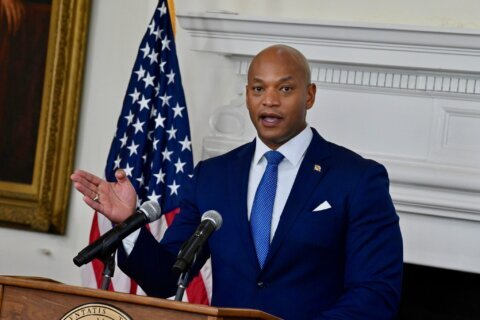
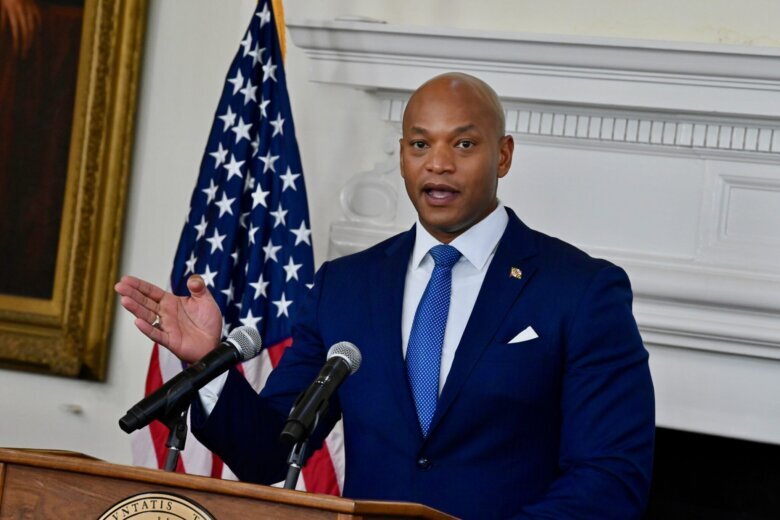
Gov. Wes Moore (D) unveiled a $70.8 billion fiscal 2027 budget proposal Wednesday that he said increases funds for education, housing and police initiatives, while closing a $1.5 billion budget gap without increased taxes or fees.
The budget, the last of Moore’s curent term, comes as the state grapples with deep cuts to the federal workforce and a stale economy.
“We know the numbers and Maryland is going to be forced to do more with less,” Moore said at a news conference to release the budget. “But here is what I want everyone in the state to understand: Being fiscally responsible and being fiscally disciplined does not mean we stop investing in what matters most to the people of the state of Maryland. It does mean that we’re going to be more targeted. We’re going to be more data driven about how we invest.”
The budget relies on cuts and fund transfers or swaps of bonds for cash.
“This budget does not raise taxes or fees on Maryland.” Moore told reporters.
House Minority Leader Jason Buckel (R-Allegany) said the budget “is largely based on accounting tricks” that do not make meaningful changes in spending.
“We are spending more than last year, increasing Medicaid and Blueprint education spending, and neither cutting the size of state government nor reducing its costs,” Buckel said in a statement. “Luckily, the stock market and the national economic growth enabled our revenue to continue to grow, creating the illusion that Maryland is on a steady fiscal course, which is not true at all.”
Included in the overall budget is the $27.7 billion state general fund budget — the portion for which the state directly taxes Maryland residents. That’s about $154 million lower than the expected appropriation of nearly $27.9 billion for the current general fund budget, which increased by more than $950 million because of higher than expected spending in programs such as Medicare.
Moore said the budget was developed in consultation with the legislature.
“Our administration did not simply submit this budget to the General Assembly,” Moore said. “We collaborated, and we worked with the General Assembly. The General Assembly members we had the honor of working with, they can see their work, their fingerprints all over this proposed budget.”
To close the projected gap, Moore relies on nearly $1.1 billion in cash transfers. Included in that is $150 million from the local income tax reserve account. Budget officials said the money represents an overpayment to the account that will not have to be paid back.
The budget also includes a number of swaps of bonds for cash.
The state planned to send $167 million to the Washington Metropolitan Area Transit Authority in the coming year. The payment would have come out of the operating budget. Instead, Moore plans to use the cash to balance the budget. Borrowed money that could be used for other projects such as school construction and renovation will be used for the WMATA payment.
Other transfers include:
- $292 million from the Strategic Energy Investment Fund.
- $145 million from the Rainy Day fund, taking the balance to 8% of general fund revenues, in line with a legislative recommendation. That amount is higher than the legally required 5% minimum. hhjkii
- $187 from the Fiscal Responsibility Fund, an account that holds capital gains taxes — a volatile revenue source.
Moore takes another $100 millions from the Strategic Energy Investment Fund to again give utility customers a one-time payment of $40 to offset high utility bills. The amount is half that given last year.
The SEIF — which is used for energy efficiency and clean energy projects, like programs for low- and moderate-income Marylanders — has ballooned in recent years as utilities have opted to pay into the fund for “alternative compliance payments” rather than complying with state mandates for the share of renewable energy they must supply.
In fiscal 2025, nearly $365 million worth of alternative compliance payments went into the SEIF, representing about 54% of its proceeds. Previously, these payments had been a minority contributor to the fund.
Solar alternative compliance payments have increased in part because the legislature in 2019 increased the solar energy mandate for utilities, according to a January report from the Maryland Energy Administration. Non-solar payments have soared because energy markets routinely made the alternative compliance payments cheaper than the mandated “renewable energy credits.”
Last year, the governor and legislature faced a $3.3 billion structural budget deficit. The budget was balanced using a combination of cuts, one-time fund transfers and $1.6 billion in tax increases to end the 2025 session with a projected budget surplus of $300 million for the coming year.
But last fall, officials learned the forecast surplus had become a projected deficit approaching $1.6 billion, including $1.2 billion in cash. The administration and lawmakers pointed down Route 50 to the policies of President Donald Trump for the change in the budget.
“Simply put, Donald Trump happened,” said Acting Budget Secretary Yaakov “Jake” Weissmann.
Despite conservative revenue forecasts, Maryland felt the brunt of federal workforce reductions. So far, almost 25,000 federal jobs in Maryland have been cut. Tariffs and inflation also played a role.
Weissman said “what nobody could have predicted was the chaos in D.C. The abdication of responsible governing and the attacks that hurt Maryland more than any other state in the nation, costing 15% of our federal workforce their jobs and increasing budget costs in a variety of ways.”
Del. Jefferson Ghrist (R-Upper Shore), a member of the House Appropriations Committee, blamed the state’s budget problems on profligate spending.
“I have seen nothing in the Governor’s budget proposal that addresses the long-term issues that have created these giant budget holes,” Ghrist said in a statement. “We are just setting Marylanders up for another round of tax increases after the election. It is disappointing.”
The budget also contains some difficult choices including $150 million in cost containments within the Developmental Disabilities Administration. Advocates said the combined cuts including federal match reduces funding by $300 million.
“Since last session, the Moore Administration has engaged with stakeholders to discuss financial and programmatic issues related to DDA programs,” Laura Howell, CEO of the Maryland Association of Community Services, said in a statement. “While those discussions are appreciated, we are concerned about the impact of the proposed FY27 cuts, on top of budget cuts that were sustained in FY26. The current proposal will need to be assessed and refined in order to avoid further negative impacts on Marylanders with developmental disabilities.”
Last year, advocates rallied to restore proposed funding cuts to the Developmental Disabilities Administration.
Local governments will also be asked to dig deeper.
“I would say we’ve worked with our local jurisdictions to come to these solutions,” Moore said. “We’re pushing costs on locals because when locals look at their budgets, they know what percentage of their budgets are also … underwritten by the state. This is just making sure that we are both aligning on priorities and ensuring that there is a measurement of sharing when we think about how we’re going to fund these priorities.”
Weissmann, during the news conference, said the budget includes shifting 50% of increased retirement costs in K-12 education, community colleges and libraries to local governments, at an estimated cost of $39 million.
The proposal also flat funds disparity grants to local governments at current year levels.
“Local government aid goes up this year in the budget even with that cost shift,” Weissman said. “Our local governments are receiving more money this year from the state than they did last year.”
Community colleges will also see some state funding formulas capped at a maximum of 3% based on enrollment.
Republican Minority Leader Sen. Stephen S. Hershey Jr. (R-Upper Shore) expressed concerns about shifting costs to local governments. While the budget does not appear to raise taxes or fees, “there is a lot beneath the surface that gives us pause.”
“The proposal shifts additional responsibilities to counties and municipalities, putting local governments in a position where higher local taxes become more likely. It also relies on moving and raiding funds to support ongoing spending,” Hershey said in a statement. “Now that the budget is in the hands of the General Assembly, we’ll see how it ultimately takes shape — but what’s missing is a firm commitment from the Governor to stand against any tax or fee increases that could be added during the legislative process, especially given what Marylanders experienced last year.”
Legislative budget analysts will dissect the budget for House and Senate fiscal committees Monday.
In December, the Joint Spending Affordability Committee recommended the governor hold the line on hiring. The panel asked that Moore create no new positions and fill only critical jobs.
But this budget creates 419 new positions, and converts almost four dozen contractual jobs into state employees. These increases are offset by the elimination of 207 jobs.
Moore is also seeking to recouple some business tax provisions in President Donald Trump’s signature tax-cut legislation. The budget anticipates that Maryland tax code will adopt three provisions in the federal law: the research and experimentation expenditure deduction; small-business expensing; and the business interest deduction.
Doing so will reduce state revenues by about $100 million. Budget officials said they believe the reductions will be offset $132 million by decoupling from two other tax provisions in the bill. A large portion of that savings goes away in three years as some provisions expire.