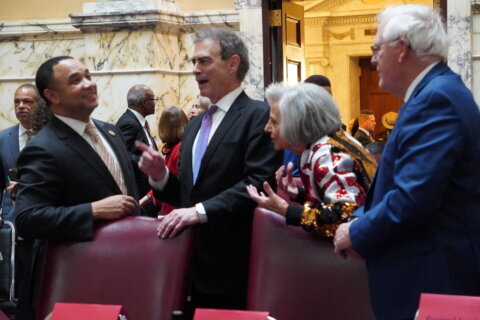
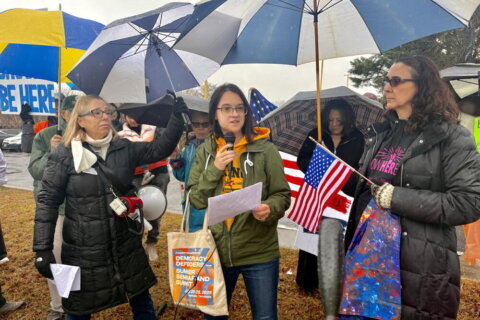
While affordability and the state’s budget are the themes talked about by Democratic legislators, some of the laws they intend to quickly pass will target the efforts of federal immigration officers operating in the state of Maryland.
One bill, Senate Bill 1, which is reserved for legislation that wants to make a symbolic point, would prohibit federal law enforcement officers from wearing masks while conducting normal operations.
“I think all of us can sit back and imagine if you’re sitting in your car and somebody runs up to you, even as a law enforcement agent that quickly shows us a badge and has their face covered, I know I would be terrified,” said Senate President Bill Ferguson. “It’s just not how you build trust in policing.”
With a super majority in both chambers, a version of the bill is expected to pass over the objections of Republicans like Frederick County State Sen. William Folden.
“I don’t think that as a state, we’re allowed to tell the federal government — we can’t tell them what their policies are going to be,” Folden said. “Let’s be very transparent on this. If we didn’t have… activists going out and doxing these agents and their families and putting their addresses out on social media and endangering them — their well being — as well as their family. You wouldn’t have this problem.”
Folden, who spent decades with Maryland State Police, calls the bill an “irrational response” from Democrats who want to distract voters from issues of affordability, especially as it pertains to energy bills around the state.
Ferguson said under the 10th Amendment to the U.S. Constitution, the state has the power to pass bills like this.
“Anything that is not expressly outlined in the Constitution is the responsibility of the state,” Ferguson said. “How a law enforcement entity operates in the state of Maryland is subject to Maryland state laws and constitution.”
Folden expressed skepticism about that.
“I don’t know that that’s accurate,” he said. “They’re literally federal law enforcement officers that have a job description, and they’re enforcing the law of the land.
Folden compared the high number of deportations under former President Barack Obama’s administration to ICE’s operations in the U.S. under President Donald Trump.
“We didn’t see this,” he said. “We didn’t see these people out there doxing federal agents.”
Ferguson did admit the issue would likely end up in the courts.
Another issue likely to be decided in a courtroom is the participation of local enforcement agencies with Immigration and Customs Enforcement’s 287(g) program, which allows local officers to help ICE identify and remove noncitizens arrested for another crime. Efforts to keep local agencies from participating in that program stalled out last year.
Ferguson and House Speaker Joseline Peña-Melnyk say that won’t happen this time.
“Immigrants deserve to live with dignity and respect,” Peña-Melnyk said. “How can we as Americans stand by the disrespect? The abuses? People losing their lives? Racial profiling? Civil rights violation?
“It doesn’t matter whether you’re a Republican, a Democrat,” she added. “What’s right is right, what’s wrong is wrong. You don’t treat any human being that way. My God, that I believe in, loves everyone.”
Ferguson described ICE as a “paramilitary force” that was “offensive to humankind” during his comments Wednesday.
“Of course, we should enforce the law, but we don’t need to do it in a way that disrespects humanity,” Ferguson said. “So until there is a major shift, until there is a major restructuring of how that organization functions, Maryland should not be partnering and furthering an organization that does not follow Maryland values.”
But Folden touted the system and said scrapping it will only lead to more chaos.
“The process we have in place is very uniform,” Folden said. “It’s justified, as they’re already under arrest for another offense, and it’s not invasive into our communities, as far as boots on the ground going in and being disruptive. It’s only when they have another contact with law enforcement for an arrestable offense.”
He said the elimination of the program in Maryland would likely lead to the sort of efforts and encounters happening in Minnesota.
Folden also isn’t sure the state has the power to tell elected sheriffs, whose jobs exist under the state constitution, when they can and can’t engage with federal agencies. If the bill is passed into law, it’ll be a judge who makes that determination.
“They’re already lining up. They’ve already got counsel,” said Folden, about some sheriffs’ offices. “They’re lining up because everyone can see the writing on the wall. It’s about virtue signaling. It’s not about anything else except hiding their own mismanagement of funding and taxpayer dollars.”
Get breaking news and daily headlines delivered to your email inbox by signing up here.
© 2026 WTOP. All Rights Reserved. This website is not intended for users located within the European Economic Area.