This article was republished with permission from WTOP’s news partners at Maryland Matters. Sign up for Maryland Matters’ free email subscription today.
The first day of the General Assembly is traditionally a time for more back slaps than broadsides, more applause lines than arguments, and opening day 2026 was no exception.
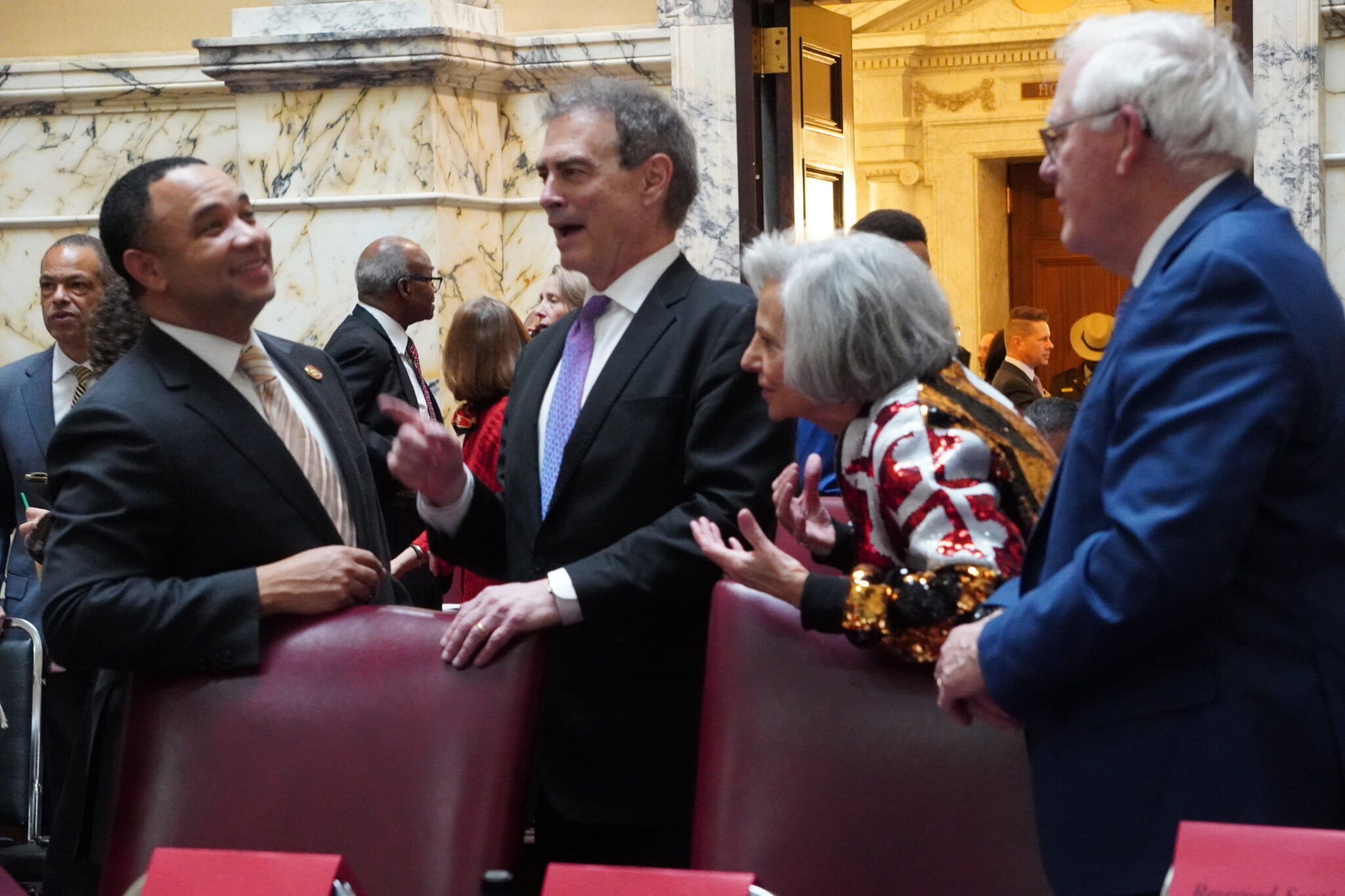
The actual business of the day took about an hour in the Senate, about and hour and a half in the House, as each chamber elected its leaders for the session, approved rules and read the first batch of bills across the desk — 231 in the Senate and 301 in the House.
Each chamber was packed with family members, former member and visiting state and local officials — and an international visitor in the House, where the ambassador of the Dominican Republic was on hand to witness the swearing-in of new Speaker Joseline Peña-Melnyk (D-Prince George’s and Anne Arundel), a native of the island and the first Afro-Latina leader of the chamber.
Peña-Melnyk spent a chunk of her nearly 30-minute speech heaping praise on former Speaker Adrienne Jones (D-Baltimore County), who was the first woman and first Black lawmaker to lead either chamber of the Maryland General Assembly when she was sworn in in 2019. She announced in early December that she was stepping down as speaker, but would retain her seat as a delegate.
“You have made it possible for someone like me, this little island girl inside, to come here and dream of this possibility,” Peña-Melnyk said to Jones, who was seated front-row center in the House.
“One day as we look at all these men in the chamber in these pictures, your picture, your portrait is going to be here,” Peña-Melnyk said, pointing toward the paintings of former House speakers, all men, that ring the chamber. “When little girls come into this chamber, Madam Speaker, your picture will be here and they can dream and they can see it’s possible. You did that.”
Ferguson, who enters his seventh session as leader of the 47-member Senate, spent 3-4 minutes of his roughly 10-minute speech delivering a short history lesson on America and the importance of state governments, as the country celebrates 250 years.
“This is the first time in humankind that this many people in a single country have operated under the same system of representative democratic government for this length of time. The American experiment has not been without significant challenges and extremely painful flaws,” Ferguson said. “That said, the fundamental promise, though, is of a better society over time that is rooted in justice, equality and opportunity has propelled our nation ever forward.”
Ferguson also highlighted lessons he learned from a legislative conference he attended last month in Ohio. Because of what’s going on in the federal government, he said action at the state level “is the only way … to restore people’s trust in government. States truly are the laboratories of democracy. It has been that way for 250 years.”
Most of the day’s speeches were not so weighty, however. Much of the floor time was taken up by lawmakers lauding the nominees, interrupted often by standing ovations. Leaders thanked their families, their constituents, their staff and others.
They often joked with members of their chambers or visitors. After Sen. Malcolm Augustine (D-Prince George’s) was unanimously chosen to remain as president pro tem of the Senate, he thanked Ferguson “for his confidence and partnership and his haircut. It’s very fresh. I didn’t notice that earlier. It is quite fresh.”
Ferguson returned the compliment when he was unanimously reelected as president of the 47-member chamber, telling Augustine, “I don’t know if my haircut is as good as yours.”
In the House, Baltimore Mayor Brandon Scott was tagged twice, by Peña-Melnyk and by the new speaker pro tem, Del. Luke Clippinger (D-Baltimore City).
Peña-Melnyk, to illustrate the problem of high utility bills, told the story of how her daughter keeps the thermostat in her Baltimore home “at 60 degrees, because her last utility bill was more than $300, Mr. Mayor,” as she turned to Scott. When that drew laughter from the chamber, she quickly added, “It’s not his fault.”
Clippinger, whose job it was to introduce all the guests, prefaced his introduction of Scott with, “Is this a good time to talk about the potholes on…” before introducing “the mayor of the great city of Baltimore, Brandon Scott,” to laughs.
“We’ll talk later,” he added as an aside.
After that it was time for photos and handshakes with the local and federal officials who packed each chamber, and then on to the half-dozen receptions being held around the State House by lobbyists and interest groups.
No cred in State House credentials
But getting to the day’s events in the first place proved a challenge for reporters, lobbyists and some staff, who learned for the first time Wednesday morning that the police-issued credentials that normally let them bypass the weapon detection systems at the State House and legislative office buildings were useless.
As the state works out the kinks in a new AI detection system, badge holders — who are subject to background check by Maryland Capitol Police before a credential is issued — were told they had to wait in line to pass through security, credential or no.
The Maryland-Delaware-District of Columbia Press Association, after getting an inquiry about the issue from Maryland Matters, sent a letter to state officials expressing “deep concern” about the unannounced changes.
“Historically, credentialed members of the press who have completed criminal background checks and obtained official press badges have been permitted to enter these buildings without passing through metal detectors,” MDDC Executive Director Rebecca Snyder wrote.
“This policy has long recognized the realities of newsgathering: reporters are often entering and exiting buildings multiple times a day to cover matters of public importance, and their work is frequently time-sensitive,” she wrote. “These journalists are clearly identified, vetted, and credentialed by the state.”
The change in policy was not previously announced to the State House press corps, the press association, lobbyists or others with credentials who were affected. Snyder called the opening day roll out “an unpleasant and concerning surprise to learn this morning that members of the press are now required to wait in general security lines—sometimes dozens of people long—to enter public buildings.”
“In recent weeks, Maryland Capitol Police have been seen in the State House engaging in SWAT training and the new system was installed,” Snyder wrote. “While framed as a safety measure, this policy change raises serious concerns about freedom of the press…. The new requirements instead create unnecessary barriers to timely newsgathering, delaying access to public proceedings and information that the public has a right to receive. Over time, such barriers risk chilling coverage of government activity and undermining transparency.”
A spokesperson for the governor said they were working on fixing the problem and that, for the time being, reporters and others with credentials could jump to the front of any line when they needed to get into one of the buildings.
Let the rallies begin
Before the floor sessions began, another part of Annapolis legislative life was already sliding into gear, with a rally on Lawyer’s Mall.
On Wednesday, it was the Chesapeake Climate Action Network that handed out dozens of posters made to look like solar panels, as speakers touted the Affordable Solar Act, which would direct funds already being collected from utility companies toward new solar energy projects.
Del. Lorig Charkoudian (D- Montgomery), the bill’s sponsor, said the bill is partially a response to policy changes from President Donald Trump’s (D) administration. This July, a key federal tax credit for solar projects will disappear, as a result of the “Big, Beautiful Bill.”
“This year, the new threat is Trump and the MAGA regime that is hell-bent on lining the pockets of their fossil fuel buddies, and creating a petrol state in the United States of America — and we will not stand by while that happens,” Charkoudian told the rally.
As she spoke, rally-goers, including dozens of seniors representing Third Act Maryland, held signs with messages like “The Future Runs on the Sun.”
Robin K. Dutta, executive director of the Chesapeake Solar and Storage Association, a trade group for solar developers, said that his group — and the industry — weathered the storm the last time that Congress cut solar tax credits, in 1986.
“We survived the first one. We’re going to survive the second one,” Dutta said. “But here’s how we thrive: We thrive because of the tireless work in state capitals like Annapolis.”
This year might provide a unique opportunity for climate advocates hoping to make their case. With high utility bills at the center of debate, climate groups are arguing that solar and battery storage are the cheapest and quickest ways to add energy to the grid — as opposed to new fossil fuel or nuclear facilities.
“I have a good feeling for the 2026 legislative session,” Charkoudian said.