This article was republished with permission from WTOP’s news partners at Maryland Matters. Sign up for Maryland Matters’ free email subscription today.
Several people showed up at Motor Vehicle Administration offices Wednesday to get new identification cards with a special butterfly logo, but it’s hardly surprising that the first one went to Montgomery County resident Eric Carpenter-Grantham.
After all, “Eric’s ID Law,” which allowed for the creation of the new cards, is named after Carpenter-Grantham.
The law requires that the MVA add the butterfly logo above the words “hidden disability” on cards for those who request it, like Carpenter-Grantham, who has high-functioning autism. The logo is meant to help police identify Marylanders with developmental or intellectual disabilities that are not immediately noticeable.
Dozens of elected officials, disability advocates and other supporters traveled to the MVA’s White Oak location to celebrate “Eric’s ID Law” that went into effect Tuesday.
“God has blessed me to create a special logo to be placed on the IDs for people like me and my friends who have invisible disabilities,” said the 20-year-old Montgomery College student. “If we [are] ever stopped by law enforcement, we can be safe. Eric’s ID law is to help police officers and the public better understand the needs of citizens with an invisible disability.”
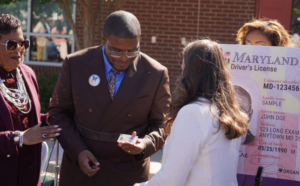
The local can also be placed on MVA-issued identification cards, and even moped licenses.
One of those getting a new ID Wednesday was Addison Jawando, the 13-year-old daughter of Montgomery County Council Vice President Will Jawando (D-At-Large). His daughter is on the autism spectrum.
“It’s an exciting day,” Jawando said before taking a picture with his daughter and others. “It’s been an honor to have a personal connection with my own daughter, who’s on the spectrum, to be able to have this and share it with her friends. It’s kind of a form of advocacy for her, too.”
Jawando and other a few others acknowledged the law wasn’t easy to get approved.
Former Del. Rachel Jones (D-Calvert) sponsored legislation in 2022 that would have had the MVA include a notation that a person had a disability. The bill passed the House, but died in the Senate.
Jones, who now works as a government relations director with the state Department of Agriculture, said the inspiration to craft a bill began with her son, Aaron, now 16 and also diagnosed with high-functioning autism. She helped Carpenter-Grantham and his mother, Linda, get the measure passed, that included testifying in Annapolis.
“As mothers, we both understood we had that same desire. We wanted to do this for our sons,” Jones said in an interview after Wednesday’s event ended. “I knew that one day he [Aaron] would need some sort of protection, and so my desire came from wanting to protect him.
“It was just so wonderful to watch them carry the torch with the passion that they had, and to be able to work alongside them,” Jones said.
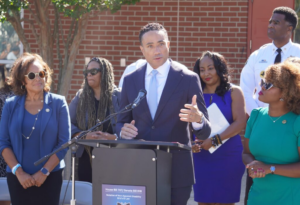
Besides the Carpenter-Grantham family, three other people received credit as sponsors of this year’s measures: Sen. William C. Smith Jr. (D-Montgomery) and Dels. Jheanelle Wilkins (D-Montgomery) and Kym Taylor (D-Prince George’s).
The Carpenter-Granthams are constituents in Smith and Wilkins’ legislative District 20. The law is personal for Taylor, whose 27-year-old son has an invisible disability.
“As a mother of a son on the spectrum, I know personally the fears and anxiety experienced when your child lives with nonapparent issues,” Taylor said. “It’s not just about policy. It’s about safety, compassion and justice for families like mine across the state.”
Public safety officials praised Eric Carpenter-Grantham for helping lead the effort to get the measure passed.
“The fact that this young, 20-year-old man can actually galvanize and bring everybody together … says a lot,” said Prince George’s County Sheriff John Carr, as he stood next to Carpenter-Grantham.
“We just want to let you know we’re here to serve you and thank you for getting this across. We will always be here for you, those who have invisible disabilities, and all of our community,” Carr said.