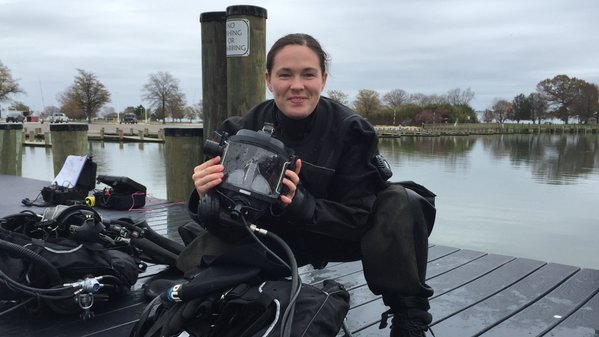
SCUBA masks used by @mdSP dive team have a system for above/under water communication #WTOP pic.twitter.com/7Z0v40WIXQ
— Kristi King (@kingWTOP) November 18, 2015Underwater Recovery Team @mdSP train today @SandyPointSP #WTOP pic.twitter.com/4ORxwq0MxX
— Kristi King (@kingWTOP) November 18, 2015
Tpr Justin UpDegraff checks Hard Hat Dive Helmet's nasal cavity for leak during @mdSP dive team training #WTOP pic.twitter.com/KI22ZnShFi
— Kristi King (@kingWTOP) November 18, 2015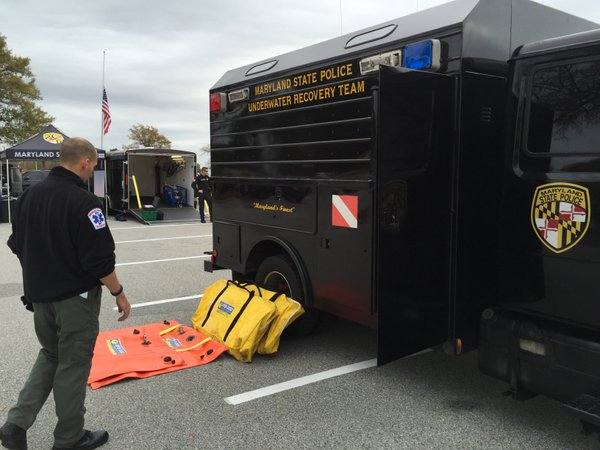
Trooper Of Yr TFC Scott Bell & Cpl Michael Dawson assit @mdSP diveteam member training @SandyPointSP #WTOP pic.twitter.com/aiujvEEqhL
— Kristi King (@kingWTOP) November 18, 2015Dive gear @mdSP wet/dry suits. Dry suits to layer clothes under in cold water or if water contaminated.#WTOP pic.twitter.com/QjiyZHQWQC
— Kristi King (@kingWTOP) November 18, 2015
TFC Adam Matthai stands by as a 'safety diver' for @mdSP dive team ofc training underwater #WTOP pic.twitter.com/jlZz6G8EAk
— Kristi King (@kingWTOP) November 18, 2015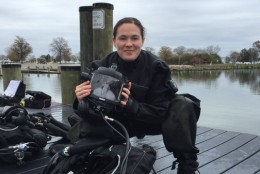
WASHINGTON — Maryland state troopers don’t just patrol the highways, they dive into the water and recover evidence.
On Wednesday, the Maryland State Police Underwater Recovery Team held a training exercise at Sandy Point State Park in Annapolis to demonstrate its equipment and show off its skills.
One of those skills includes “seeing” in the dark when diving in black water with no visibility.
“We know what we’re supposed to be looking for, whether it be a handgun or a shotgun, or a vehicle to a body,” said Trooper Megan Heun of the Underwater Recovery Team. “And you have to picture in your mind, kind of what that feels like and what that looks like.”
The team needs specialized training for the Ocean City Air Show.
“If a plane were to crash, we’d have to go in and try to recover the pilot,” said Trooper First Class Adam Matthai. “It’d be our job to try to get him out of there as soon as possible.”
Participating aircraft might include everything from fighter jets to helicopters, so dive team members need to become familiar with various cockpits.
“We meet with some of the pilots and look at how the cockpit is set up [to learn] where to hit with an entry tool and where not to — to try to get them out,” Matthai said.
Getting sunken planes, boats or cars to the water surface involves the use of specialized equipment, such as airbags. Attaching and inflating those airbags is a lot easier now that the dive team has hard hat diving helmets.
“The helmet allows us more flexibility [vs scuba],” said MSP Sgt. Adam Howard. “We don’t have the buoyancy compensator or the air tank or anything else. All we have to deal with using the helmet is the operation at hand.”