This article was republished with permission from WTOP’s news partners at Maryland Matters. Read the story at Maryland Matters.
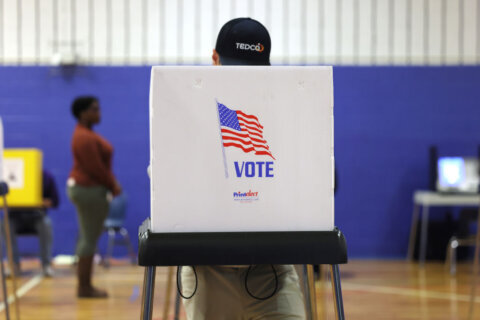
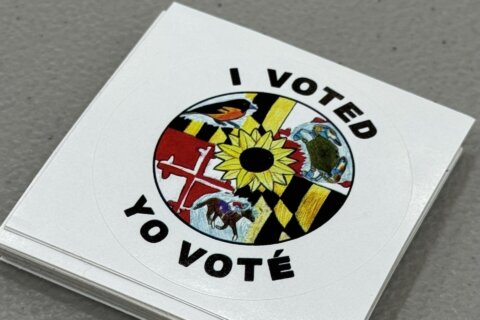
A number of Maryland elections will likely be determined in the primary, now just days away, but Amber Ivey won’t be participating.
Not because she doesn’t want to. Because she can’t.
Ivey is one of more than 1 million registered voters in Maryland who are not affiliated with any political party, meaning they are prohibited from participating in the state’s closed primary election, which are open only to registered party members. She is also one of five plaintiffs in a lawsuit seeking to change that.
“I should not have to join a private political party to fully participate in a public election,” Ivey said on a conference call Thursday with other plaintiffs in the case. “And neither should the more than 1 million other Maryland voters who are unaffiliated. This is a voting rights issue.”
The group, represented by former Lt. Gov. Boyd Rutherford, filed suit against the state in May 2025, seeking a court order that would prevent the state from funding elections that exclude independent voters. The case was dismissed by a judge at the Anne Arundel County Circuit Court in November, a ruling that is now in the process of being appealed.
Rutherford said the Office of the Attorney General responded to the early last week, arguing that political parties have a First Amendment right to decide who is going to be their candidate and who can vote in their primaries.
The attorney general’s office declined to comment Thursday on the lawsuit or its response to the appeal.
Rutherford said Thursday that the suit does not challenge anyone’s ability to associate with the political party of their choice, but that it should not be a state function. He said that excluding voters from participating in elections that are paid for with their taxes is a violation of their constitutional rights.
“We are not challenging their ability or their right to associate with like-members,” Rutherford said. “We’re saying that the state can’t pay for it because by endorsing, by supporting, by funding, you are denying the rights of citizens as guaranteed by the state constitution.”
Rutherford said the plaintiffs are going to issue their response to the office early next week and are waiting to get a hearing date, which both parties have requested.
“[Our response] would reiterate the fact that they are off track in terms of what their arguing is,” Rutherford said. “They keep saying that we’re trying to force the parties to accept this, we’re just saying the state can’t pay for it.”
In Maryland, voters must be registered with either the Republican or Democratic Party to participate in primary elections, but can vote for non-partisan offices, like board of education seats.
More than 1 million voters throughout the state, which is about a quarter of the state’s eligible voters, are not registered with either political party, according to Maryland Board of Elections records from May. This totals an increase of more than 42,000 new unaffiliated voters in the past year.
According to Sam Novey, chief strategist at the University of Maryland’s Center for Democracy and Civic Engagement, closed primaries do have some benefit, in that they can strengthen voters affiliation with political parties, which can help elect political leaders who better understand their communities’ needs.
“The drawback is that you’ve got a lot of people who are wanting to participate in shaping the election who are not able to participate,” Novey said in an interview. “That is obviously problematic as well.”
On the Thursday press call organized by Open Primaries — an organization that advocates for nonpartisan primary systems — Jeremy Gruber, its senior vice president said that as elections throughout the state and country are becoming less competitive, denying unaffiliated voters the chance to participate in primary elections denies them a “meaningful say” in the politicians who represent them.