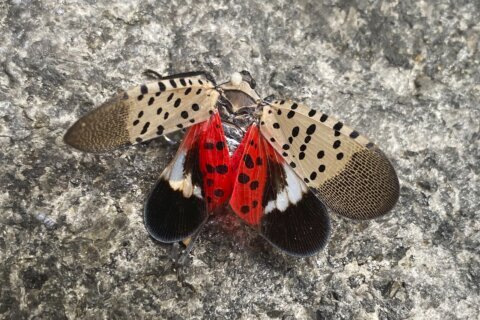
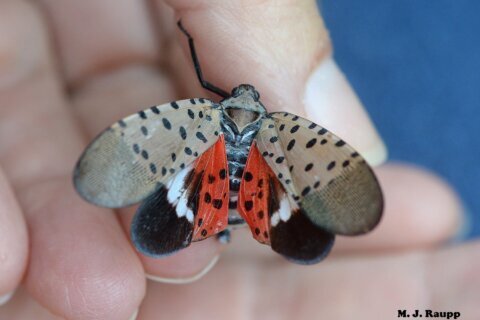
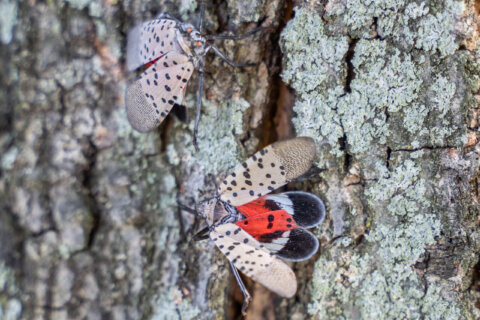
Since crossing into Maryland in 2018, the spotted lanternfly has increasingly left its sticky mark across the D.C. area, damaging plants and pestering residents.
The invasive species’ latest show of force painted the weather radar Thursday.
“It’s going to be partly cloudy, with a chance of lanternflies here in the DMV,” said Michael Raupp, professor emeritus at the University of Maryland and the self-proclaimed “Bug Guy.”
Thursday’s radar featured what experts believe to be a mass of spotted lanternflies moving about as they were picked up by wind currents.
Raupp, an expert in entomology, the study of insects, said it’s mostly female lanternflies on the move.
“We have females in particular moving about the landscape, trying to find the perfect host plant rich in nutrients so they can feed and develop their eggs,” Raupp said.
The Washington Post was the first to report on the buggy radar.
Anything of the right size in the atmosphere could pop up on the radar.
“We typically don’t see these kind of things, but definitely not unheard of, just a little uncommon,” 7News First Alert Meteorologist Mark Peña said of the lanternflies’ appearance.
Peña said the weather radar works by sending out a signal from a site at Dulles International Airport.
“These pulses of information go out, and they’ll reflect back anything that’s in the sky,” Peña said. “So for us, it’s usually used for rain and snow, but at certain levels of the atmosphere, it can also pick up bugs and butterflies, birds have even shown up.”
It’s a matter of process of elimination to figure out the origin of unexpected images.
“We knew that there was no rain falling, it just ended up being deduced down to some kind of bug,” Peña said. “And we all know that the lanternflies are all over the place now.”
In the D.C. area, cicadas have also made an appearance on the radar. Peña said in his home state of Texas, he’s spotted migrating monarchs and bats.
“There’s big bat colonies in Texas, and every summer, whenever they go out at night, you’ll see these big explosions out of these caves,” he said.
Are spotted lanternflies in the DC area’s extended forecast?
Though a mob of invasive bugs might be annoying, Raupp said they don’t pose a direct danger to people. They don’t bite or sting.
“In a residential landscape, the biggest concern I have is the vast amount of the honeydew they excrete. This carbohydrate-rich liquid will fall down on plants below, discoloring them,” Raupp said. “A nasty fungus called ‘sooty mold’ will blacken those plants and actually may harm those plants.”
That honeydew can attract instincts that sting, including yellow jackets, paper wasps, hornets and honeybees.
“This creates a health hazard for people and their pets,” Raupp said.
The population of lanternflies may be at its peak in the D.C. region, but predators and parasitoids are beginning to push back on lanternfly populations.
“Mother Nature’s hit squad will ramp up a little bit and hopefully put a beatdown on these spotted lanternflies,” Raupp said.
Raupp said populations are declining in some areas.
“We’re going to have to wait this one out, but eventually those populations, we expect they will collapse,” he said. “And we’ll be back to perhaps a more normal state of affairs with spotted lanternflies.”
The spotted lanternfly is expected to continue to move south and westward, as it has since the invasive species first appeared in the U.S. in Pennsylvania about a decade ago.
“You can stomp on lanternflies if it makes you happy, it’s a form of retribution, but don’t do this with a mistaken belief that you’re going to affect the population dynamics,” Raupp said.
Get breaking news and daily headlines delivered to your email inbox by signing up here.
© 2025 WTOP. All Rights Reserved. This website is not intended for users located within the European Economic Area.