BELGRADE, Serbia (AP) — Thick gray smoke drifted over a wooded area in northeast Serbia on Friday as authorities raced to contain a major wildfire, while multiple other blazes raged across the country amid extreme heat and prolonged drought gripping the Balkans.
Firefighters used helicopters to drop water on the blaze sweeping through pine forests near Deliblatska Pescara, a protected nature reserve about 65 kilometers (40 miles) from the capital, Belgrade. Another major fire raged near the central town of Kraljevo.
The blistering heat wave bearing down on Europe in recent weeks has set national temperature records in multiple countries, led to droughts that have strained national energy systems and fueled wildfires from Western Europe to the Balkans.
Fires in Serbia rage close to settlements
Fires in Serbia rage close to the settlements of Cardak and Sumarak in the Deliblatska Pescara area. Regional television reported that villagers from Sumarak have been asked to leave their homes as a precaution. Authorities said that no houses had caught fire and no casualties had been reported.
Days of dry weather and scorching heat reaching 40 degrees Celsius (104F) have worsened the wildfire risk. Strong winds across the Balkan nation on Friday complicated firefighters’ efforts to contain the blazes.
After an emergency meeting Friday, Serbia’s Interior Minister Ivica Dacic said the army had been brought in to help emergency efforts. The government urged all state companies to provide any equipment and human resources they can spare to help tackle the blazes. Dacic added that despite nine wildfires affecting various parts of the country, the situation was “not critical.”
Firefighters were also tackling blazes on Friday in neighboring Montenegro near the town of Cetinje, and other locations in the Adriatic Sea nation.
Heat wave breaks records in Europe
The extreme weather across Europe has pushed temperatures above 40 C in many countries, prompting health warnings for millions of people. Scientists and officials warn that such events are becoming more frequent and intense as the climate warms.
In Central Europe, Slovakia and Austria both recorded all-time high temperatures this week.
In Dolne Plachtince in southern Slovakia, temperatures soared to 42.2 C (108 F), while the Austrian village of Bad Deutsch-Altenburg near the Slovak border recorded 41.2 C (106.2 F). Hungary also recorded its warmest overnight temperature on record, with temperatures falling only to 28 C (82 F) in the capital, Budapest.
In Italy, officials placed all its major cities under the highest heat alert on Thursday, signaling a health risk for the entire population, not only vulnerable groups.
Severe droughts hit major European rivers
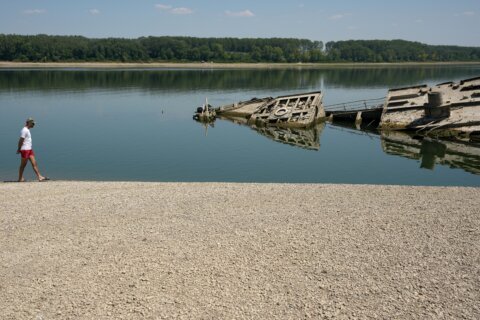
Prolonged droughts have left major European rivers such as the Danube River and Rhine River at significantly low water levels, and multiple Central and Eastern European governments are facing energy emergencies as a result.
On Friday, Romania continued an operation to sink four rock-laden barges into the Danube near the Bala Canal to redirect water downstream toward its state-owned Cernavoda nuclear plant, which relies on river water to cool its reactors. The aim is to buy more time before the second reactor is likely forced offline after its first reactor was shut down last week.
In neighboring Hungary, operators of the country’s only nuclear power plant were also forced to reduce output to about 10% of normal production due to the Danube’s low levels, prompting the government to ask businesses and the general public to cut down on their electricity use, particularly during peak hours.
On Friday, Hungary’s Prime Minister Péter Magyar told a news conference that slightly cooler weather and water level increases of around 20 to 30 centimeters (8 to 12 inches) on the Danube meant that energy-saving measures could be suspended. He praised Hungarians for successfully reducing the burden on the electrical grid.
“We would like to thank everyone who, during the difficult week that’s behind us, joined in this unprecedented national cooperation,” he said. “We have preserved Hungary’s energy and water security.”
Magyar said some rainfall could raise water levels on the Danube further and bring “temporary respite” in the coming days, but warned that more hot and dry weather in the forecast would likely lead to levels dropping again.
Over the past week, Slovakia’s biggest hydroelectric power plant in Gabčíkovo was forced to shut down seven of its eight turbines, and Germany also faced growing concerns over the impact of drought on transportation and industry as water levels on the Rhine and other rivers continued to fall.
In Moldova, which relies heavily on imported electricity, including from Romania, authorities have urged citizens to voluntarily reduce usage during peak hours.
—
McGrath reported from Leamington Spa, England. Justin Spike reported from Budapest, Hungary.
Copyright © 2026 The Associated Press. All rights reserved. This material may not be published, broadcast, written or redistributed.